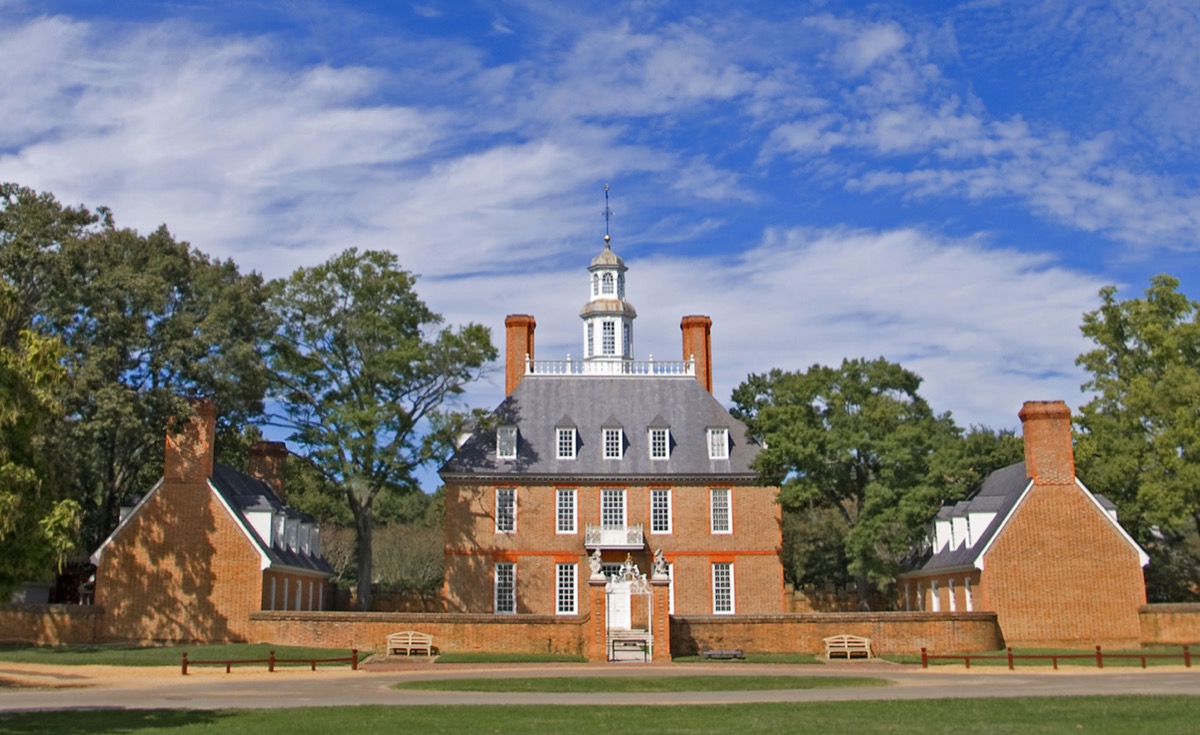
Archaeologists dug for foundations in 1930 and pulled up 158 bodies. Seven royal governors lived here. Three died here. Two rangers hear it say thank you.
In June 1930, an Egyptologist named Prentice Duell started digging in the west garden of the Governor's Palace in Williamsburg. He had three things to work from: a floor plan Thomas Jefferson had sketched while living there, a copper plate of the façade, and a map drawn by a French army engineer in October 1781, two months before the building burned. Duell was expecting foundations. He found 158 bodies.
One hundred fifty-six men. Two women. Nearly all between twenty-five and thirty-five years old, laid out in shallow graves in the formal gardens of what had been, until 1780, the seat of royal authority in Virginia. The dig record is academically clean on the count. Some ghost-tour retellings round it down to 140, or up past 150. The number is 158, and the breakdown matters: this is a hospital body count, not a battlefield one.
The palace had spent its final weeks as a Continental Army hospital. After Virginia moved its capital to Richmond in 1780, the building sat empty until the wounded from the Siege of Yorktown filled it. On December 22, 1781, it burned to the ground. Wikipedia's framing, drawn from contemporary accounts, says over a hundred sick and wounded men were inside when the fire broke out, and that "by the timely exertions of a few people, only one perished in the flames." Some tour scripts inflate that to a mass casualty. They shouldn't. One man died in the fire. The cause was never determined. Possibly arson. No one was ever caught.
The two women in the graves don't have names. They might have been nurses, laundresses, soldiers' wives following the army. The records don't say. That nameless gap is where the ghost stories pour in.
Seven royal governors lived in the original palace. Three of them died inside it. Hugh Drysdale, the lieutenant governor, died here on July 22, 1726, after two years of failing health. Francis Fauquier died on March 3, 1768, leaving a will that asked his doctors to autopsy him if they couldn't figure out why he'd died, writing that he hoped to be "more useful to my fellow Creatures by my Death than I have been in his life." Thomas Jefferson, who knew him, called Fauquier "the ablest man who had ever filled that office." And on October 15, 1770, Norborne Berkeley, Baron de Botetourt, died of erysipelas in an upstairs bedroom. Erysipelas is a streptococcal skin infection that turns the skin red and swollen and, in the eighteenth century, often killed you. Botetourt is buried in the crypt under the chapel at the College of William & Mary, not here. Drysdale lies in the yard at Bruton Parish Church a few blocks away. Nobody dies and stays at the palace.
Except, depending on who you ask, maybe they don't leave either.
The ghost story I trust most at the palace is the smallest one. A tour guide reported hearing a voice say "Thank you" while locking up on Veterans Day. The Flat Hat, the William & Mary student magazine, and an independent Halloween site both tell it the same way: the phenomenon has happened fifty to sixty times, but only when one of two specific veteran rangers is the one closing the building. Same two men. Same date. Same word. The rangers aren't named in either telling, which is a gap I wish were filled. But the pattern itself is unusual enough to take seriously: a ghost story with a calendar.
The other recurring sighting, reported by visitors and ghost tour guides, is a lantern moving past a third-floor window at night. Two interpretations get offered, depending on who's telling it: a surgeon making rounds, or one of the wounded with a candle. No photographer's name. No date. Treat it the way you'd treat any third-hand glimpse, which is to say, with a raised eyebrow and an open mind.
A lot of what Williamsburg ghost tours sell at this stop, you should know up front, is folklore. The story about a William & Mary student murdered in the hedge maze around 1918 by an asylum escapee with a scythe is told as fact on multiple tours. It doesn't appear in any William & Mary archive, any Virginia newspaper archive, or any police record I could find. The phrase "bite the bullet," supposedly born from soldiers chewing on lead during palace surgeries, is also folklore: etymologists trace the phrase to flogging, not amputation, and its first literary appearance is Kipling in 1890. The 2,820-bottle wine cellar at Botetourt's death gets quoted everywhere; I couldn't find it documented in any contemporary record. Botetourt's deathbed line about leaving his comforts "with as much composure as I enjoyed them" is the same story: probably from a Graham Hood book, possibly from an interpreter's script, not findable in any verifiable archive. None of that makes the palace less haunted. It just makes the history thinner than the tours pretend.
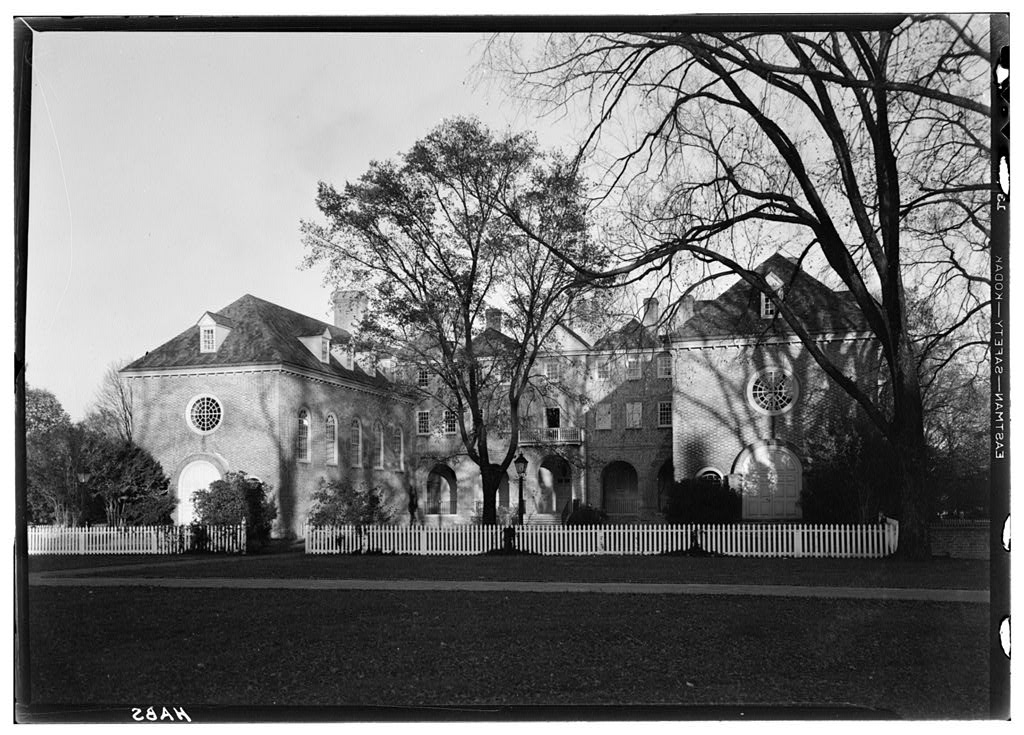
What the palace has that the tours don't need to embellish is the dig. Duell's team finished the main excavation in four months. Reconstruction ran from December 1931 to April 1934. The palace opened as an exhibition on April 23, 1934. Two halves of a marble mantel carved with a deer motif were recovered from the cellar rubble during the dig and reinstalled above the first-floor front parlor fireplace, where you can see them now. The reconstructed building has stood longer than the original ever did. The original lasted seventy-one years. The reconstruction has been there for ninety-two and counting.
Every Veterans Day, the Williamsburg Chapter of the Sons of the American Revolution lays a wreath at the small garden cemetery where the 158 are buried. One hundred fifty-six men, two women, ages twenty-five to thirty-five, in the west garden. A floor plan in Jefferson's hand. A French map. An Egyptologist who said yes when Rockefeller called.
And, if you happen to be one of two specific rangers, locking the doors on the right November afternoon: a voice that says thank you.