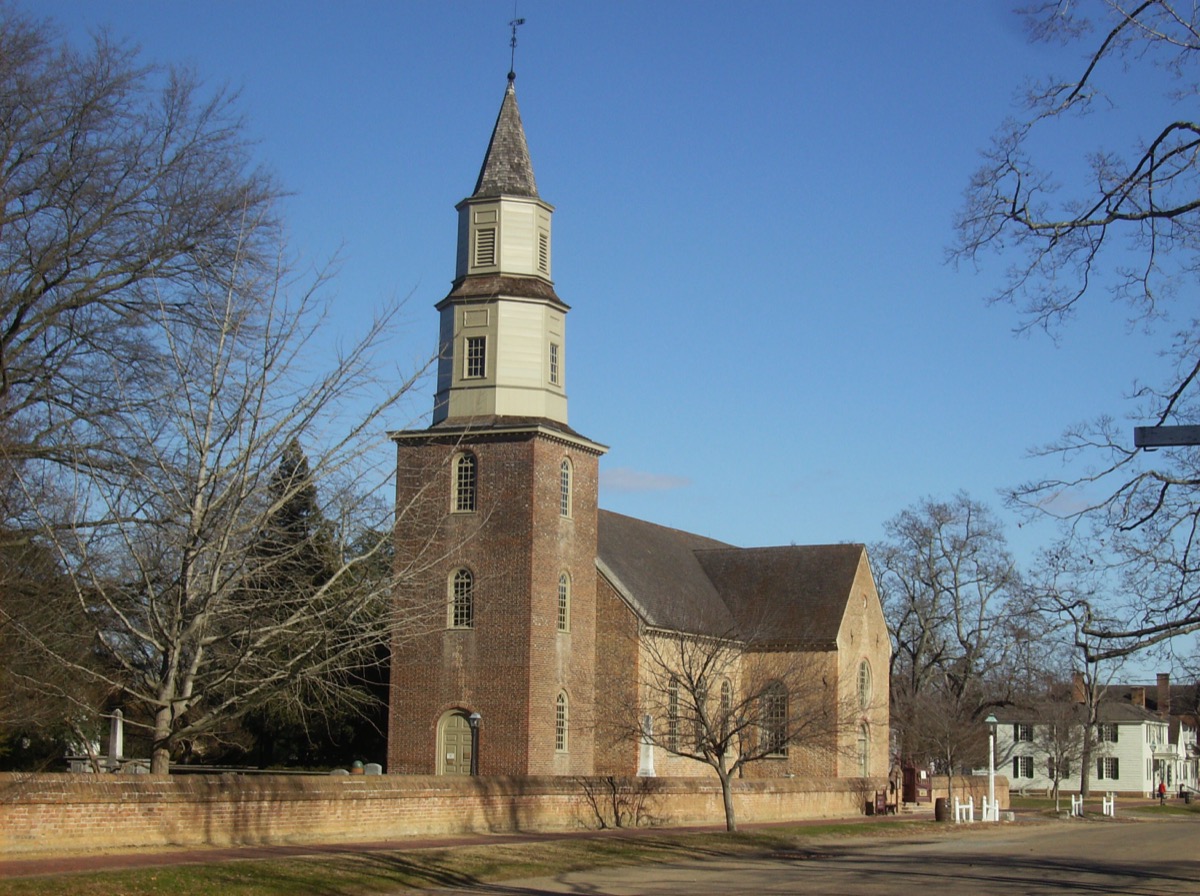
Bruton Parish Church in Williamsburg holds George Washington's pew, John Blair's grave, and a rector's-wife legend no historian can date.
George Washington's name plate is still bolted to a box pew here. So is Thomas Jefferson's. So is Patrick Henry's, James Madison's, John Tyler's, and Benjamin Harrison's. They all sat in numbered, high-backed wooden boxes inside Bruton Parish Church, which is the working Episcopal congregation in the middle of Colonial Williamsburg, and the only one of those six who's actually buried in the churchyard outside isn't on that list. He's John Blair, signer of the Constitution and a U.S. Supreme Court Justice appointed by Washington himself, who died at his Williamsburg home on August 31, 1800 and was laid in the ground a few feet from the brick wall.
All before you even get to the ghosts.
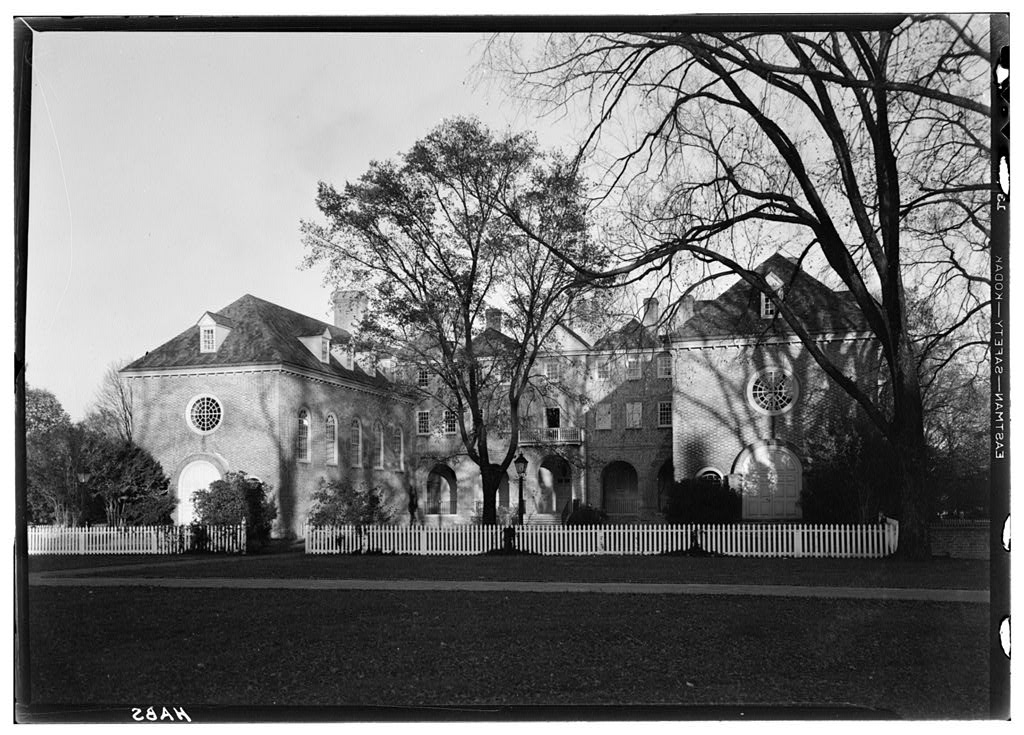
The parish was formed in 1674. The first sanctuary was probably a wooden one from 1660. The current cruciform brick building went up between 1711 and 1715, designed by Royal Governor Alexander Spotswood and built by James Morris, and it was the first cruciform-plan church in Virginia. Seventy-five feet long, twenty-eight wide, with nineteen-foot transepts. The two-tiered steeple was added in 1769 by Benjamin Powell. The Virginia Assembly helped pay for it because the legislature worshipped there during sessions, which is a polite way of saying the founders had reserved seating. National Historic Landmark on April 15, 1970. NRHP a few weeks later.
The story Williamsburg's ghost tours tell goes like this: a colonial rector lost his wife. Three months later he came back with a new bride and buried her between himself and the first wife when the time came, locking the first wife into eternal company with the woman who replaced her. The Williamsburg Ghost Tour names this rector "Reverend Scervant Jones," which is almost certainly wrong. The historical Scervant Jones (1785-1854) was the first minister of the Williamsburg Baptist Church, not Bruton Parish. The actual first rector of Bruton was Rev. Rowland Jones, who took charge in 1674 and held the post for fourteen years until his death on April 23, 1688. Whether the legend belongs to a different rector entirely or whether the tours grabbed the wrong Jones, no one's documented an answer. There's also no date for when this rector lived. No anchor, no decade, no record. The first wife's name is given as Elizabeth in tour write-ups and nowhere else.
So here we are. There's a real, beautiful, three-hundred-and-fifty-year-old church with founders buried in the yard, and the ghost story everyone tells about it is missing its name, its date, and most of its primary documents. The lore is real lore. The historical hooks for it aren't there.
What is there: the Battle of Williamsburg on May 5, 1862, after which the sanctuary became a makeshift Union hospital treating wounded from both sides. On May 6, Mrs. Cynthia Coleman and Mrs. Letitia Semple came to nurse the wounded. Even Delia Bucktrout, a hard secessionist, brought water to a wounded Union soldier inside the church. Dr. J. R. Bronson, a volunteer Union surgeon from Massachusetts, later wrote that "if ever men appreciate little kindnesses of this character, it is when sick away from home." It's the only Civil War quote we'd vouch for here. The tour version of this story claims a mass burial pit of "nearly, or quite 100 men" was discovered at Bruton itself. The historical record places those mass graves at Market Square and the Baptist Church across town. The Confederate remains weren't moved to Bruton's churchyard until 1920, after Isabella Sully kept a promise she'd made to dying soldiers in 1862 that they'd eventually rest in consecrated ground. The 1893 granite obelisk in the churchyard marks them, but the obelisk predates the actual reinterment by twenty-seven years.
The Williamsburg Ghost Tour and US Ghost Adventures collect the rest. A tall shadowy figure in a black colonial suit, vest, and elongated neck with glowing red eyes near the churchyard wall. Hymnals that lift from the pews and slam into the walls inside the locked sanctuary, according to the tour write-ups. The 1755 organ, the first one installed in the church and originally played by Peter Pelham, playing music late at night when the building is empty. Virginia Tourism's official blog has documented this last tradition. There's a 2014 video, dated April 10 around 11:30 PM, said to capture the organ playing on its own, but the only host is a tour-operator site, so take that as you will.
A second recurring sighting comes from a Colonial Williamsburg security guard known only as Charles. Charles is the only source, and he gave the account to a walking-tour operator. But the detail hangs together: he says he watched a "construction paper black" silhouette of a colonial man, ponytail, knickers, stockings, shirt, vest, walking along Duke of Gloucester Street near the church entrance. The figure vanished when it reached a lit tree.
What's notable, and worth saying plainly: no paranormal investigation team has ever publicly documented work at Bruton Parish. No EVPs, no equipment readings, no investigator names beyond the people running the walking tours. Every haunting account at this church traces back to the people running paid walking tours. The history at Bruton is well-documented. The hauntings live entirely in the universe of paid evening walks down Duke of Gloucester Street.
Which is honestly fine. The history alone makes Bruton worth the visit, and we'd rather a church this old keep its mysteries than have a TV crew show up with night vision and ruin them. The graveyard holds Thomas Ludwell's 1678 stone, the oldest dated marker on site, belonging to the colonial secretary whose family came from Bruton in Somerset, England. The parish is named for that town. Governor Francis Fauquier is buried here. Governor Edward Nott. The infant children of Martha Custis, who later became Martha Washington. The churchyard contains one of the finest collections of colonial table tombs in North America. They look like stone sarcophagi laid out in rows. Some of them you can read. Some of them the lichen has taken.
The church is still alive. Nearly 2,000 members. Four Sunday services. Holy Eucharist Rite I at 8:00 a.m., Rite II at 9:15 and 11:15. The 9:15 service streams. The brick wall around the yard is the same one Coleman and Semple walked past on May 6, 1862, on their way in to wash blood off Union and Confederate boys who'd been shooting at each other the day before.