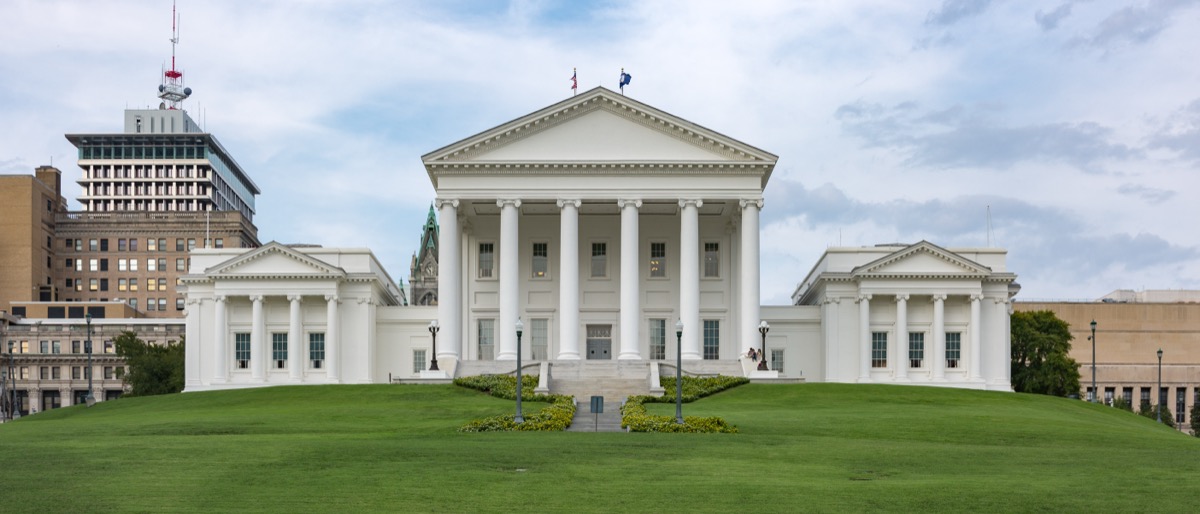
At Virginia's State Capitol, a 1870 courtroom collapse killed 62. The Old House Chamber stays cold, and Capitol Police see shadows in the gallery.
Just before 11 a.m. on April 27, 1870, a girder snapped over a crowded second-floor courtroom in the Virginia State Capitol. The spectator gallery came down. Then the courtroom floor itself collapsed, sending bodies, bricks, beams, desks, and iron bars forty feet straight down into the House of Delegates chamber. Sixty-two people died. Two hundred fifty-one were injured. The Richmond Dispatch wrote the next morning that "over fifty souls were launched into eternity."
The case being argued was Ellyson v. Chahoon, a Richmond mayoral fight between a Republican and a Democrat that had drawn hundreds of spectators. The court ruled for Ellyson two days later, almost drowned out by the continuous tolling of funeral bells.
Among the dead: Patrick Henry Aylett, great-grandson of Patrick Henry and editor of Richmond's Examiner and Enquirer, covering the trial as a journalist. He was crushed by the same beam that killed Joseph Brock, a former Confederate surgeon turned reporter. State Senator J.W.D. Bland. William Charters, chief of the Richmond Fire Department. John Turner, a thirteen-year-old House page. Both mayoral claimants survived. So did former Governor Henry H. Wells. The grandson of Patrick Henry did not.
A memorial plaque to the disaster sits in the Old House of Delegates Chamber, the room where they all fell. Capitol Police officers say that room has a constant, distinct chill. So pronounced that doors are sometimes opened in summer to help cool the rest of the building from it. Virginia summers are not subtle. The Old House Chamber stays cold anyway.
Paul Hope worked the graveyard shift as a Virginia Capitol Police officer and wrote a book about it. "Policing the Paranormal: The Haunting of Virginia's State Capitol Complex," Schiffer Publishing, 2013. During his training, he was standing at the 1870 memorial plaque with a senior officer when both of them saw a dark shadow move across the gallery above. They swept the gallery with flashlights. Nothing was there.
L.B. Taylor Jr., Virginia's main ghost-story chronicler, put it this way: "the eerie cry of mournful voices, muted under tons of debris, can still be heard in the hallowed corridors of the Capitol." Pamela K. Kinney repeated the accounts in "Haunted Richmond, Virginia" in 2007.
Hope's book also recounts an incident from a Capitol Police officer he calls Emma. In 2003, on the sixth floor, she saw an elderly man with curly brown hair, a short beard, and a brown suit reflected behind her at a vending machine. She turned. No one was there. Nobody knows who he is. Sources don't identify him with any historical Capitol figure, and Hope's book is the only place the story appears.
Hope had his own sixth-floor encounter too. A moving shadow in the hallway, a strong cigar smell with no source, his body hair standing on end. Single source again, his own.
Thomas Jefferson designed the building with French architect Charles-Louis Clérisseau, modeled on the Maison Carrée, a first-century Roman temple in Nîmes, France. Construction began in 1785 and finished in 1788. Jefferson had Clérisseau swap the Maison Carrée's ornate Corinthian columns for the simpler Ionic order. It was the first Roman temple-style public building in the New World, a detail that sounds like a tourism-board exaggeration until you check, and it's true. Named a National Historic Landmark in 1960.
The rotunda holds Jean-Antoine Houdon's life-size marble statue of George Washington. Carrara marble, eighteen tons, signed 1788, based on a life mask Houdon took at Mount Vernon in the fall of 1785. It is the only sculpture of Washington made from life. Installed in the Capitol on May 14, 1796. When the Marquis de Lafayette saw it in 1824, during his Grand Tour of America, he stood in front of it and said: "That is the man himself. I can almost realize he is going to move." Lafayette was in Richmond October 26 through 31 of that year. A Houdon marble bust of Lafayette from 1786, originally commissioned by the General Assembly to honor him after Yorktown, shares the rotunda with the Washington statue. They've been keeping each other company for two centuries.
The Capitol stories land harder than most for a reason. It isn't a creaky old inn with a marketing budget. It's a working statehouse. Capitol Police walk those halls every night. The Houdon Washington stands in the rotunda. The room where sixty-two people died is two floors up from where the legislature still meets. The cold in the Old House Chamber is not a tour-guide bit. It's a maintenance problem.
Next door, the Virginia Executive Mansion, completed in 1813, is the oldest continuously occupied governor's residence in the United States. Its resident ghost is called the Lady in Taffeta, sometimes the Gray Lady. The legend says she attended a holiday party at the mansion, left in a white taffeta gown, got into her horse-drawn carriage, and was killed when it tipped over. No primary newspaper, mansion log, or obituary confirms this. The story passes from one Richmond ghost compilation to the next.
What's better sourced: in the early 1890s, Governor Philip W. McKinney reported the first sighting of a lady sitting at a window. And Governor Terry McAuliffe, who lived in the mansion from 2014 to 2018, told NBC12 that lights would switch off on their own. He never saw the Gray Lady. He told the interviewer her story the way every governor before him probably did, including the carriage line: "She came out, she was at a holiday party and she walked out and got into her horse drawn carriage, it tipped over and killed her."
The plaque to the dead of April 27, 1870 hangs in the Old House Chamber. The room is still cold.