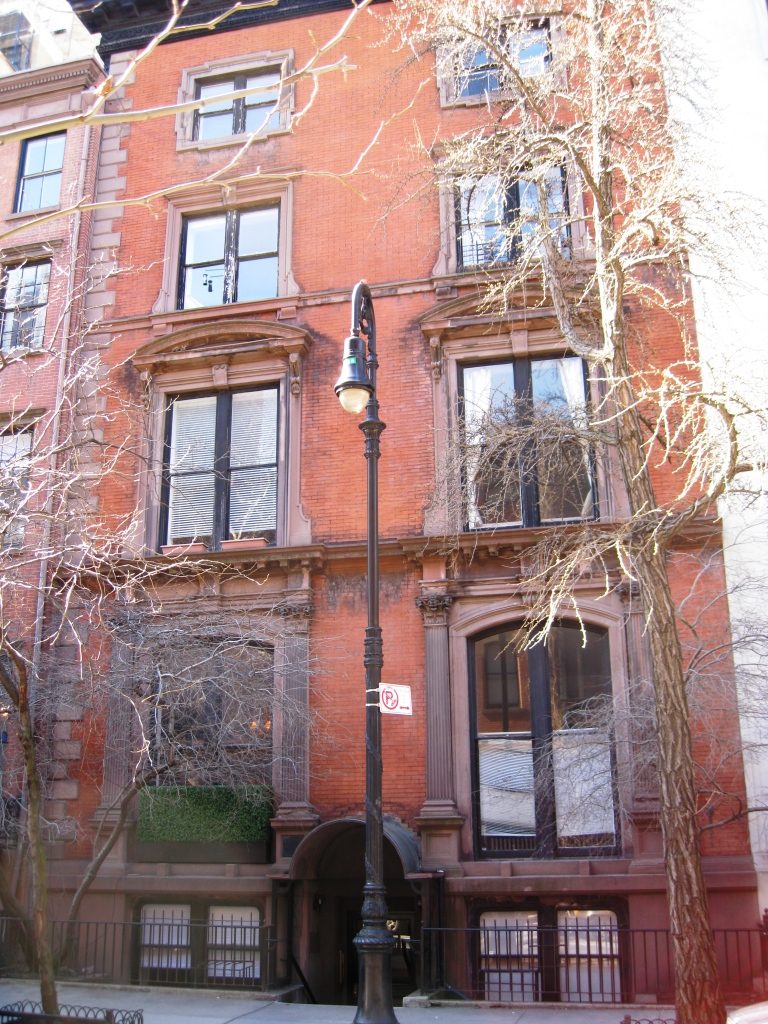
The brownstone at 14 West 10th Street in Greenwich Village earned a grim nickname: the House of Death. A mother and daughter once met an old man's ghost there who gave his name as Clemens. Mark Twain had lived in the house decades before.
At 14 West 10th Street in Greenwich Village, a mother and daughter once told the building superintendent they'd seen an old man with wild white hair appear near a window. He spoke to them. "My name is Clemens," he said, "and I has a problem here I gotta settle."
Samuel Clemens — Mark Twain — had lived in that brownstone from 1900 to 1901, decades before either of them moved in. It was said to be his favorite New York address. The story goes he's been seen on the first floor and on the staircase since, in his white suit, sometimes with a cigar. Ghost-tour tellings add an older legend: that Twain himself once watched a piece of kindling move on its own near the fireplace, fired a gun at it, and found a few drops of blood and no animal. No letter or diary of his confirms it. It lives only in the retellings.
The house was built in 1854. It started as a single family home and was carved into ten apartments in the 1930s, the stoop pulled off, the front door dropped to basement level. Roughly 22 people have died inside it over the years, which historians will tell you isn't strange for a building this old. The number stuck anyway, and the lore grew to match it: a gray cat residents say they've spotted across different decades, a woman in white on the stairs.
In 1957, an actress and writer named Jan Bryant Bartell moved into the top-floor apartment, the old servants' quarters. She stayed about seven years and left a memoir, *Spindrift*, published in 1974, a year after she died. She wrote about touching something in the dark. "A substance without substance," she called it. "Chilly, damp. I could feel my fingers freeze at the tips." A monstrous shadow loomed behind her, the way she told it. She left the building after about seven years.
The ghost stories all predate the thing that actually made the building famous.
On November 1, 1987, in apartment 3W, a disbarred attorney named Joel Steinberg beat his illegally adopted six-year-old daughter, Lisa, until she was unconscious. Then he left for a dinner appointment. He came home and freebased cocaine for hours instead of calling for help. When police finally reached the apartment, they found garbage, no working lights, $25,000 in cash, and a 16-month-old boy tied to a playpen. Lisa was taken off life support four days later.
That is when the nickname took hold. The house had been collecting ghosts for fifty years before it earned it.