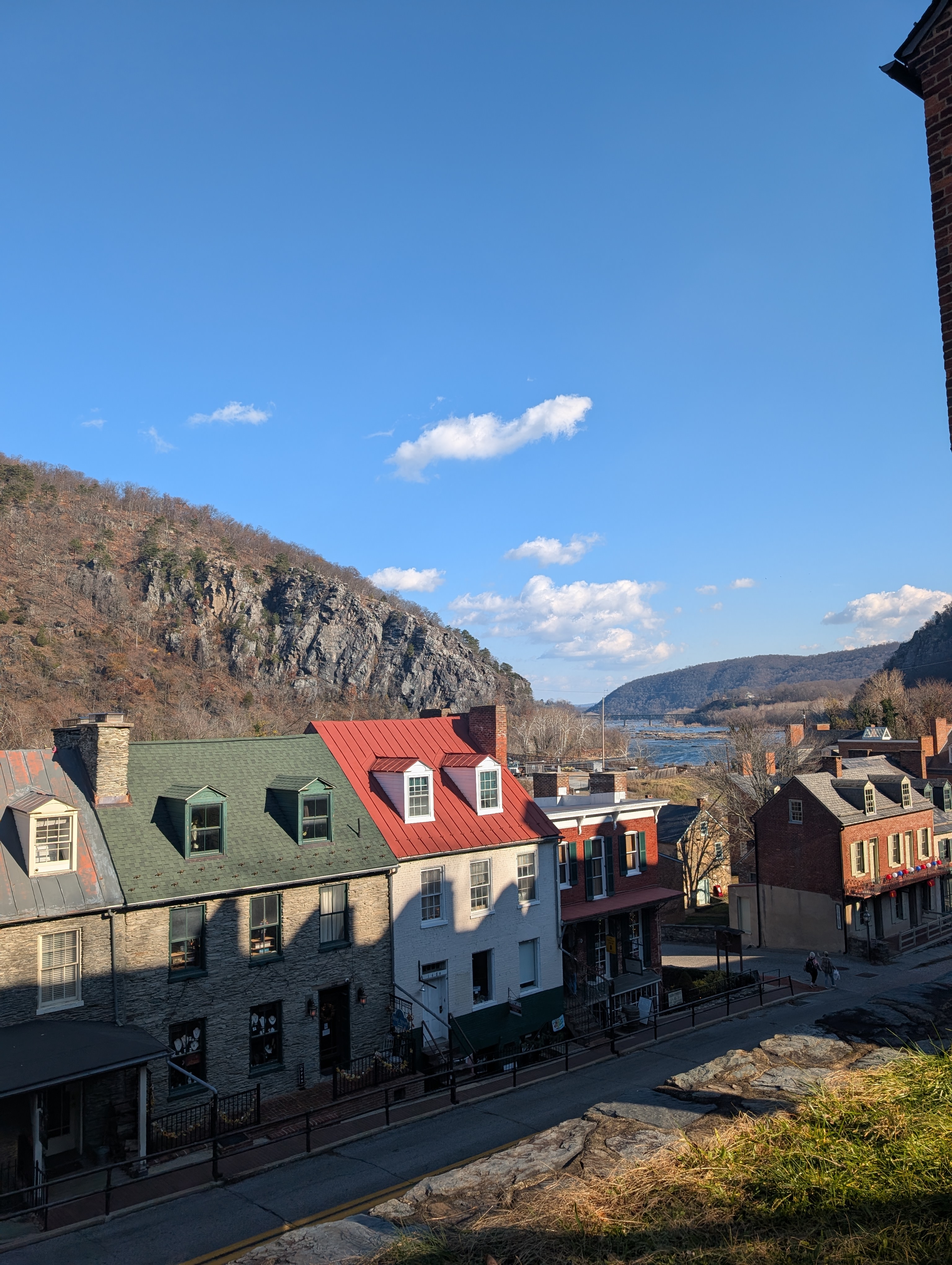
The Harper House in Harpers Ferry, West Virginia keeps a woman at an upstairs window in 1700s clothing, watching the garden. Rachel Harper is said to have buried the family's ferry money there in jars, then fell from a ladder in 1780 and died without ever saying where.
At the top of a slate staircase off High Street in Harpers Ferry, West Virginia, the Harper House is said to keep a woman at an upstairs window. She wears the clothing of the 1700s, and she is always looking the same direction: down at the garden. Accounts differ on which window. The uppermost one, a second-floor one, or just "a window overlooking her garden." They do not differ on what she is watching.
The Harpers ran the ferry that gave the town its name. The business did well before the Revolution, and England taxed it heavily, so the earnings went into jars and into the ground somewhere in the garden across the way, where no collector would find them. Who did the burying depends on the teller. The West Virginia folklore accounts hand the jars to Rachel Harper. The paranormal database PANICd says Robert buried the treasure and Rachel is only looking after it.
In 1780, doing ordinary household work, Rachel fell from a ladder. She was 60. "She died the next day," the folklore account reads, "without telling anyone, even her husband, where the money was buried."
None of that survives in the paperwork. The Park Service pages on the house and on Robert Harper's grave never name Rachel, a fall, or a death in 1780. The closest any history comes is a passing line about a relative of Harper's wife.
Her husband is all over the record. Robert Harper, a millwright out of Pennsylvania, patented 125 acres at the confluence in 1751 and bought out the ferry that came with them. He began the stone house on the hill above Lower Town in 1775. He died in October 1782, the year it was finished, a widower with no children, and was buried on Camp Hill above the town. The property passed to a niece. The jars were never found.
The house went on without either of them. From 1782 to 1803 it was the only tavern in Harpers Ferry, and Park Service wayside text allows that Thomas Jefferson may have stopped in during 1783 and that Meriwether Lewis may have rented a room in 1803, among the last travelers to seek shelter there. Since then it has been a residence, a rental property, an abandoned ruin, and a restored exhibit, and it is the oldest surviving building in town. A second figure moves through the rooms in some tellings, a man. PANICd calls him a friend of Harper's named Hamilton who died in a fall inside the house. The ghost tours say he is Robert.
Rachel died in 1780. The house was a shell then, five years into construction and two years short of done. The woman at the upstairs window is watching her garden from a building she never lived in, and neither did he.