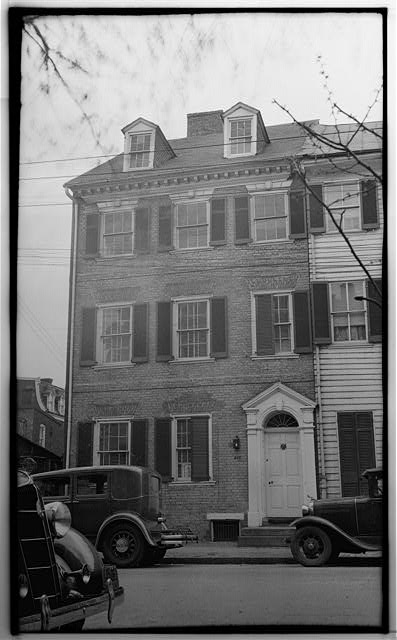
A Revolutionary War colonel buried in Philadelphia, dug up in 1859, and apparently back home at his Alexandria townhouse with a grudge against the English.
An English woman went to tour 210 Prince Street with a realtor and never made it past the staircase. She felt a cold hand land on her shoulder. She told the realtor she was psychic, and that the entity had just informed her he didn't like her British roots and didn't want her buying his house. She left without an offer.
Tour guides on Prince Street tell that story a lot, and it's the cleanest illustration of why the haunting at Colonel Michael Swope's townhouse reads differently from the usual "uneasy feeling on the landing." The ghost has a politics. He fought a specific war, lost specific years to it, and the resentment outlived him by a couple of centuries.
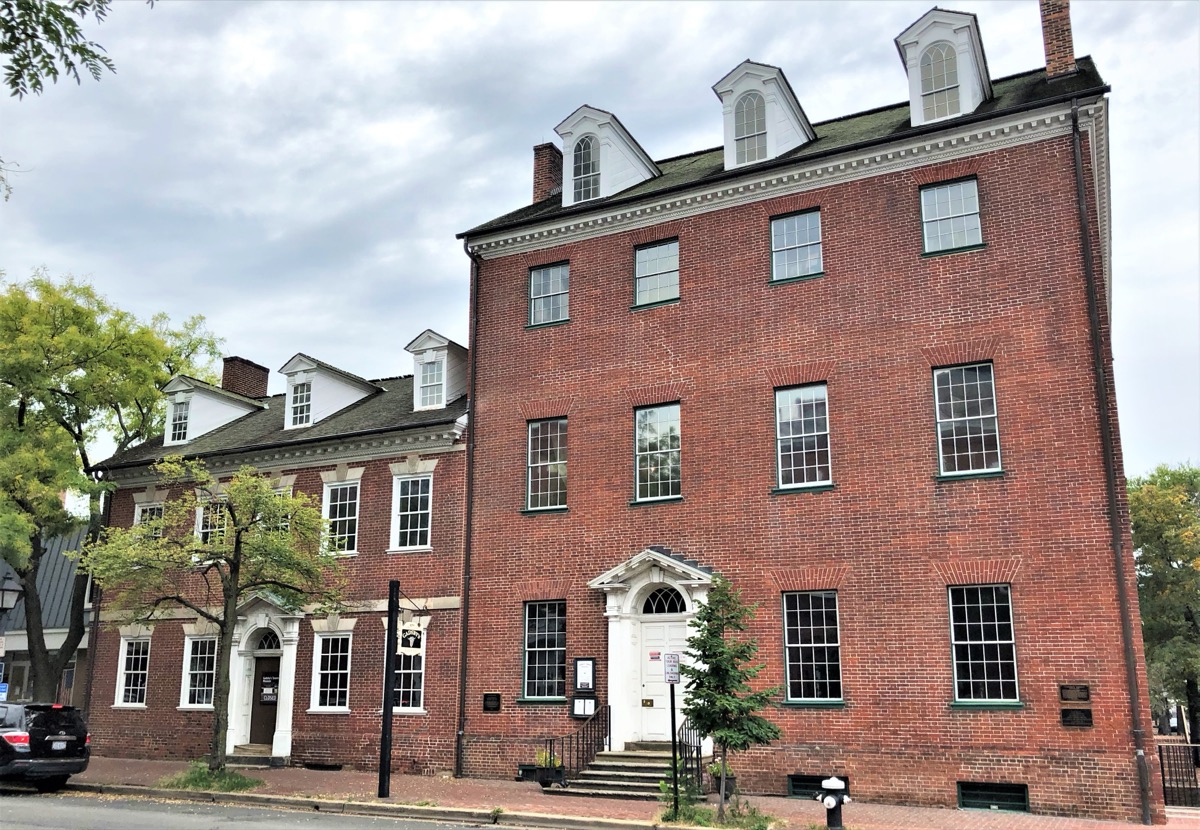
Swope built the house between 1784 and 1786 with his wife Eva Kuhn Swope, a three-and-a-half story semi-detached Georgian on what's now called Gentry Row, the 200 block of Prince Street. The Library of Congress documented it in 1933 as HABS VA-292, and it's on the National Register (NRIS #66000928). It's still standing, still privately owned, and the architectural record is clean. The history of who lived there is clean too. The haunting layer sits on top.
The war is what set everything up. Swope was from York, Pennsylvania, born in 1725 or 1726, and a civic figure in York before the Revolution. When fighting broke out he took command of the 1st (York) Regiment of the Pennsylvania Flying Camp. On November 15, 1776, the British adjutant general Lt. Col. James Paterson rode up to Fort Washington under a flag of truce with a surrender demand. The next day, November 16, the fort fell to British and Hessian forces. Swope and most of his regiment were taken prisoner. He spent years in British captivity before being exchanged, one for one, for William Franklin, the Loyalist governor of New Jersey and Benjamin Franklin's estranged son. The exact length of his captivity gets fuzzy in retellings. The trade itself is well-documented.
He came out of the war and eventually came to Alexandria in 1784, running a ship chandlery on the waterfront while the house went up. He died in 1809. His body was carried by carriage down to a ship at the Union Street wharf and sailed to Philadelphia, where it was placed in the family vault. The house stayed in the Swope family until 1823.
This is the part where the ghost story should end, because the man is buried and the family has moved on. It doesn't.
In 1859, yellow fever was tearing through Philadelphia. City officials, worried that recent epidemic dead had been slipped into private vaults, ordered the Swope family vault opened and inspected. The casket was disinterred. No fever victims were found. Whatever the officials saw, they put everything back.
According to Michael Lee Pope, who wrote the haunting up in *Ghosts of Alexandria* (History Press, 2010), the first reported sightings at 210 Prince Street date to that same year. Worth being honest about: the 1859 date traces through Pope's book, not through any surviving Alexandria newspaper from 1859 that I could find. There's no contemporaneous "Alexandria Gazette reports strange figure on staircase" clipping. The link between the Philadelphia disinterment and the Virginia haunting is local lore, not court record. But it's the lore that the town has stuck with for over a century and a half, which counts for something.
The phenomena reported in the house repeat across accounts in a tight cluster. A figure in Revolutionary War uniform on the staircase. Phantom piano music from inside the house when no one's home. The smell of tobacco. Sudden cold spots. And the thing that gives the place its texture: the ghost is described as friendly to most visitors and openly hostile to anyone English. The cold hand on the realtor's client wasn't a one-off. It was the ghost being in character.
There's a wrinkle on identity that the tour guides skim over and Pope flags directly. Two versions of the legend exist. One names Swope. The other names a man called John Dixon, said in the lore to have been a wealthy Alexandria merchant executed by the British as a spy. Dixon isn't corroborated by any primary historical source. He shows up in Pope and in the ghost-tour ecosystem and nowhere else I could find. He may be a real Alexandrian whose record got thin, or he may be a legend grafted onto the house later. Most modern tours treat Swope as the primary spirit and Dixon as a secondary one. That ordering is tour-script convention, not anything a historian has signed off on.
Wellington Watts, who runs Alexandria Colonial Tours, gave Pope the line that sums up the local affection for the figure: "Swope was a true patriot. Here's a man who is a real hero of his day, someone who was admired and revered." That's Watts, via Pope. The attribution matters because the quote gets reassigned to Pope himself in a lot of secondhand retellings, and that flattens what's actually happening: a working tour guide telling a working journalist why this particular ghost still matters to the people who live and walk past the house every day.
The haunting at 210 Prince Street is unusually well-anchored. The architectural record is federal-grade. The man existed. The capture date is exact. The prisoner exchange is documented. The disinterment happened. The ghost story is the soft layer on top of a hard historical spine, and most of the embellishment that piles up in the local tour circuit (specific room numbers, hundreds-of-miles forced marches, a named music room with a beloved piano) is exactly that, embellishment. The simpler version is better. A colonel got dug up in Philadelphia in 1859, and people in Alexandria started seeing him on a staircase on Prince Street in a uniform he wore in a war that ruined a chunk of his life.
The house is private. There's a historical marker on Prince Street if you want to stand in front of it. The brick is original. The party wall it shares with the neighboring townhouse is original. The staircase is the one in the stories.