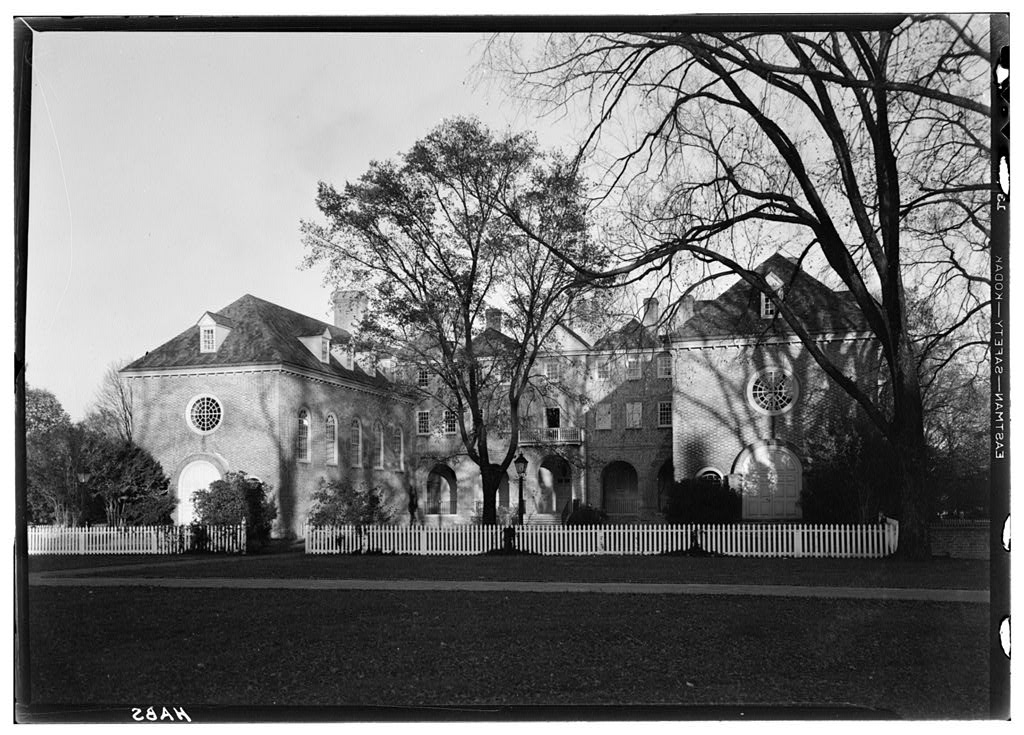
A Native boy's ghost runs across William & Mary's Sunken Garden several feet above the grass, at the elevation the ground sat before 1935.
On foggy nights at William & Mary, students say a young Native American boy sprints across the Sunken Garden. He doesn't touch the ground. He runs several feet above it, at the elevation the lawn used to be, before the Civilian Conservation Corps dug the garden out in 1935-36.
The W&M Alumni Magazine wrote it that way, not a ghost tour. The 2019 Halloween piece spells it out: the apparition floats "where the ground level was when he was alive," and the lawn he's crossing didn't reach its current shape until the New Deal. Flat Hat Magazine, the student paper, runs the same line. It's the cleanest paranormal claim on campus, because it's the only one with a built-in physics check. If you wanted to fake a Brafferton ghost, you'd put his feet on the grass.
Williamsburg's college was chartered February 8, 1693, by King William III and Queen Mary II. Second-oldest school in the country. The Wren Building went up between 1695 and 1699 (it's older than Williamsburg itself), and it has burned down three times: October 1705, February 1859, and September 1862, when the 5th Pennsylvania Cavalry torched it during the Peninsula Campaign. Every fire took something. The 1859 blaze left burials in the chapel crypt exposed; tomb robbers came in afterward. Union soldiers came back in 1862 and stole silver from Lord Botetourt's copper coffin.
The crypt is the part of campus that earns its haunting on history alone. Sir John Randolph (d. 1737). His son Peyton Randolph, twice president of the Continental Congress (d. 1775). Lord Botetourt, the colonial governor (d. 1770). Bishop James Madison, the first Episcopal Bishop of Virginia and cousin to the future U.S. president (d. 1812). President Thomas R. Dew (d. 1846). All of them are still under the chapel floor. More recently, students and staff have reported footsteps on the Wren's upper floors with no traceable human source, plus screams and soldier apparitions. The Wren is often called a Revolutionary War hospital in ghost-tour retellings, but the well-documented hospital role belongs to the President's House. Treat the Wren-as-hospital line as widely repeated but only loosely sourced.
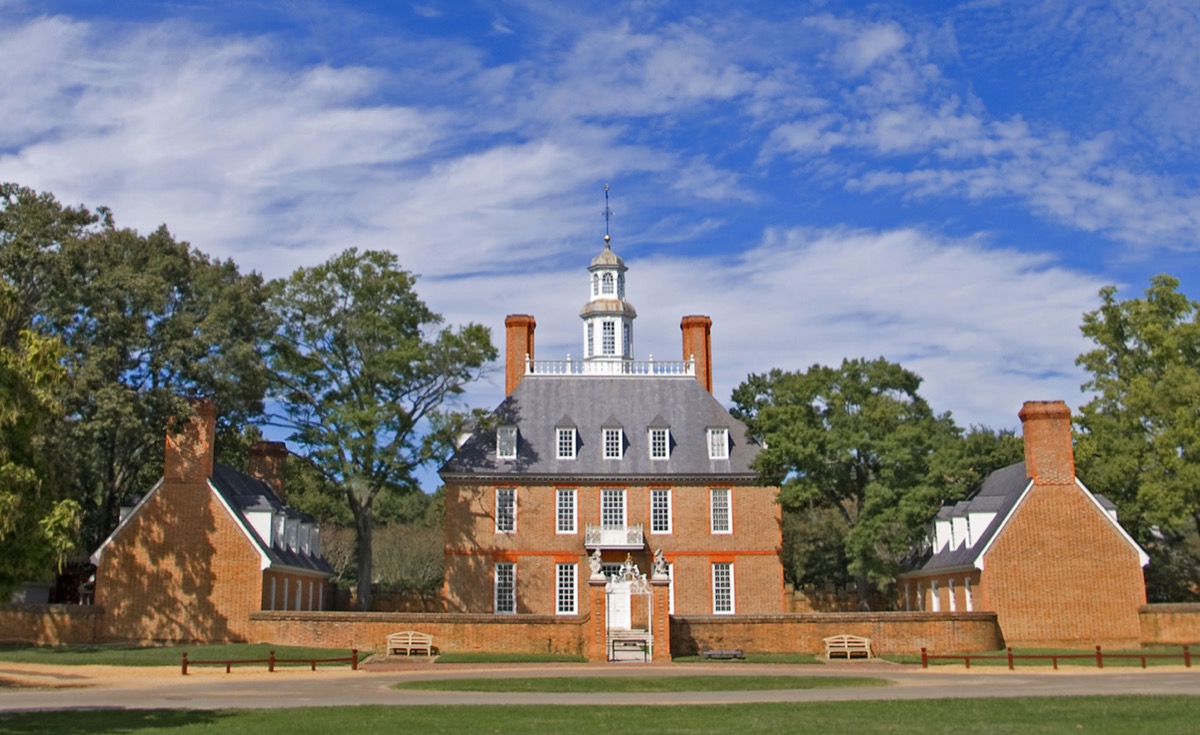
The President's House has its own résumé. Built 1733. Oldest residence for a university administrator in the country. On June 25, 1781, Cornwallis evicted the college president (Bishop James Madison) and moved in as his personal headquarters. Months later, French General Rochambeau took the house and used it as a hospital for officers wounded at Yorktown, who then accidentally set the place on fire. Today the lore claims three ghosts: a French soldier, a weeping woman, and the spirit of a skeleton found inside a wall. Colonial Williamsburg's archaeologists found small fragments of bone and shell mortar in a drain. Nothing bricked-up, no body. The story is legend.
The Brafferton Building went up in 1723 to house the Indian School. The school itself started around 1700-1702 with roughly four young Catawba boys, captives acquired through colonial Indian traders. The whole operation was funded by the estate of English scientist Robert Boyle, whose 1691 will purchased Brafferton Manor in Yorkshire to bankroll the Williamsburg project. The last Indian School students left in fall 1778, after the Revolution disrupted the estate's income.
The ghost story attached to all of this is the running boy. A Native student at the school fashions a rope, slips out his second-floor window at night, and comes back before dawn. One morning the rope is hanging and the boy is gone. His body turns up in what is now the Sunken Garden. Cause never determined. No one wrote his name down. W&M's alumni magazine and Flat Hat both carry the legend, and neither one names the boy. A child taken from his nation, kept in a stone building, tried to leave at night with a rope. Then he was gone. The haunting feels less like a ghost story and more like a campus refusing to forget what it can't quite remember.
The elevation detail is what gives the story teeth. The Sunken Garden was designed by Charles M. Robinson between 1919 and 1923, modeled on Sir Christopher Wren's Royal Hospital Chelsea in London. (Wren designed the building that's named for him on this campus, and then a garden modeled on a Wren design got dug into the lawn next to it. The whole campus keeps doubling back on itself.) The CCC excavation didn't happen until 1935-36. A ghost from before 1900 would, in fact, be running at a higher elevation than today's lawn. The apparition's physics matches the geography, which is a detail most ghost stories don't bother with.
Tucker Hall, the English Department building, opened May 14, 1909, as the college's first free-standing library. Around 1980, a female student hanged herself on the third floor; the lore says her parents had told her she couldn't come home until she finished her studies. Students pulling all-nighters report a woman who asks how their exams are going. Answer "well" and she screams and throws a fit. Answer "poorly" and she tries to talk you into following her path. The "She made me do it" follow-up note tied to a 1982 student is folklore, not documented fact. The 1980 suicide itself is dated by Clio.
Lucinda haunts Phi Beta Kappa Memorial Hall. She was supposedly cast as the lead in Thornton Wilder's Our Town sometime in the late 1950s or early 1960s, died in a farm equipment accident before opening night, and was spotted by her understudy on the balcony in the black graveyard-scene dress on opening night. No surfaced source gives her last name or a confirmed year. There's a complication: the original PBK Memorial Hall, which opened March 27, 1957 (the first PBK building had burned in a 1953 fire), was demolished in 2019-2020. A new PBK Hall opened on the same site in Fall 2023, with a main stage named for alumna Glenn Close. The Lucinda legend belongs to a building that no longer physically exists. The name carried over. The bricks didn't.
PBK is also where Althea Hunt shows up. She's the real anchor in the theatre lore. Born December 7, 1890, died April 1, 1971. Founded the William & Mary Theatre in 1926, directed it until 1957, retired from the faculty in 1961. Students who report seeing her in the building call her "Miss Hunt." A green room in PBK is named for her and her successor Howard Scammon, and a dormitory carries her name. The woman is documented. The haunting isn't, but the woman is.
For a campus inventory, William & Mary alumna Margot Baden, class of 2020, built an interactive ArcGIS map titled "Hauntings at William and Mary." It collects dozens of paranormal reports submitted by students and alumni. A real student project, student-sourced and citable, built by someone who walked the campus at 2 a.m. The alumni magazine talks about W&M as a living archive of the restless dead. The map proves the archive is still being added to.
Walk Old Campus at dusk and you can stand at the edge of the Sunken Garden and find the line where the lawn used to be. The boy, if he's there, runs along it.