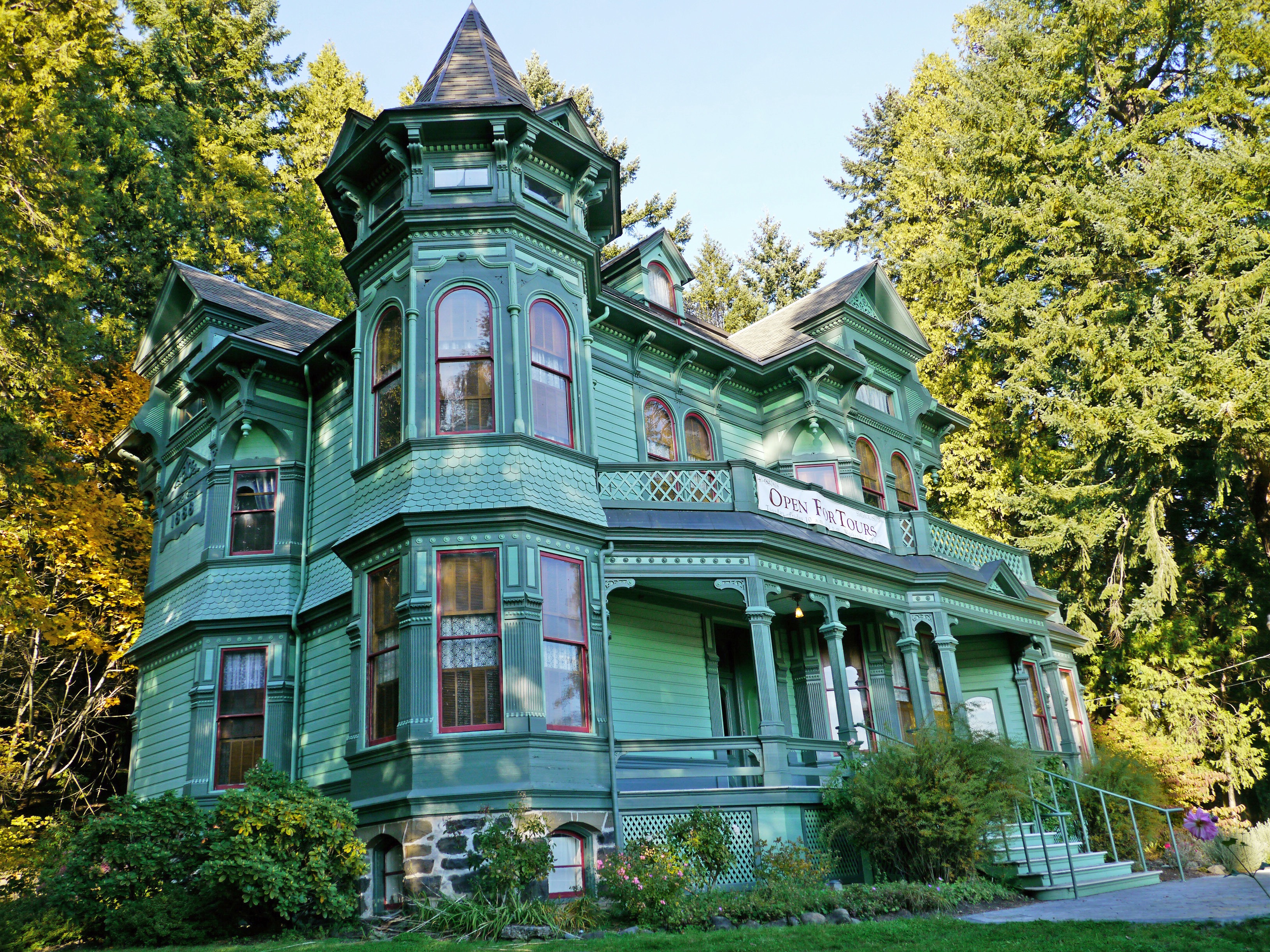
The staff at the Shelton McMurphey Johnson House in Eugene, Oregon insist the Castle on the Hill isn't haunted. Then they describe footsteps on the stairs, lights coming on in empty rooms, and the doll that toppled face-first off its display the moment someone stepped in.
The Shelton McMurphey Johnson House in Eugene, Oregon keeps a room full of dolls. The story people tell about it is short. One of the dolls toppled face-first off its display the moment a visitor crossed into the room — no breeze, no one near it, no reason anyone could name.
The people who run the house will tell you it isn't haunted.
They'll tell you that, and then describe the rest of it. Footsteps on staircases with no one climbing them. Lights flicking on in empty rooms. Bursts of laughter that come from nowhere and belong to no one. Atlas Obscura adds cold spots and disembodied whispers with no source. Even the writeups that quote the museum's official "not haunted" line concede that the place has, in their own words, all the classic features one expects of a haunted house.
It certainly looks the part. Built in 1888, it's a green-and-white Queen Anne mansion — a polygonal tower, carved gables, open porches — perched on the slope of Skinner Butte above downtown Eugene and the old train depot. Locals call it the Castle on the Hill. It's the most elaborate Victorian house in the city, and it's named for all three families who lived in it.
By the museum's own telling, the lot had already seen one fire before the mansion went up: the original structure burned in 1887, set alight by an aggrieved workman, and the house that stands now was rebuilt the year after.
Then the families moved through it, one after another. Dr. T.W. Shelton built the place and was gone by 1893. His widow deeded it to their daughter Alberta and her husband, Robert McMurphey. Robert died suddenly in 1921. Alberta stayed on until 1949. After her, the house passed to Eva and Curtis Johnson, and Eva lived there until her death in 1986 — the last person to call it home before it became a museum.
Three families. Nearly a hundred years between the first of them and the last, each one handing the green house on the hill to the next.
The museum named the place for every one of them — Shelton, McMurphey, Johnson. And it insists, on the record, that not one of them ever stayed, even as the people who work there go on reporting the footsteps overhead, the laughter out of nowhere, and the doll that went over on its face.