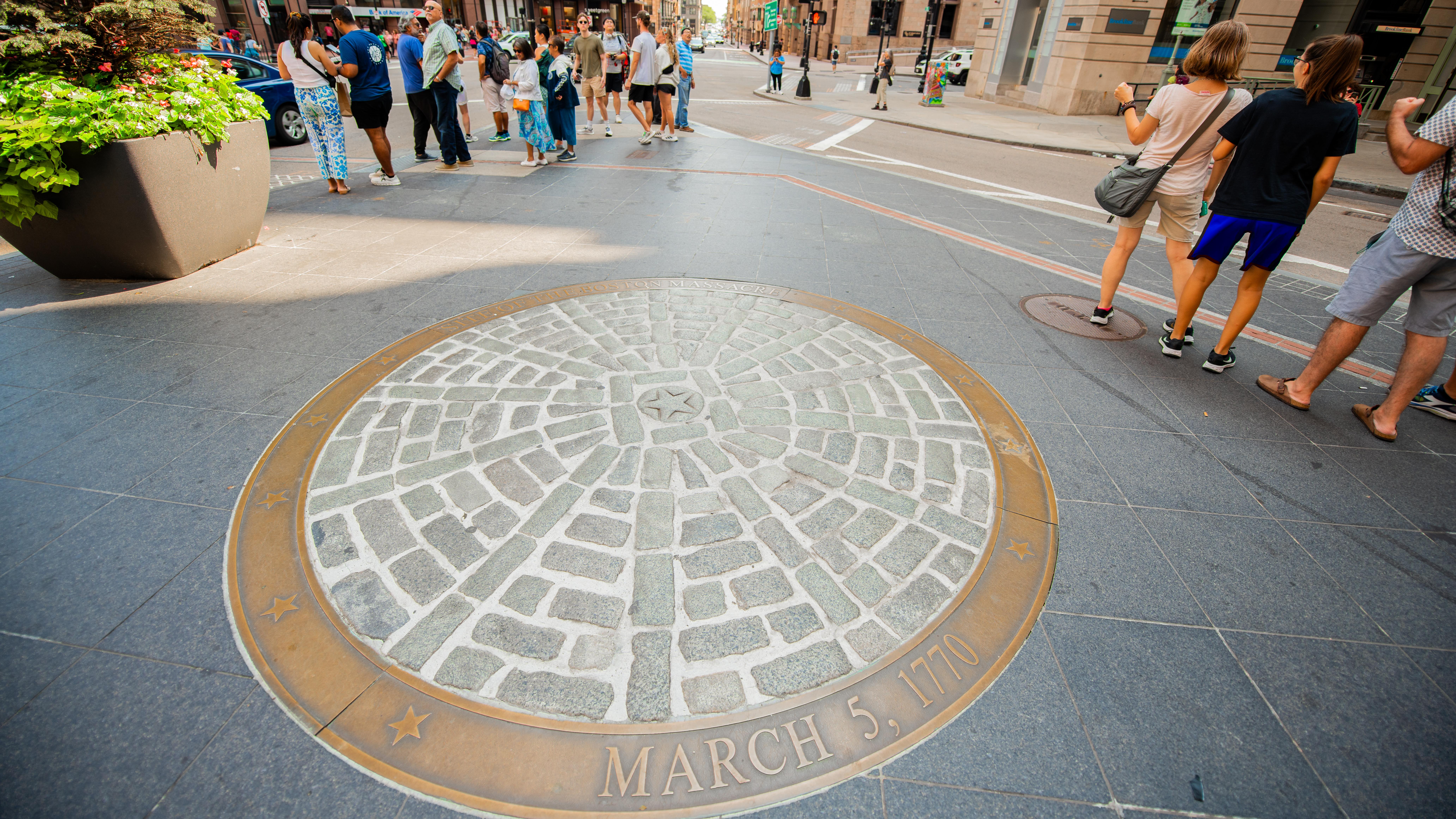
Set in the sidewalk outside Boston's Old State House, a bronze-ringed circle of cobblestones marks where five colonists were shot dead in 1770. No named ghost walks the spot. Ghost-tour guides say the stones give back sounds instead, as though the ground remembers what it absorbed.
Outside the Old State House in Boston, set flush into the sidewalk, there's a ring of bronze around a circle of cobblestones. Ghost-tour guides stop their groups here and tell them to listen. What people report hearing, the guides say, are "sounds that do not correspond to any identifiable source — a shout, a sharp crack, the sound of running feet on cobblestones." No one is running. The crack has no gun behind it.
The circle marks where five men died on the night of March 5, 1770. British soldiers, hemmed in by an angry crowd on what was then King Street, fired into it. Three were killed where they stood: Crispus Attucks, a mixed-race former slave and the first to fall; Samuel Gray, a rope maker; James Caldwell, a mariner. Samuel Maverick, a 17-year-old apprentice, was struck by a ricocheting ball and died the next morning. Patrick Carr, an Irish immigrant, took a shot to the abdomen and lingered about two weeks before he died of it.
The Sons of Liberty called it a massacre and made it the spark of a revolution. Paul Revere engraved the scene into propaganda, turning a chaotic street confrontation into a rallying image. The soldiers were tried for murder, defended in court by John Adams, the future president, and most were acquitted. After independence, the city renamed King Street to State Street, quietly erasing the royal name from the spot where the rebellion's first blood was shed.
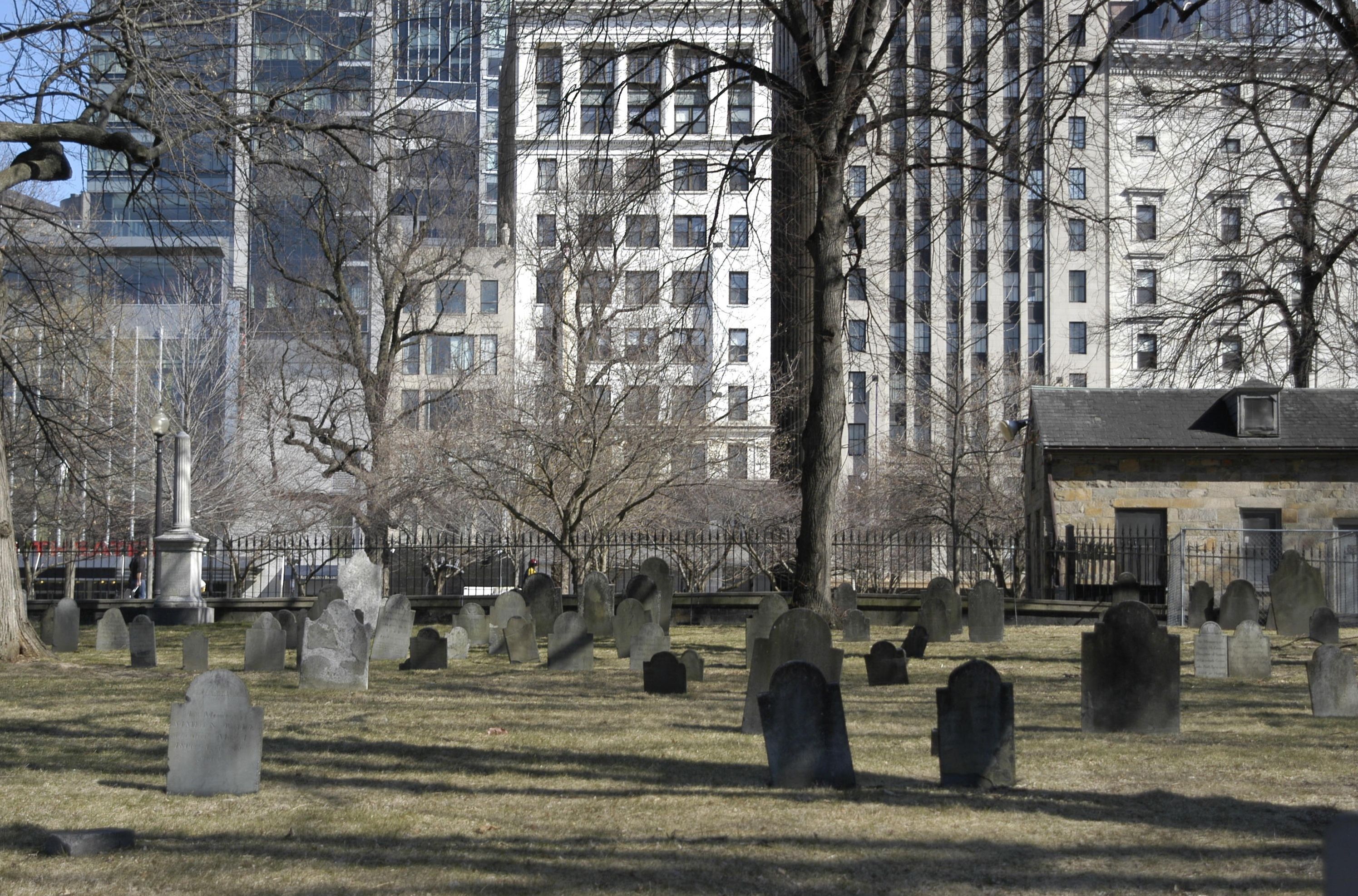
No spirit is reported here by name. The five men lie a short walk away, buried together at the Granary Burying Ground, and none of them is said to wander back. What stays at the cobblestones, by every ghost-tour account, is something thinner than an apparition: the sounds, and cold spots that settle hard over the granite even on warm days, "as though the ground is remembering what it absorbed."
The marker itself has never held still. It was set down in 1887, pried up in 1903 for the subway, pulled again in 1924 for resurfacing, redesigned in 1937, shifted to a traffic island in the 1960s, and landed on this sidewalk in 2011. Over its life it has marked the death-spot of two different victims, Attucks at first and later Caldwell, depending on where the city moved it.
So the bodies are at the Granary, and the marker has been half a dozen places. Only the night, the guides say, has stayed exactly where it happened.