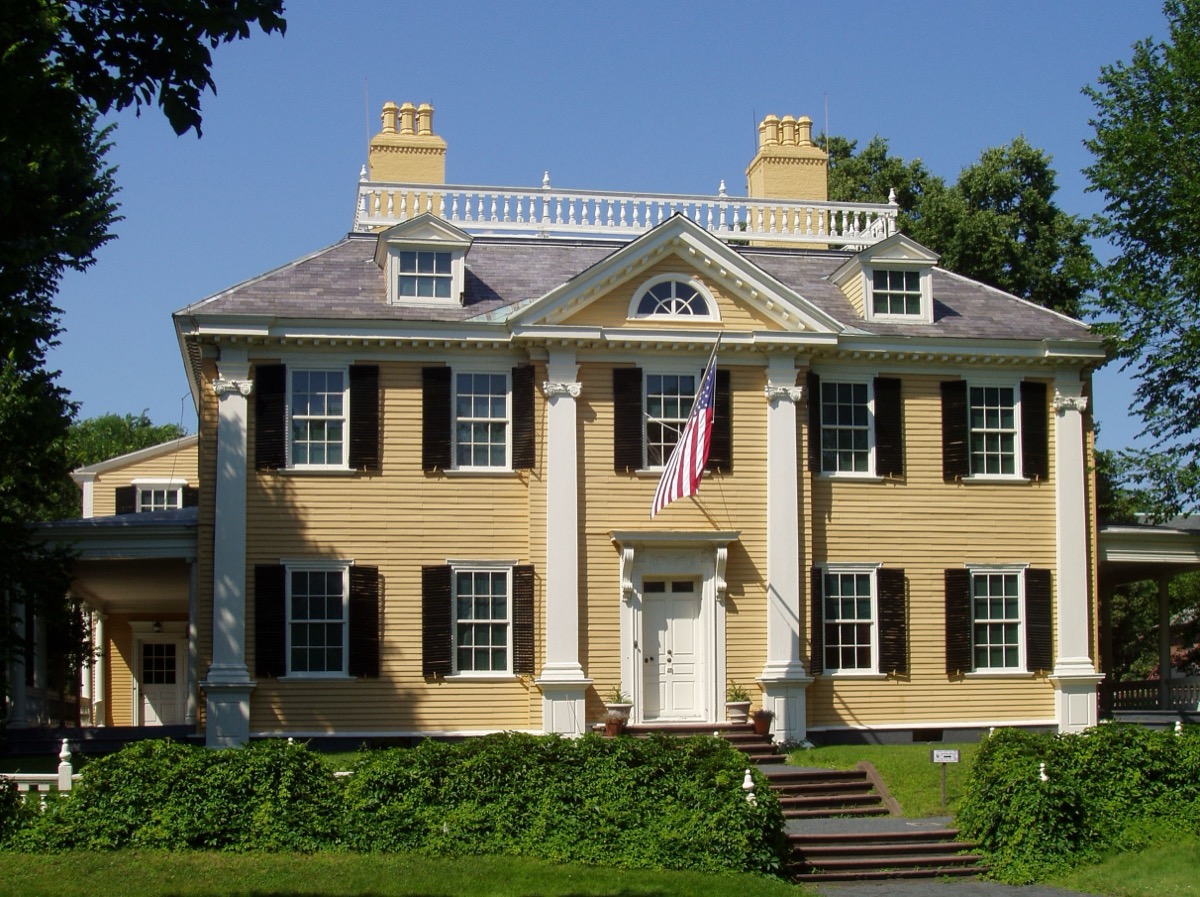
At Longfellow House on Brattle Street in Cambridge, Massachusetts, the poet wrote a line about haunted houses in 1858. Three years later his wife burned to death in the library, and the Park Service that runs the place now leans into the ghost stories.
The yellow Georgian mansion at 105 Brattle Street in Cambridge, Massachusetts, was already famous before it earned a darker reputation. The poet Henry Wadsworth Longfellow lived there for forty-five years, and in 1858 he published a poem that opened with a line he could not have known he was writing toward: "All houses wherein men have lived and died / Are haunted houses."
Three years later, his own house earned the title.
On the afternoon of July 9, 1861, Longfellow's wife, Fanny, was in the library, melting wax to seal an envelope holding a lock of one of her daughters' hair. Her light summer dress caught fire. She ran into the study where Henry was napping, and he wrapped a rug around her to smother the flames, burning his own hands and face in the process. She died the next morning. Accounts differ on exactly how the fire began. The traditional version blames the candle and sealing wax, while Longfellow's youngest daughter said years later there had been no candle at all — that it started from a self-lighting match that fell to the floor.
Henry's burns kept him from his own wife's funeral, held July 13, on what would have been their eighteenth wedding anniversary. He grew the full beard he's remembered by partly to cover the scars on his face. He had loved her plainly. "I never looked at her without a thrill of pleasure," he once wrote, "she never came into a room where I was without my heart beating quicker." He went on living in the house another twenty-one years and died there in 1882.
The house had seen plenty before the fire. It was built in 1759 for a Loyalist named John Vassall, who kept enslaved people on the property, among them a woman called Cuba and her son Darby, who later became an abolitionist. The Patriots confiscated the place in 1774. George Washington moved in the following summer and ran the Siege of Boston from its rooms, with Martha joining him through the winter. Longfellow himself arrived in 1837 as a boarder, renting second-floor rooms from a widow. In 1843, when he married Fanny, her father bought the house outright for ten thousand dollars and gave it to the couple as a wedding gift.
The National Park Service runs the place now, and it doesn't shy from the dark part. Every so often the rangers produce a Halloween program built around Henry's "scariest poetry, his spectral encounters, and a little bit of Victorian drama" — ghost stories, they say, "both written and real-life." No one reports an apparition drifting the halls here. The haunting is the poem and the fire, the line he wrote three years early and then lived all the way out.