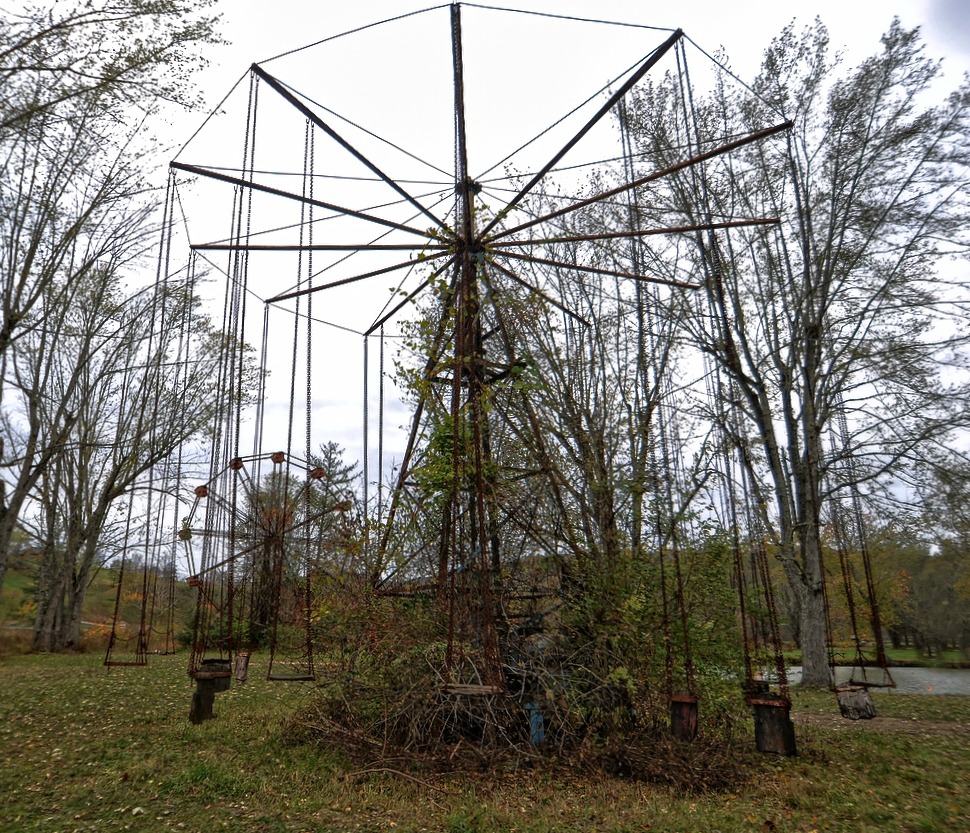
The rides at Lake Shawnee Amusement Park in Rock, West Virginia have stood rusting for decades, and people keep seeing children among them: a girl in a pink dress near the circle swing that killed her, a drowned boy waiting at the front gate.
Gaylord White was clearing brush on a tractor at the old Lake Shawnee Amusement Park in Rock, West Virginia when he looked up and saw a girl in a pink dress with ruffled sleeves. He took her for the child killed years before on the park's circle swing. He parked the tractor where it stood and left it, because she seemed to like watching it. The tractor is still out there.
So is the swing. It sits rusted and grown through with saplings, and a travel writer who took the daytime tour describes a red ribbon tied to the seat where the girl died, though guides say she seems to prefer the swing beside it, the one with the owl ornament hanging from it. A truck delivering soda to a refreshment stand backed into the path of the ride while it was turning. Nobody agrees on the year, and no source anywhere names her.
She was one of two children who died at the park while it was open. The other was a boy who drowned in the spring-fed swimming pool. His mother dropped him off in the morning and came back that afternoon, and after the grounds were searched, they found him floating. The owners filled the pool in with sand.
C.T. Snidow had opened the place in 1926: a dance hall, a racetrack, cabins, a Ferris wheel. By the park's own telling, coal miners came from miles around for a weekend of it. Every account says he had no idea what he was building on. Archaeologists hold that two Native settlements stood on this ground and were abandoned centuries before the first white settlers arrived. A later excavation recovered 13 sets of remains along with pre-Columbian artifacts. And in August 1783, a raiding party killed two of Mitchell Clay's children in the field here and carried a third off to Ohio, where he was burned at the stake. A headstone put up by the Daughters of the American Revolution in 1937 stands on the grounds.
What visitors report now is chanting, voices, orbs in photographs, and the long-idle rides moving on their own, the swings watched from clear across the park while they turn. One apparition shows up over and over: a man seated in the Ferris wheel car at the nine o'clock position.
The boy stays down front. "According to some of the paranormal investigators he hangs out at the front gate where the clown's mouth is," current owner Chris White told WVVA. "They think it's cute that this kid has took it upon himself to keep this park safe."
When the White family reopened the park, they bought a replacement for the circle swing and checked its serial number. It matched the ride that had stood on the property since the 1920s.