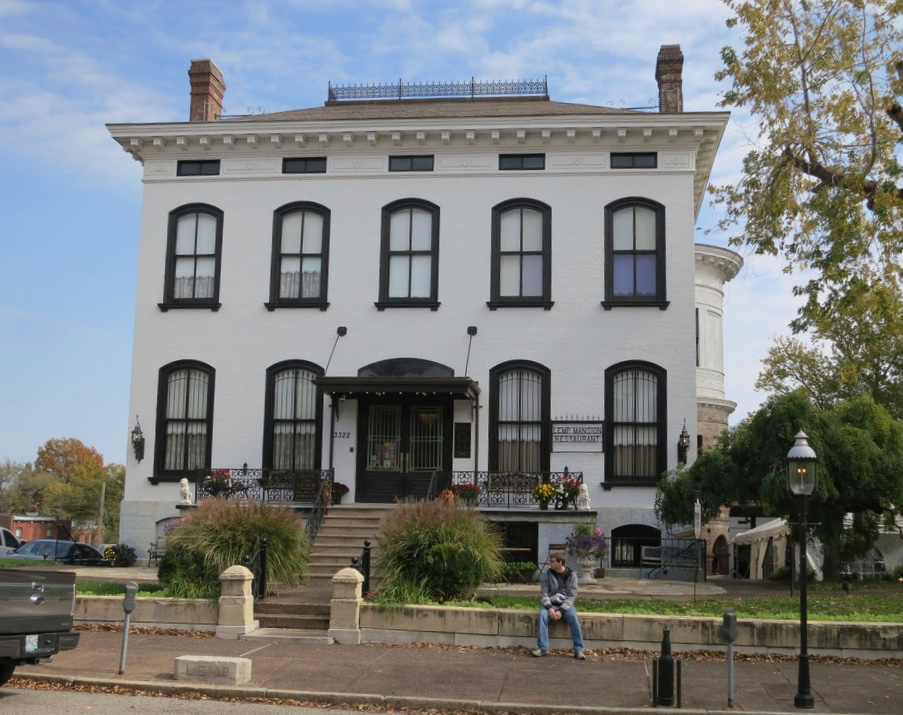
The Exorcist House in Bel-Nor, Missouri is the quiet brick home where the 1949 case behind the famous film took place. Its address is kept secret to this day. When a cable network aired a live exorcism of it in 2015, nothing happened on camera.
On October 30, 2015, the cable network Destination America pointed a live broadcast at a two-story brick house in Bel-Nor, Missouri, and announced it would exorcise the building itself. They brought in a crew of ghost hunters and a psychic medium named Chip Coffey. They timed it to the 66th anniversary of one of the original rites. Across hours of airtime, a Variety reviewer summed up the result in two words: "absolutely nothing happened."
The house earns the attention because of what did happen there, in 1949.
That winter, a 14-year-old Maryland boy and his mother left Cottage City for relatives in Bel-Nor, just north of St. Louis. The strange events around him, the accounts say, had started after the death of an aunt, a spiritualist who'd shown him a Ouija board. The family described scratching sounds, furniture sliding on its own, objects flying when the boy was near. For decades he was known only as "Roland Doe," a pseudonym carried through the books and the broadcasts. His real name, Ronald Hunkeler, wasn't widely confirmed until after he died in 2020. "The Haunted Boy is Ronald Hunkeler," said the journalist who traced him. "That's a fact."
Jesuit priests from Saint Louis University took the case. Father Raymond Bishop, a faculty member, first went to see the boy, then brought in Father William Bowdern, pastor of the university's church, who got permission from the archbishop to perform the formal rite. Prayers began the evening of March 16. Bowdern led; Bishop kept the diary that became its central record. One entry reads, "The contortions revealed physical strength beyond natural power."
Witnesses described words surfacing on the boy's skin, including "evil" and "hell." A guttural voice. The mattress shaking during the Litany of the Saints. Father Walter Halloran, a young priest who drove for Bowdern and assisted him, came away with a broken nose. The boy was baptized Catholic on April 1, and much of the rite, by then, had moved to a hospital across town. It ran from mid-March into spring, and Bishop's diary closed it out on Easter Monday, April 18: "Since Monday at 11 p.m. there have been no indications of the presence of the devil."
A Georgetown student named William Peter Blatty read about all this and built a novel from it. *The Exorcist* came out in 1971; the 1973 film did the rest, and "the Exorcist house" became a name people drove out to find.
The Bel-Nor house is still a private home, and its exact address is kept quiet on purpose, to keep the curious off the doorstep. Whoever lives there now lives where the most documented exorcism in America was prayed over, in a house that drew a live TV crew and gave them nothing.