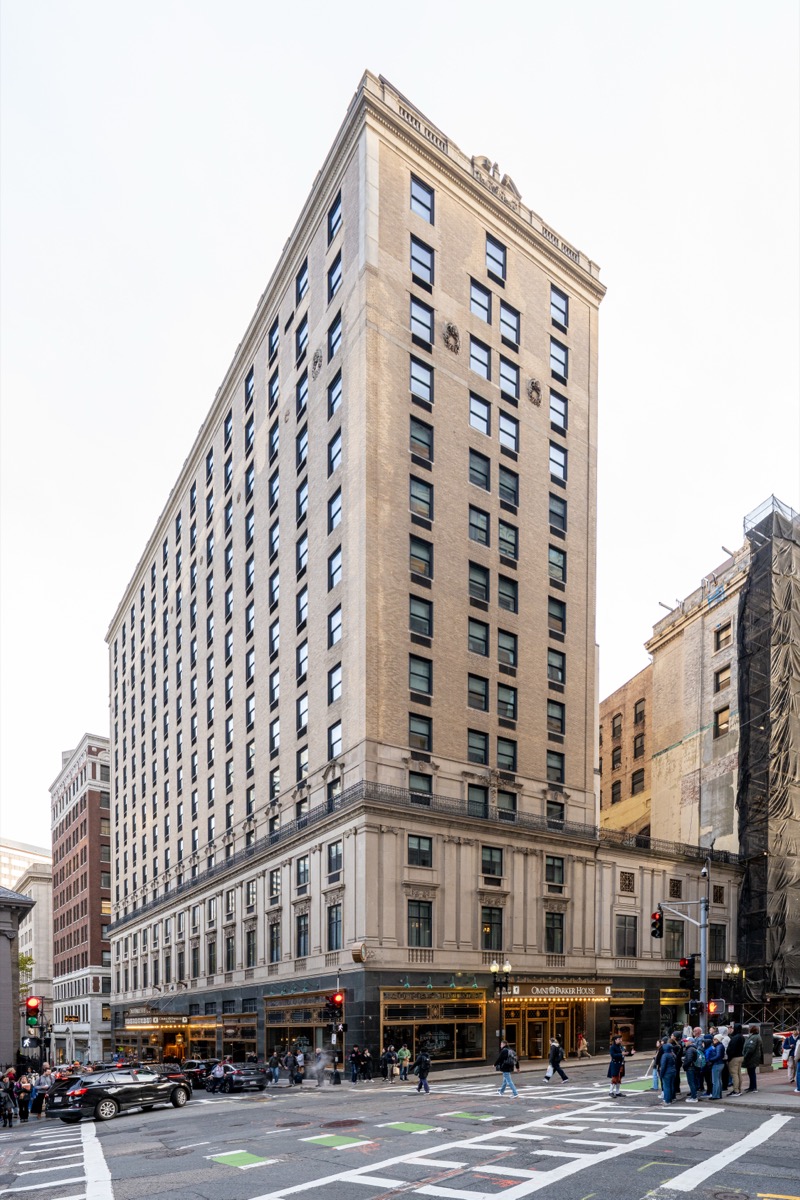
At the Omni Parker House in Boston, Elevator Number One keeps traveling to the third floor on its own, empty, with no one waiting. Staff say it has done that since Charlotte Cushman died on that floor in 1876, and they've stopped trying to explain it.
At the Omni Parker House on School Street in Boston, one of the elevators rides to the third floor by itself. No one's inside it. No one's pushed a button. Elevator Number One simply stops at three, opens onto an empty hall, and the staff have a flat answer for why: it has been doing that since Charlotte Cushman died up there.
Cushman was the most famous American actress of the nineteenth century, the first native-born star on the stage, known for playing Lady Macbeth and Romeo both. She died in a third-floor room here on February 18, 1876, of pneumonia after a long fight with breast cancer. She was 59. Since then, the staff say, the elevator keeps coming back to her floor.
She is not the only one who stayed.
Charles Dickens lived at the Parker House for roughly six months in 1867 and 1868, in rooms 138 and 139, where he rehearsed his readings of A Christmas Carol before a tall mirror framed in black walnut. The mirror still hangs on the mezzanine, authenticated by the Boston branch of the Dickens Fellowship. The story goes that the glass sometimes shows Dickens in his performance dress, and that saying his name three times in front of it sets the nearby elevator bells chiming. A staff member is said to have stopped cleaning it after condensation kept appearing on the glass beside him, as if someone close by were breathing.
Not everyone who passed through left a ghost. Some just left a record. John Wilkes Booth checked in on April 5, 1865, eight days before he shot Lincoln at Ford's Theatre. A bellhop named Barney Brogan served him breakfast in the ladies' café the morning of the sixth and remembered him as "a handsome, kindly and good natured man" with "luxuriant black glossy hair." During that same stay, a witness reported watching Booth practice pistol shooting at a gallery up the street, firing "in various difficult ways such as between his legs, over his shoulder and under his arms." Then he went south, and the kindly man at breakfast became the most hated name in the country.
Then there is Harvey D. Parker, who opened the place in 1855 and, by the accounts of guests, never left it. They describe a heavy-set bearded man in nineteenth-century dress, sometimes a grey mist that gathers into him on the upper-floor corridors, gone the moment he's noticed. One guest in room 1012 woke at daybreak to a man standing at the foot of her bed. He smiled. When she smiled back, he vanished. She placed him later from his portrait hanging in the lobby: the founder, still checking on his guests.
Boston's oldest hotel has been turning away the dead for over a century. They don't seem to be in a hurry to check out.