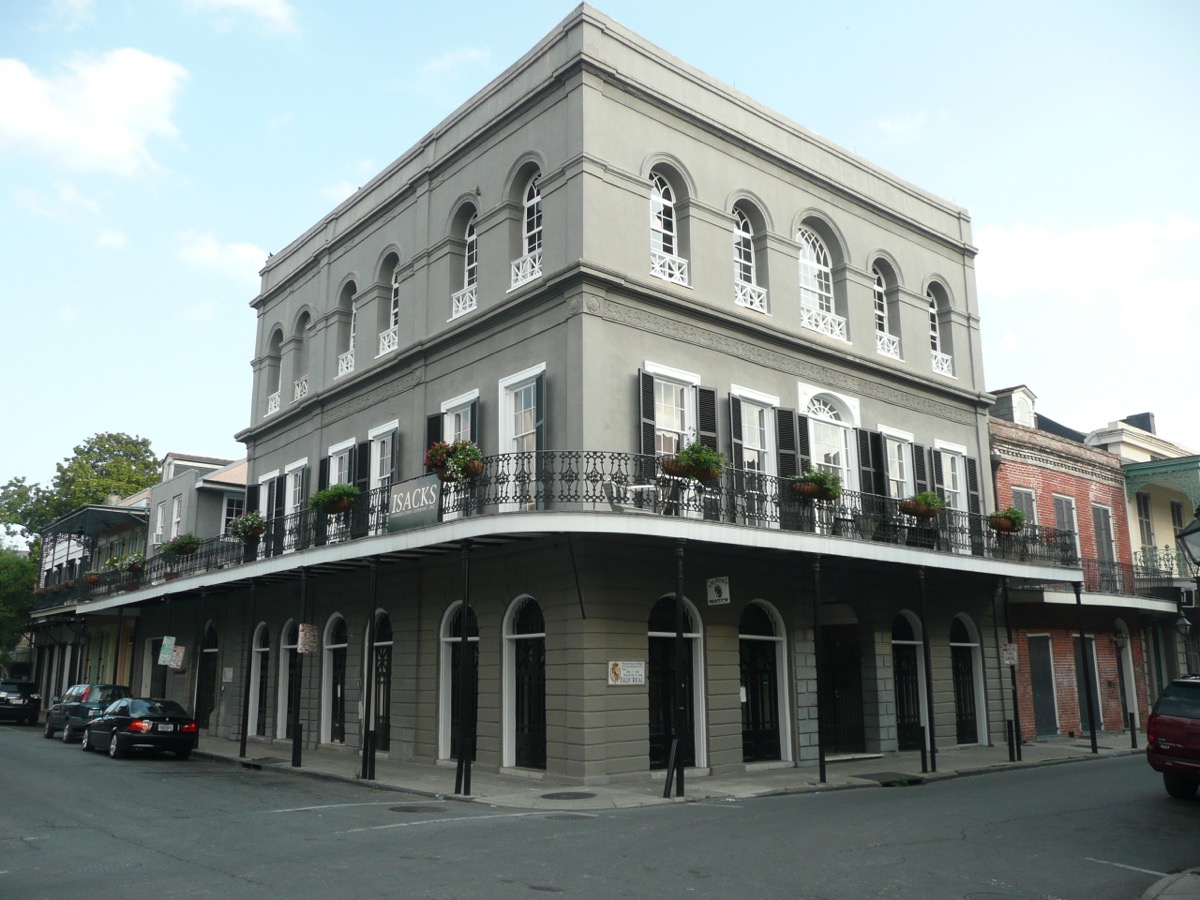
The LaLaurie Mansion on Royal Street is the most haunted address in the French Quarter. Tour groups pause at its corner to hear about chains and screams. The documented 1834 fire is worse than the legend, and the house standing there now isn't even the one it happened in.
The LaLaurie Mansion sits on the corner of Royal and Governor Nicholls in the French Quarter, and ghost tours stop on the sidewalk outside it every night. They can't go in, since it's private, so they stand at the corner and tell the crowd what people report from the closed third-floor shutters: crying, chains dragged across the floors, the smell of burning. The lore describes a man in chains on the staircase and a pale woman watching from the upper windows.
What the tours are circling is real, and it's on the record. On April 10, 1834, a fire broke out in the kitchen of Delphine LaLaurie's home. It was set by the cook, a woman of about 70 who was chained to the stove. According to the contemporary newspaper account, she said she'd started it as a suicide attempt, because she feared being punished again.
When neighbors and fire crews tried to reach the locked upper rooms, the household refused them the keys "in a gross and insulting manner." So they broke in. The New Orleans Bee reported finding "seven slaves more or less horribly mutilated," chained, held for months; a rival paper that same week counted six, one of them with "a large hole in his head ... filled with worms." An enraged crowd then ransacked the house, leaving "scarcely any thing but the walls." The rescued were taken to the Cabildo, where, by one local account, some 4,000 townspeople came to look at them.
The legend grew from there, and it grew worse than the papers. The surgical experiments, the gouged eyes, the bodies stitched into new shapes — none of it appears in the 1834 accounts. It was invented in a 1946 book, more than a century after the fire. One researcher calls it fakelore. The one early detail that does hold up is grim enough: a contemporary traveler, Harriet Martineau, wrote in 1838 of an enslaved girl who fell to her death from the roof while fleeing LaLaurie.
Delphine LaLaurie was never charged. She fled the city, then France, and died in Paris in 1849. The house she left behind passed through stranger lives than her own: an integrated public school after the war, an 1880s music conservatory, a home for indigent men in the 1920s, then apartments. Even Nicolas Cage owned it, buying it in 2007 to write, he said, the great American horror novel; he lost it to foreclosure two years later.
Here's the part the crowd on the corner rarely hears. That 1834 fire destroyed the house. The three-story building they're photographing was rebuilt around 1838 by a man named Pierre Trastour, after she was already gone. The most infamous address in New Orleans is haunting a house it never lived in.