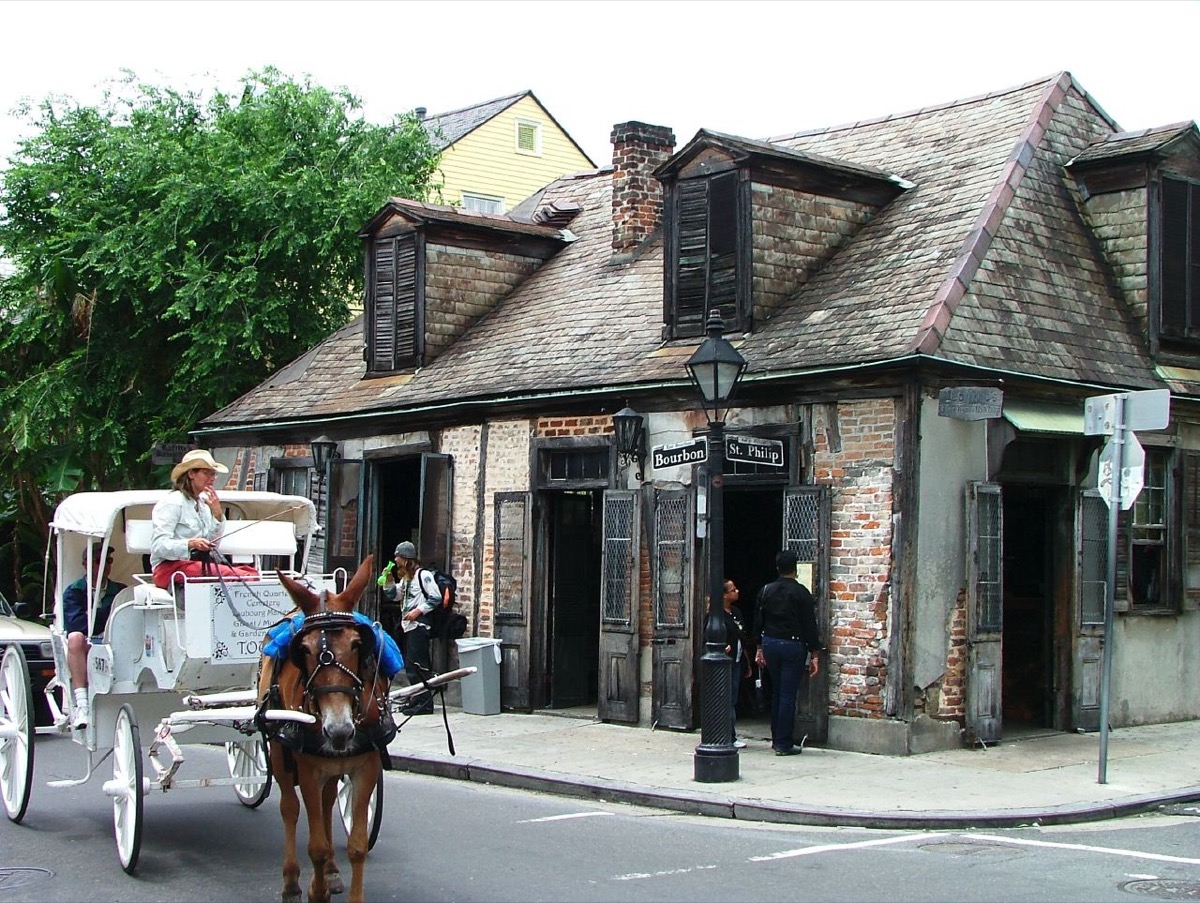
Lafitte's Blacksmith Shop on Bourbon Street is one of the oldest buildings in New Orleans, run on candlelight. Locals say a pirate's treasure is walled into the brick, guarded by a pair of red eyes in the fireplace, and by Jean Lafitte himself, watching from the dark.
Lafitte's Blacksmith Shop Bar sits on the corner of Bourbon and St. Philip in the French Quarter, and locals say if you stare into the fireplace long enough, a pair of glowing red eyes will stare back. They hold on you, then fade. The eyes come with no body and no voice, and the story goes that they are a warning. The treasure of the pirate Jean Lafitte is supposed to be hidden somewhere in the brick of this building, in the bricks or down in the fireplace grate, and something in there does not want you looking for it.
The bar runs almost entirely on candlelight, with little electric light anywhere in it, so the dark corners stay dark. That is where people report the other ghost. He stands in the shadows near the same first-floor fireplace, watching, and the way it is told he stares at you until you notice him, and the moment you do, he is gone into the shadows. He never speaks. The people who report him think he is Lafitte himself, still standing guard over what he buried. Along with the eyes and the figure, regulars and staff report cold spots, glassware sliding off the shelves on its own, and the smell of pipe tobacco in a bar where no one is smoking.
The building is real history, even if the pirate is mostly legend. It is one of the oldest surviving structures in New Orleans, reputed to be among the oldest buildings used as a bar in the country, and it was named a National Historic Landmark in 1970. Nobody is even sure how old it is. The bar's own history puts it in the 1720s; the landmark record and local historians place it later, in the 1770s. Either way it is a rare survivor of French Colonial briquette-entre-poteaux construction, soft brick packed between timber posts, which is why it outlasted the two great fires that burned most of the Quarter in 1788 and 1794.
The Lafitte brothers were real, too. Jean and Pierre and their Baratarian privateers genuinely helped Andrew Jackson hold New Orleans against the British in early 1815, and Madison pardoned the whole crew that February. But here is the part the legend skips. The name Lafitte never appears anywhere in this building's property records. A historian who went looking found the family actually spelled it Laffite, and found no proof the brothers ever owned the place or ran a smuggling front out of it. The connection that draws everyone to the door is the one the records can't confirm.
Upstairs there is a second presence, a woman rarely seen but described as talkative, who is said to lean in and whisper visitors' names directly into their ears.