Howard Street Cemetery in Salem, Massachusetts holds the unmarked grave of Giles Corey, the only man pressed to death in American history. Legend says he cursed the town's sheriff as he died, and people have looked for his ghost ever since, in the days before disaster.
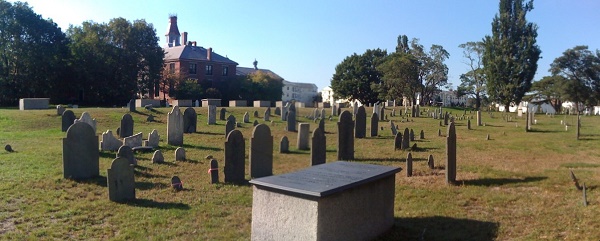
At Howard Street Cemetery in Salem, Massachusetts, the story is about an old man buried somewhere on the grounds in a grave nobody marked. Local tradition holds that he turns up here before a tragedy strikes the city. The night before the Great Salem Fire broke out in 1914, they say, he was seen again.
His name was Giles Corey, and what happened to him is the only case of its kind in American legal history. In September 1692, at 81, he was charged with witchcraft and refused to enter a plea. So the court ordered him pressed. They laid him face-up on the ground, set a board on his chest, and the high sheriff, George Corwin, added heavy stones one at a time. It took roughly two days. When they asked him to plead, the accounts say he answered the same way each time: "more weight."
He stayed mute on purpose. Untried, his estate couldn't be seized by the government, and it passed to his sons-in-law instead. Samuel Sewall wrote it in his diary that day: "Abt noon, at Salem, Giles Corey was pressed to death for standing mute." Three days later, on Gallows Hill, they hanged his wife Martha.
Legend holds that as he died, Corey cursed Salem and its sheriff. The curse has a shape you can almost follow. George Corwin, the man who supervised the pressing, dropped dead of a heart attack in 1696. He was 30. After that a tradition grew that every Essex County sheriff died in office or retired with a heart or blood ailment, until the office finally left Salem for Middleton in 1991. One of them, Robert Cahill, took a heart attack and a stroke in 1978, then retired with a rare blood disease, and went looking into the curse himself. He found the ones before him had died of heart trouble in office, or left with their blood gone wrong. He wrote it up in a book.
The cemetery opened in 1801, next to the old Salem jail, and the last person was buried there in 1953. About 1,100 headstones sit across its two and a half acres, over Revolutionary soldiers and sea captains and an oyster dealer named Prince Farmer. Corey's isn't one of them. He went into the ground here without a stone, and no one has ever known the spot. The man people watch for is the one the cemetery never marked.