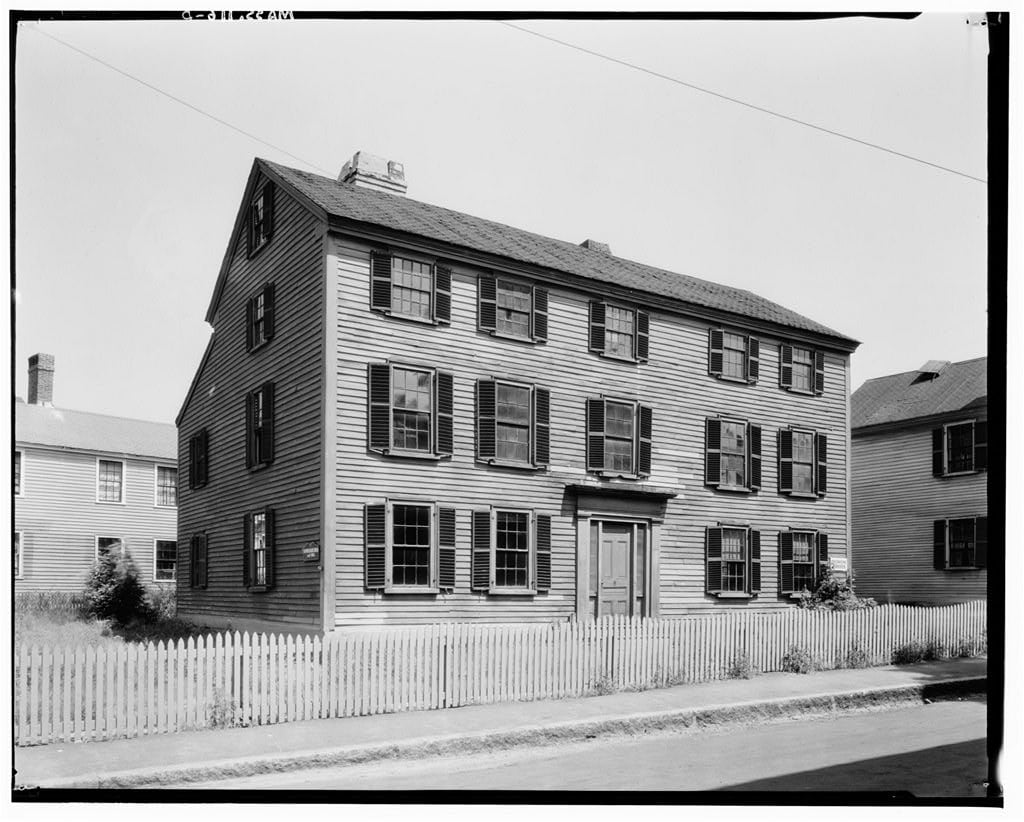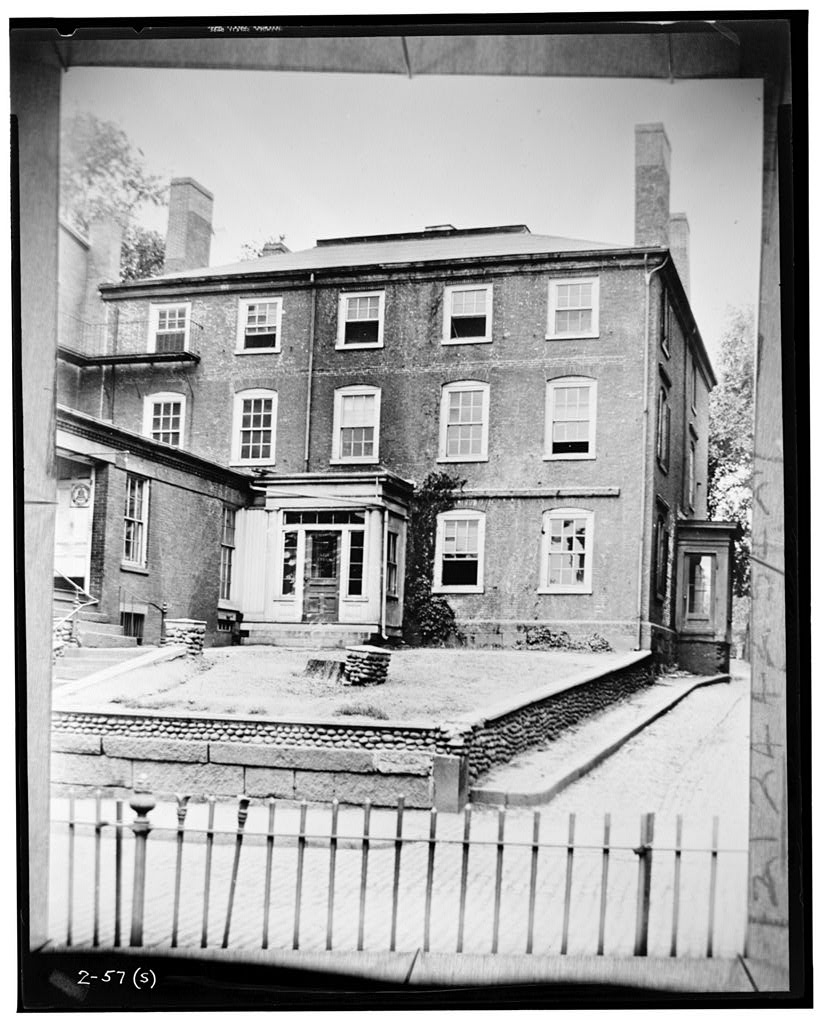
The Joshua Ward House in Salem, Massachusetts, was built over the home of George Corwin, the witch-trials sheriff. In 1981 a real-estate office Polaroid came back showing a gaunt woman in black who was never in the room.
The Joshua Ward House in Salem, Massachusetts, made its name on a single photograph. In 1981 the place was a Carlson Realty office, and at a holiday shoot an employee named Dale Lewinski took a Polaroid of a coworker. When it developed, the coworker wasn't in it. In her place stood a gaunt, dark-haired woman in a long black dress nobody recognized — the Lady in Black.
The picture ran in Robert Ellis Cahill's 1983 book *New England's Ghostly Haunts*, went national, and made this the most haunted house in Salem. It is a house built to attract that story. Joshua Ward, a wealthy merchant and rum distiller, raised it in 1784 as one of Salem's first brick mansions, and lived in it until he died in 1825. George Washington spent a night here in 1789, recorded in his own journal and in the diary of a local reverend. The interior woodwork is Samuel McIntire's, and the house holds the oldest surviving staircase he carved.
But Ward built on borrowed ground. The lot had belonged to George Corwin, the high sheriff of the 1692 witch trials, appointed to the post at 25. Corwin escorted the condemned to the gallows at Proctor's Ledge and seized their property afterward under English law — he sold off John Proctor's livestock and took Philip English's belongings. He is the man who oversaw the death of Giles Corey, an old farmer in his eighties who refused to enter a plea. They stripped him, laid him in a field by the Salem jail, and crushed him under a board piled with stones. Samuel Sewall wrote it in his diary that September: "Giles Cory was pressed to death for standing mute." Corey's answer, the story holds, never changed. More weight.
Local legend turns Corwin into a strangler who tortured prisoners in his own cellar, and says Ward built directly over his hidden grave. Neither holds up. The Salem Witch Museum is plain about it: "There is no evidence to substantiate the claim that Corwin was torturing prisoners." The pressing happened in a field, not a house. Corwin himself died suddenly at 30, four years after the trials, and was reburied across town in the family tomb at Broad Street Cemetery.
The house is a boutique hotel now, called The Merchant. As for the Lady in Black, by some accounts the woman in the photograph later offered a flat answer for it — a fogged lens, a cold-weather Polaroid. Cahill, the story goes, left that part out.