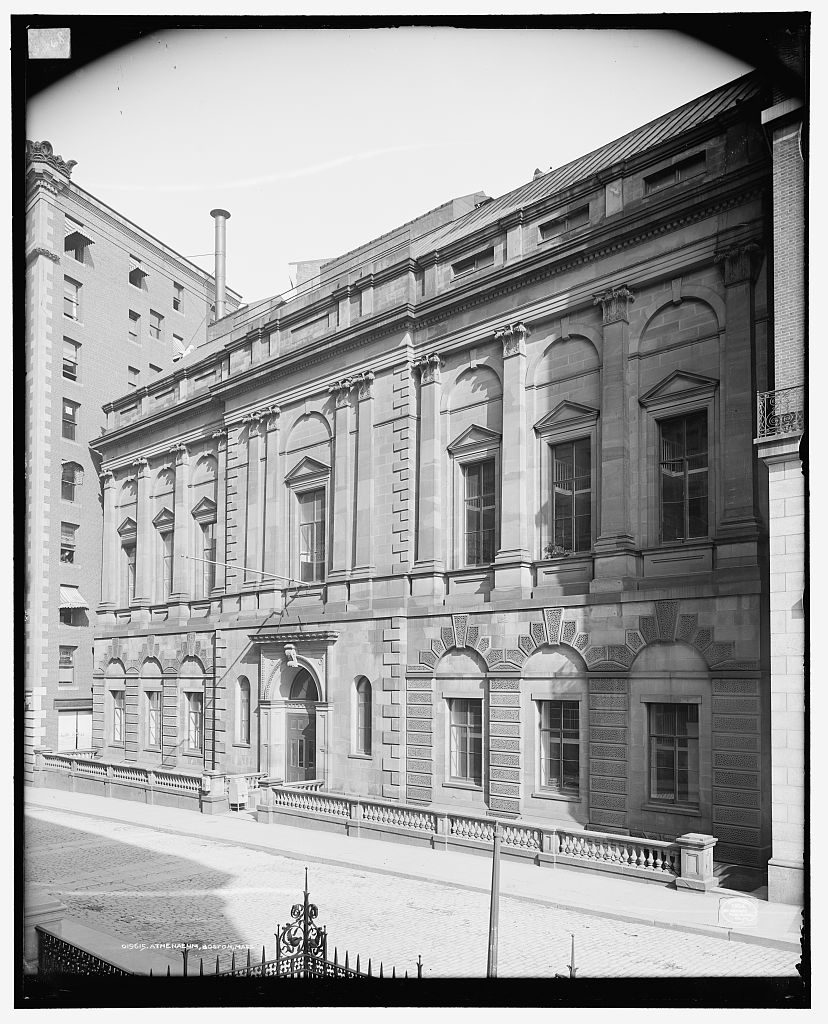
At the Boston Athenaeum, novelist Nathaniel Hawthorne kept seeing an old minister reading in the same chair, working through the morning paper exactly as always. The trouble was that the minister had recently died. Hawthorne watched for weeks and never spoke to him.
At the Boston Athenaeum, a private library founded in 1807, the novelist Nathaniel Hawthorne once spent weeks watching a dead man read. The dead man didn't know he was dead, or didn't care. He sat in his usual chair in the reading room, working through the Boston Post, exactly as he had for years.
The man was the Reverend Dr. Thaddeus Mason Harris, a Harvard librarian and Unitarian minister, and a longtime member of the library. He died in April 1842, at 73. The morning after, Hawthorne walked into the reading room of the Athenaeum's old Pearl Street home and saw Harris in his chair, the newspaper open in front of him. He thought nothing of it. That evening a friend mentioned that the old minister had died. "I saw him at the Athenaeum to-day," Hawthorne said.
He returned the next day. Harris was there again. And the next, and the next, for weeks: a solid, lifelike figure reading in the same spot, who never looked up, never spoke, never seemed to enter or leave the chair. Hawthorne watched, and said nothing.
He had his reasons, and he wrote them down. Conversation was forbidden in the reading room. He and Harris had never been formally introduced. And by his own account, he was "shy as any ghost" himself, which left two of them sitting in the same quiet room, neither willing to be the first to speak.
What unsettled him most was the newspaper. Hawthorne came to suspect the Boston Post in those days carried Harris's own obituary, and that the old minister sat reading the notice of his death without ever registering it. He could never bring himself to walk over and look.
Hawthorne kept no copy of the story. He told it years later in a Liverpool parlor, wrote it out for a friend, and let it disappear. The manuscript surfaced in 1900, decades after his death, which makes it one of the most strangely pedigreed ghost stories in America: a haunting reported, in the first person, by the author of The Scarlet Letter.
The dead minister is not the only unquiet thing in the collection. Among the library's 600,000 volumes sits the confession of a highwayman named James Allen, printed in 1837. On his deathbed Allen asked that a copy be bound in his own skin and given to a man he had once tried to rob. The library has it. The skin was treated to pass for grey deerskin, and the cover carries a line of Latin, "Hic Liber Waltonis Cute Compactus Est" — this book is bound in Walton's skin, Walton being one of the names Allen used. Scientists have since confirmed the binding is human.
A portrait of Dr. Harris hangs in the library to this day, watching the room he never quite left.