At Old Burying Point in Salem, Massachusetts, the judge who sentenced the accused witches of 1692 lies buried a few feet from the memorial to his victims. Visitors say a dark figure turns up in photographs taken at his grave.
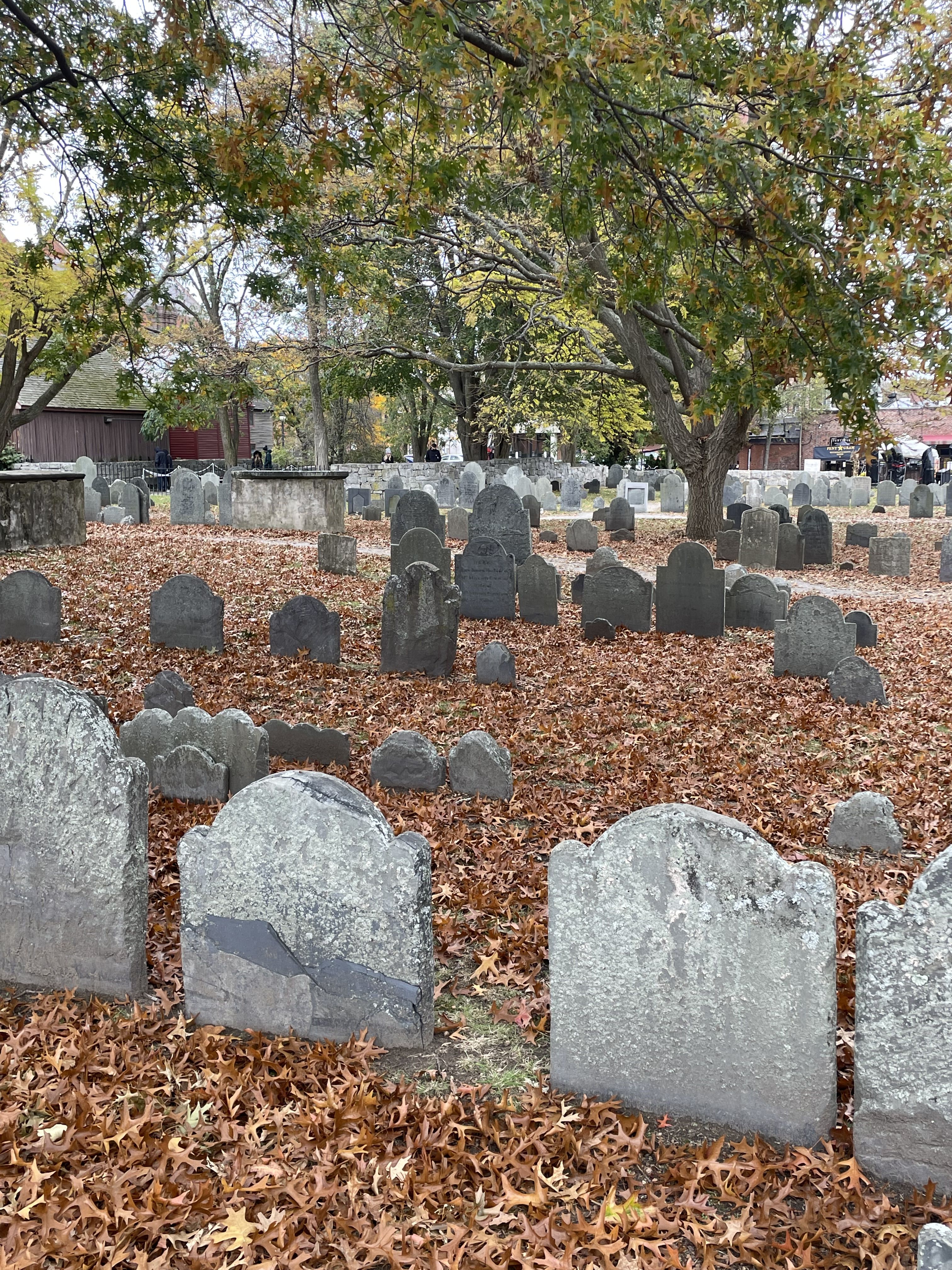
At Old Burying Point in Salem, Massachusetts, one grave gets photographed more than any other. It belongs to John Hathorne, a magistrate of the 1692 witch trials, and the story goes that a dark figure sometimes turns up in the pictures people take of it.
Hathorne sentenced the accused, and he never apologized for it. He died on May 10, 1717, at 76, and his headstone, set into a granite block on the left side of the cemetery to preserve the original stone, still reads "Here lyes interred ye body of Co John Hathorne Esq." His own descendant couldn't live with the name. The author Nathaniel Hawthorne added a "w" to distance himself, and wrote that his ancestor "made himself so conspicuous in the martyrdom of the witches, that their blood may fairly be said to have left a stain upon him."
Here is the strange part. A few feet from Hathorne's grave stands the Salem Witch Trials Memorial, dedicated in 1992. Twenty granite benches reach inward from a low wall, one for each person executed in 1692, each etched with a name and a means of death. Black locust trees grow on the grounds, the species thought to have supplied the gallows. The threshold stones carry the victims' own words, carved where you cross into the memorial: "God knows I am innocent." "On my dying day, I am no witch." The judge who condemned them rests in sight of the benches that honor them.
None of the executed lie here. Denied Christian burial, their bodies were taken by families or left near the gallows. The cemetery, established in 1637 and the oldest in Salem, holds the other side of the story instead. Hathorne is here. So is fellow magistrate Bartholomew Gedney, in his red sandstone tomb, and Simon Bradstreet, the old governor who spoke out against the trials. Around them lie people with no part in 1692 at all, among them Richard More, the only Mayflower passenger buried in Salem, and Samuel McIntire, the woodcarver whose work still shapes the city's old houses. A single yard holding both halves of the trials, settled in among colonial neighbors.
People report voices across the grounds, sudden fog, cold spots, shapes that surface in photographs. The attention always drifts back to the same stone. The man who sent the accused to die has the most-visited grave in the cemetery, a few steps from the wall built to remember them, and the only figure anyone catches there keeps appearing beside his name.