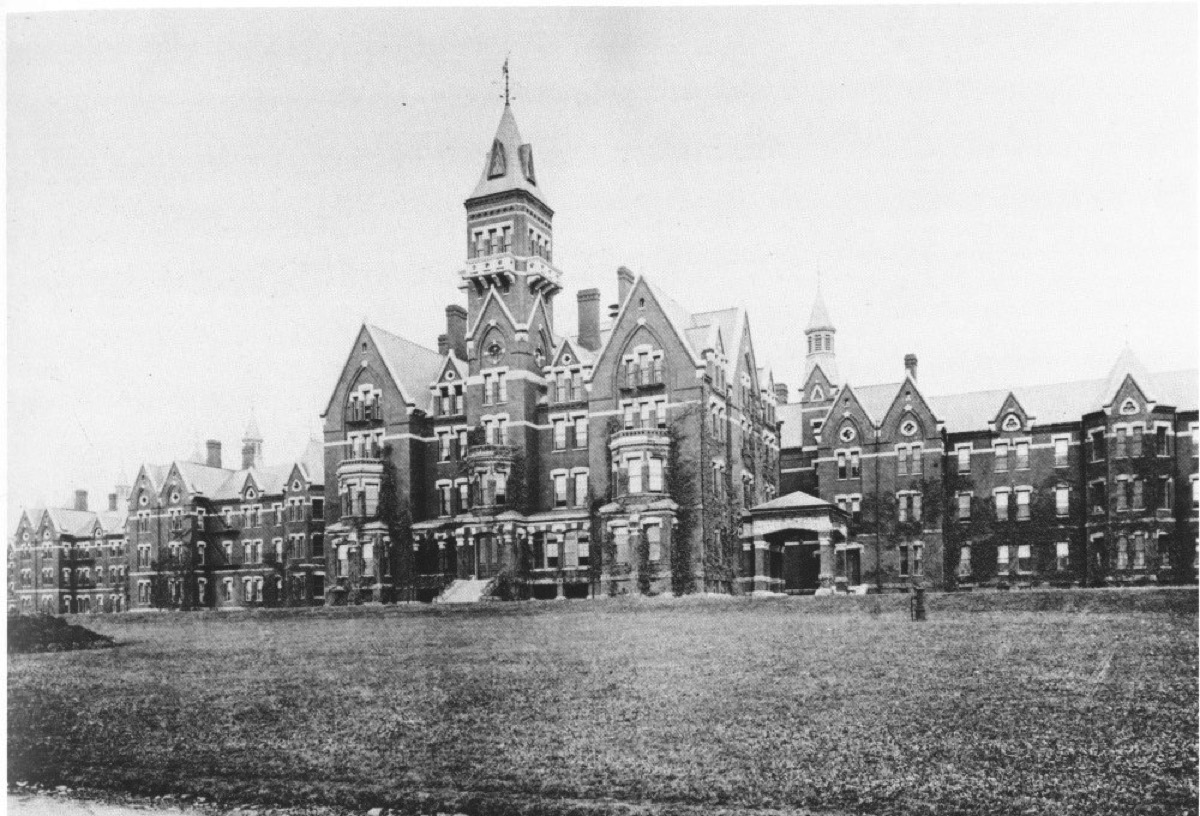
Danvers State Hospital sat on a hill in Danvers, Massachusetts, built to heal the mentally ill and ending as a name people whispered: Hell House on the Hill. An administrator's daughter who lived on the grounds says a scowling old woman watched her family from the attic.
Danvers State Hospital crowned a hill in Danvers, Massachusetts, and one of the people who lived there as a child says it was never quiet. Jeralyn Levasseur, daughter of a hospital administrator whose family had quarters on the grounds, tells it plainly: a scowling old woman the children kept seeing in the attic, bedcovers pulled clean off her bed in the night, footsteps in the second-floor halls, doors opening on no one. She says she never felt she was in real danger. She just felt watched.
The building was supposed to be the opposite of all that. It opened in 1878 on the Kirkbride Plan, a Victorian theory that sunlight, fresh air, and a beautiful building could cure mental illness. The architect gave it a 1,100-foot Gothic front of red brick, eight wings fanning off a central tower, and locals called it the castle on the hill.
Then it filled past anything it was built for. Designed for around 450 to 500 patients, it held 2,360 by 1939. That same year, 278 people died inside it. The first lobotomy came in 1948, shock therapy in the 1950s, and the building that was meant to be the most humane in Massachusetts collected darker names instead: the witches' castle, and finally Hell House on the Hill. It carried a reputation as a birthplace of the lobotomy too, though the procedure was invented elsewhere and Danvers was only where it got heavy, visible use.
The hill carried weight before the hospital ever did. The land had belonged to the Hathorne family, whose son John Hathorne was the unrepentant judge who sent accused witches to the gallows in Salem in 1692. Even the architecture seems to have spread its shadow outward. The Gothic pile and its underground tunnels may have been the model for the asylum in H.P. Lovecraft's stories, which in turn gave Batman's Arkham its name.
When it closed in 1992 and sat empty, it pulled in urban explorers, and the film "Session 9" was shot inside the real wards. "It was always scary," actor David Caruso said of filming there, "and you could really feel the pain of the people that were at Danvers."
Two cemeteries on the grounds hold around 770 graves. For decades the markers carried only numbers, no names, hospital policy born of the shame attached to madness. In 1997 a woman named Pat Deegan found the main cemetery overgrown and abandoned, and the people who came after her spent years putting names back on the dead. They built to cure people, then buried them as digits.