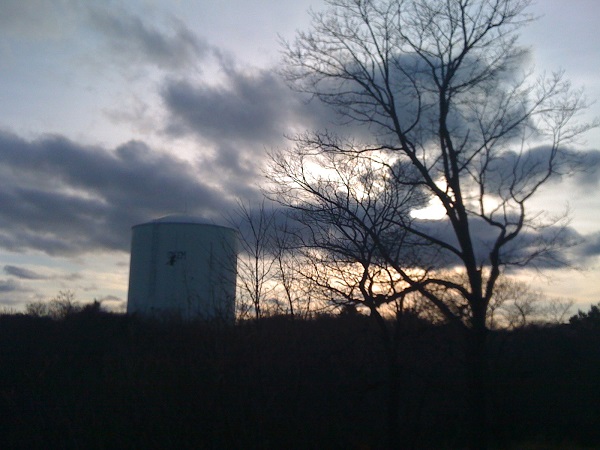
Gallows Hill Park in Salem, Massachusetts is a city park with a baseball diamond and a witch painted on the water tower. For three centuries it was thought to be where the 1692 witches hanged. In 2016 historians proved otherwise. The hauntings stayed put anyway.
Gallows Hill Park in Salem, Massachusetts has a baseball diamond, a playground, and a water tower painted with a witch on a broomstick at the top of the hill. For more than three centuries the city believed this hilltop was where nineteen people were hanged during the 1692 witch trials. Visitors come up here and, the story goes, burst into tears at the gate, or wake the neighbors with knocking at night, or catch a woman in white flickering among the trees before she's gone.
Then historians moved the executions.
In January 2016 the Gallows Hill Project announced the hangings hadn't happened on the summit at all. The team traced the mistake to 1867, when a historian named Charles Wentworth Upham picked the hilltop as the probable spot while admitting he had no evidence for it. Two facts ruled it out: the summit was too steep for a cart, and no waterway reached it. That mattered, because one of Rebecca Nurse's sons was said to have rowed her body home along the river. The real site sat a quarter-mile downhill, at a rocky shelf called Proctor's Ledge, between Proctor Street and Pope Street, where the North River once pooled at the base.
There was never a gallows. The condemned were hanged from a tree, most likely a black locust, and their bodies thrown into shallow crevices in the rock without coffins. The first to die was Bridget Bishop, on June 10. Nineteen followed over the summer, among them Rebecca Nurse, Reverend George Burroughs, and John Proctor. The last eight were hanged September 22, one of them Margaret Scott, about 76 and among the oldest to die.
Proctor's Ledge got a memorial in 2017: nineteen names cut into granite, set in a semicircle around a single oak. The history packed up and moved downhill.
The reputation never did. Back in October 1992, on the 300th anniversary of the trials, around 200 people from area churches climbed the hill and laid hands on the water tower to cleanse it. Before the program even started, a circle of roughly 100 raised their arms and chanted, "The curse over Salem with witchcraft is broken." They were standing on the wrong ground, and the curse they came to break had never been there.
The hauntings stayed too. People still report the same waves of dread on the park grounds, the same shrieking from the woods after dark, the same woman in white who appears for a moment and vanishes. None of it is corroborated past the people who keep telling it. The ghosts had the wrong address for three hundred years, and when somebody finally corrected the record, they didn't follow it downhill.