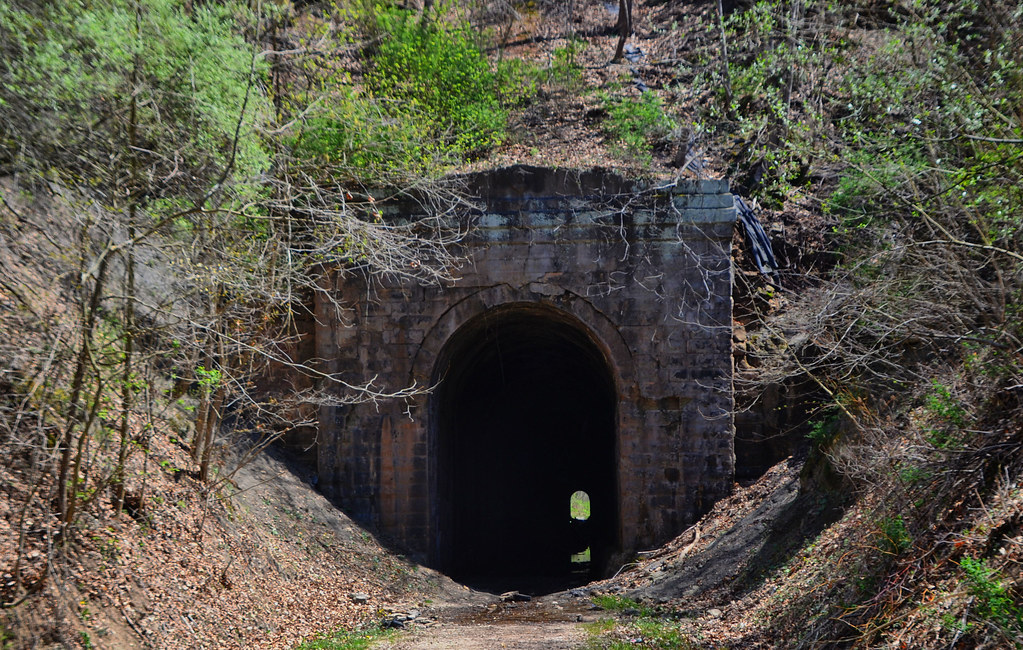
The Flinderation Tunnel, a 1,086-foot railroad bore outside Salem, West Virginia, is full of voices. Walkers report children laughing, sobbing, two phrases repeated over and over, and a phantom train running on rails that came up in 1988.
The Flinderation Tunnel is a 1,086-foot railroad bore cut under a hillside outside Salem, West Virginia, and the people who walk through it keep coming out with the same two phrases. "Help me." "Quit pushing." Investigators who have spent nights inside report children giggling somewhere ahead in the dark, sobbing, metal scraping along the walls, footsteps with nobody attached to them, and flashlight batteries that quit halfway through.
The bore is brick-lined, and set into its walls at intervals are recessed manholes, alcoves deep enough for a man to press himself into while a train went past.
The voices are older than the trail. In 1927 a reporter for the Sandusky Star Journal picked up the tunnel's story and wrote about a man who heard people talking inside the bore and followed the sound to one of those wall alcoves. Certain he would find someone tucked in there, he struck a match and looked in. West Virginia Haunts and Legends, which reproduces the account, says the alcove was empty.
Digging started at Brandy Gap in August 1852, for a line meant to carry rail traffic between Grafton and Parkersburg. Brandy Gap Tunnel No. 2 is the official name; Flinderation comes from the road outside. On a Saturday that January, the work killed a man, and the notice ran in Cooper's Clarksburg Register:
"Killed. A man named Hanley, was killed at the Brandy Gap Tunnel on last Saturday, by a quantity of earth falling on him. He was taken to Fairmont, on Monday, for interment. Two other men were seriously injured."
No source has ever turned up his first name.
The story people tell in the tunnel is a different one. A three-man track crew was working inside the bore when a whistle sounded. The engineer had no idea they were down there, and two of the men could not reach the alcoves in time. The collision and the unfinished rail work put the locomotive off the tracks. Paranormal investigators trace those two repeated phrases back to that wreck, and Clio's entry on the tunnel notes that engineers afterward "religiously wanted to avoid" the stretch of line.
There is no record of any of it. "Despite in-depth research from several independent parties," writes Theresa's Haunted History of the Tri-State, "there doesn't seem to be any record of a train derailment or even a death."
The rails came up in September 1988. The bore is a walking path now, part of the North Bend Rail Trail, and people still report a train in there, wheel clatter and a whistle.
A WDTV crew went out on October 4, 2019. A boy named Jacoby Magruder told the reporter it was not that scary, that the hauntings were "just lies that people say." Along the edges of the trail, the crew found roses, and popped red balloons.