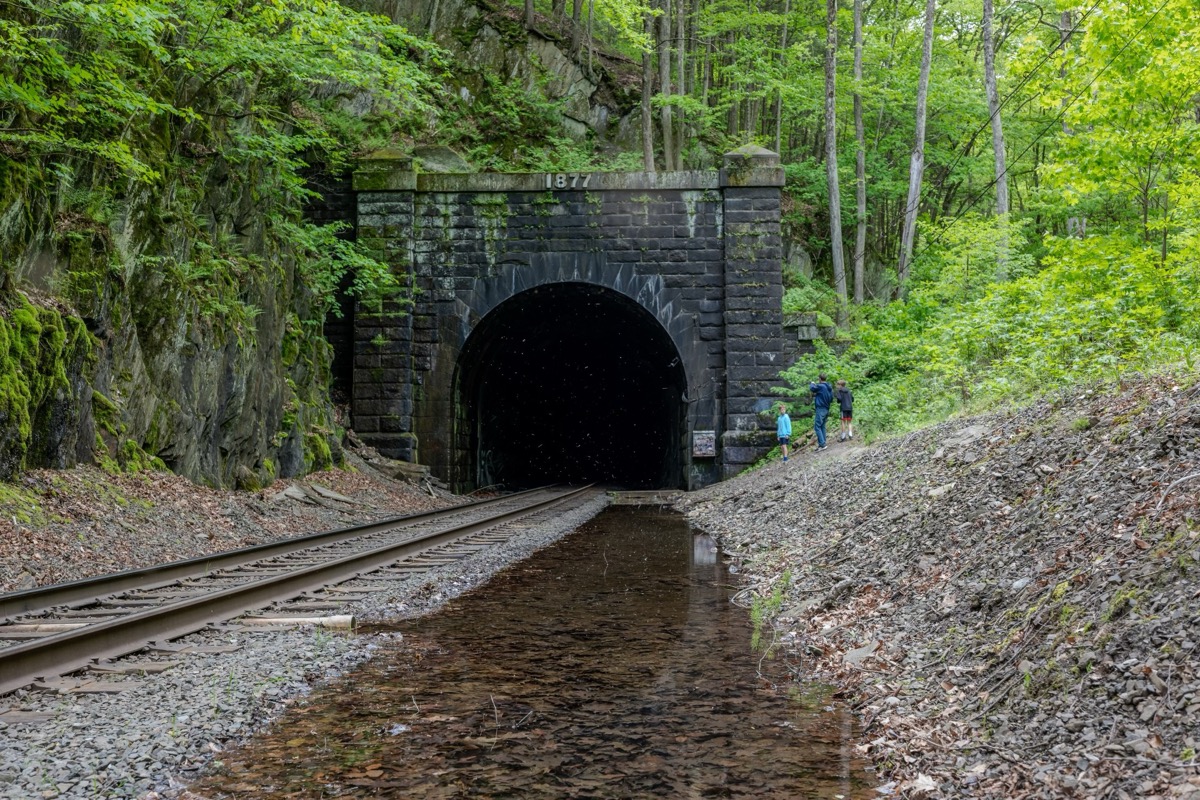
The Hoosac Tunnel cuts 4.75 miles through the Berkshires near North Adams, Massachusetts. Workers called it the Bloody Pit. One of them killed two men with an early blast, disappeared, then turned up strangled deep inside — at the exact spot they died.
The Hoosac Tunnel runs almost five miles through the Berkshires of western Massachusetts, from the Deerfield River at Florida to the city of North Adams. The men who bored it called it the Bloody Pit, and they had reason to. The story that froze them in place is about one of their own.
On March 20, 1865, three explosives men were setting a nitroglycerin charge inside the tunnel: Ned Brinkman, Billy Nash, and Ringo Kelley. Kelley set it off before the other two could reach cover. Brinkman and Nash were crushed under tons of rock. Kelley vanished that day, and no one found him for nearly a year.
Then, in late March 1866, his body turned up two miles deep inside the tunnel. He'd been strangled, and he was lying at the exact spot where Brinkman and Nash had died. The deputy sheriff fixed the time of death between midnight and 3:30 a.m. There was no suspect, no weapon, nothing. The workers had already decided who did it. The ghosts of Brinkman and Nash, the story went, had come back to settle the account.
The deaths kept coming. Construction ran 24 years and killed roughly 195 men, by black powder, by the new and volatile nitroglycerin, by cave-ins, falls, fire, and flood. The worst day came on October 17, 1867. A candle in the hoist building ignited fumes from a gas lamp, and the blast rained debris and rigging down on 13 men working far below. When the pumps were destroyed, the shaft began to flood. It took more than a year to pump it out and recover them. The rescuers found something they hadn't braced for: several of the men had survived the blast long enough to lash together a crude raft, trying to stay above the rising water, before they suffocated in the dark.
After that, the Hoosac kept collecting stories. In September 1868 an engineer named Paul Travers went in at 9 p.m. with another man to chase workers' reports of a voice crying out in agony. By the ghost-lore accounts, Travers wrote his sister that the two of them heard "what truly sounded like a man groaning out in pain," and that he had not been that frightened since Shiloh. A few years later, the same lineage of accounts has a doctor named Owen and a drilling superintendent named McKinstrey watching a dim light in the tunnel that "took on a strange blue color and appeared to change in shape into the form of a human being with no head."
The tunnel is still an active freight route. Trains run through it on no fixed schedule, and the clearance is narrow enough that there's no room to step aside for one coming the other way.