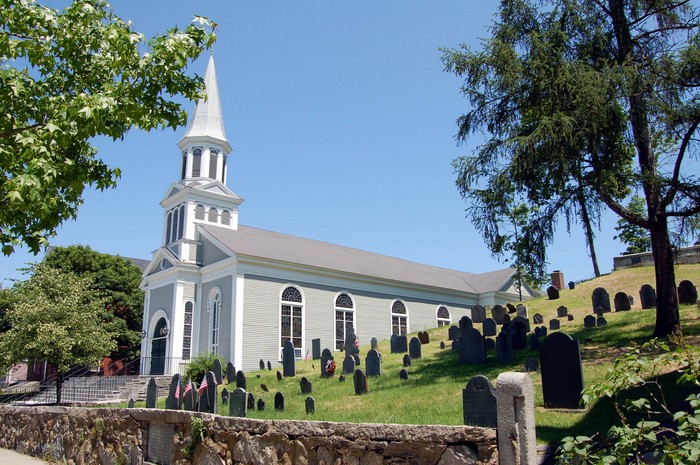
Old Hill Burying Ground in Concord, Massachusetts is the town's oldest graveyard, and one slate marker there is carved with a skull. Visitors keep reporting that real eyes appear inside the empty sockets and follow them along the slope.
On the hillside above Concord, Massachusetts, in the oldest graveyard in town, there's a slate marker carved with a skull. People call it the Skull Tombstone. The inscription speaks of bowing to the king of terror, and visitors keep reporting the same thing: real eyes appear inside the death's-head's empty sockets, and they follow you as you move along the row.
Nobody in the reachable record can say whose grave it marks.
The ground it sits in is among the earliest in Massachusetts. Concord's settlers laid out the Old Hill Burying Ground beside their first meetinghouse around 1636, on a south-facing ridge just off Monument Square. They chose the slope because the soil was too poor to farm and the sun thawed it first in spring. For roughly the first 40 years, they buried their dead with no markers at all, afraid that visible graves would tell raiders how many colonists had died. The oldest stone still standing belongs to Joseph Merriam, who died on April 20, 1677, at 47.
Nearly 500 graves crowd the hill now, carved with winged angel-of-death faces and skulls flanked by crossed swords. Among the dozens of Revolutionary men buried here is Major John Buttrick, who gave the order to fire on the British at the North Bridge on April 19, 1775.
And one stone here outscandaled every ghost. It belongs to John Jack, born in Africa around 1713, enslaved to a Concord shoemaker, who bought his own freedom and died a landowner in 1773. His epitaph was written by a loyalist lawyer named Daniel Bliss, and it opens: "God wills us free, man wills us slaves."
It goes on. "Tho' born in a land of slavery, He was born free. Tho' he lived in a land of liberty, He lived a slave." During a march through Concord in 1775, the same spring as the fighting at the North Bridge, British soldiers copied the lines down and sent them home. The verse crossed the ocean and ran in London papers, held up to mock the colonists who demanded liberty while they kept men in bondage.
Vandals smashed the original stone around the late 1810s. It has been replaced more than once since.
Ghost-tour guides add a presence said to creep between the graves at dusk, unnamed, tied to no one in any record. But the thing people come back describing is quieter. It's the skull on John Jack's hill, watching the living with eyes it was never carved to have.