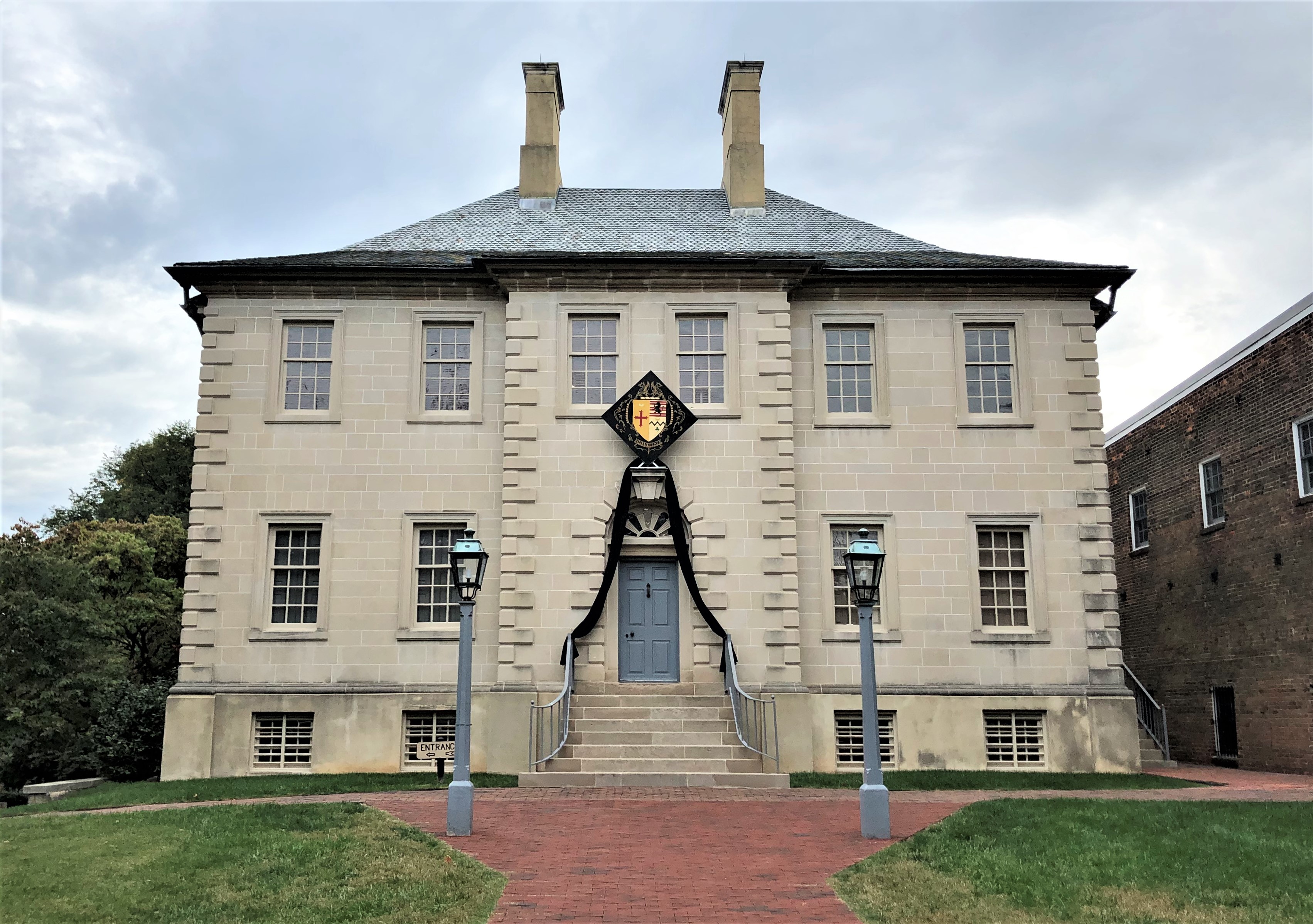
A mummified cat is sealed inside the chimney at Carlyle House in Alexandria, walled up to keep witches out of the flue. It's still in there.
In the 1970s, stone mason Jon Battista was restoring the chimney foundation at Carlyle House when he opened a sealed stone alcove and found a cat. Mummified. Sprinkled with herbs. Deliberately placed inside the wall by the people who built the house in 1753.
This wasn't a stray that wandered in and died. It's a Scottish folk charm, walled up by the builders to keep witches from coming down the flue. John Carlyle, the merchant who commissioned the place, was Scottish. He knew exactly what was in his walls.
After Battista documented the cat, it went back into the alcove. It's still there. The museum runs a thorough tour covering the Georgian architecture, the Braddock meeting, the Civil War years, all of it. The one thing they can't actually show you is the cat in the chimney.
The witch charm wasn't the only one. The archaeology collection holds a wine-bottle cork stuck with three wire-wrapped pins, the specific configuration used to seal witch bottles that were buried under hearths to redirect curses back at whoever sent them. Somebody in this house was worried enough about supernatural attack to commit at least two pieces of folk protection to the structure.
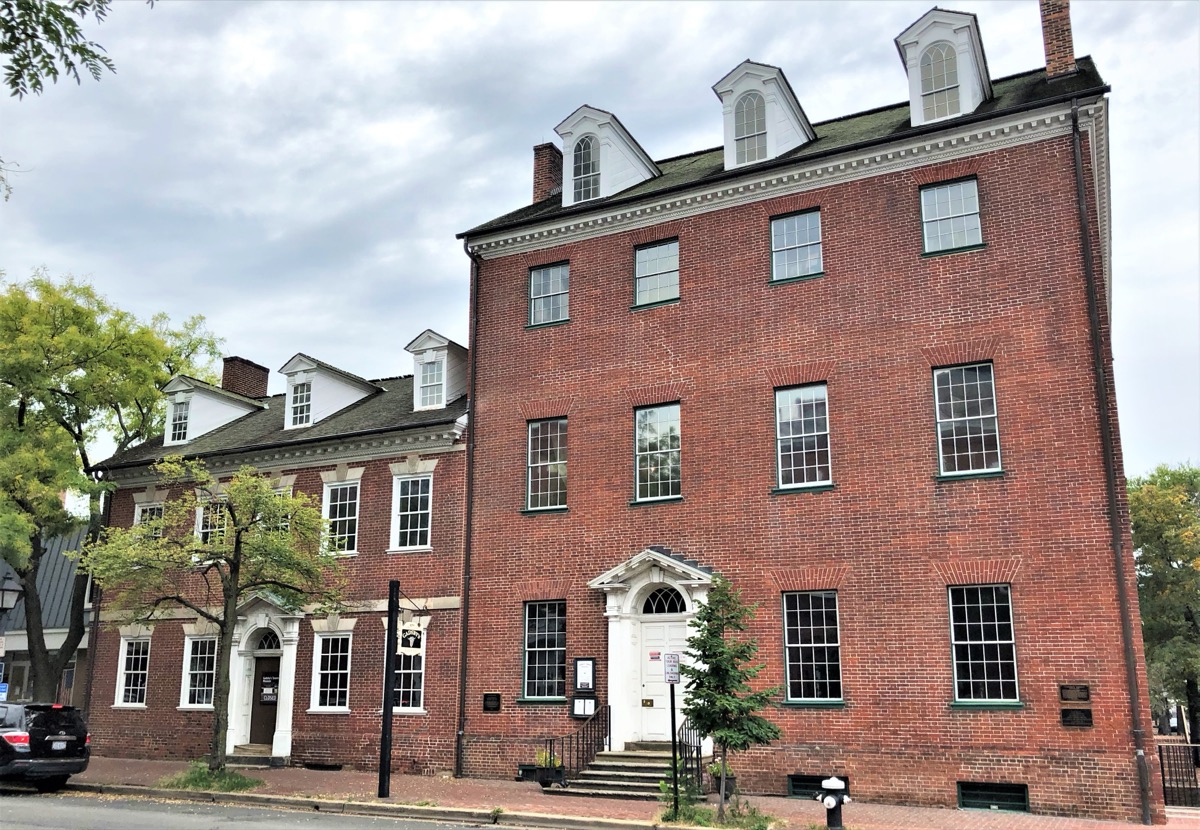
Carlyle himself is worth a paragraph. Born in 1720 to a landed British family with Scottish ties, he arrived in Virginia in 1741 as a factor for the merchant William Hicks. By 1749 he was a founding trustee of the new town of Alexandria. He bought lots 41 and 42 at the July 1749 auction and finished the stone Georgian Palladian mansion in 1753. It's still the only stone 18th-century Palladian-style residence in Alexandria. The design pulls from compact Georgian manor houses of Scotland, hipped roof, twin chimneys, a family crest above the door. Austere in a way that announces wealth without performing it.
The Congress of Alexandria happened in the dining room. April 15, 1755. Major General Edward Braddock met with five colonial governors, Robert Dinwiddie of Virginia, Horatio Sharpe of Maryland, Robert Hunter Morris of Pennsylvania, William Shirley of Massachusetts, and James DeLancey of New York, to plan the British campaign against the French. The governors refused to fund the campaign directly and told Braddock that Parliament would have to authorize any taxes first. Historians sometimes mark that conversation as an opening crack in the road to revolution, which is a lot of weight for one dining room in Alexandria.
Carlyle later wrote that it was "the Grandest Congress held at My home ever known on This Continent." Braddock and his aides used the house as campaign headquarters for roughly three weeks, from late March through April 1755. Ghost-tour guides like to claim Carlyle was furious about how Braddock treated the place, but the specific letter that gets quoted on tours doesn't appear in the museum's published correspondence, so I'll let that go.
Carlyle had two wives. He married Sarah Fairfax, daughter of William Fairfax, on December 31, 1747. Sarah died January 22, 1761. Roughly nine months later, on October 22, 1761, he married Sybil West. Of their children, only one, George William Carlyle, survived to adolescence. George William was killed at age fifteen on September 8, 1781, at the Battle of Eutaw Springs in the Revolutionary War. His father had died the previous October, on October 17, 1780, in the upstairs right-hand bedroom of the house. He didn't live to hear the news from South Carolina.
That bedroom is cited as the most active interior spot in the building. Photos taken there at night get passed around showing a figure standing in the window. There's no named investigation behind any of it, and the museum doesn't offer much commentary, so the bedroom story stays in ghost-tour territory.
The interior ghost most often named is Sybil. Ghost tour guides put her in the garden behind the house, screaming at night. There's an Alexandria ghost-lore tradition, attributed to J.J. Smith's 2009 book on haunted Northern Virginia, that Sybil burned Sarah's possessions in the basement after the second marriage. That story only shows up in tour write-ups of the book, not in any primary documentary source. Take it as folklore.
The more interesting ghosts at Carlyle House aren't actually in the house. They're on the front lawn, and they fell from a building that no longer exists.
By the late 1850s, furniture merchant James Green had built the Mansion House Hotel directly in front of Carlyle's manor, eventually obscuring the entire west facade. The hotel kept growing. On December 1, 1861, after Union troops evicted Green that November, it opened as Mansion House Hospital at 121 N. Fairfax Street, with around 500 beds and a capacity of up to 700. The PBS series "Mercy Street," which ran for two seasons in 2016 and 2017, was inspired by what happened there. The Carlyle mansion itself was used as quarters for doctors and officers.
Three documented falls happened from the hotel windows. A Union soldier convalescing after Fredericksburg jumped in December 1862, in what's described as a feverish hallucination. Samuel Markell fell in 1905. Twenty-year-old Pat Buckley fell in 1912. Michael Lee Pope's "Ghosts of Alexandria" gathered the three of them into the "Falling Ghosts" tradition.
The hotel was demolished in early 1973 to restore Carlyle House and open the park. Now the apparitions are described as falling onto open lawn, because what they fell from is gone. Visitors on the lawn at night describe their clothes being tugged, a hand on the shoulder, the usual catalog. I haven't found a named witness on the record for any of it.
NOVA Parks (then NVRPA) acquired the property in 1970. Carlyle House reopened to the public on January 23, 1976, as part of the Bicentennial. It's listed on the Virginia Landmarks Register (May 13, 1969) and the National Register of Historic Places (November 12, 1969). The Congress of Alexandria gets reenacted every year in the dining room where it happened.
In 2005 the museum hung a Halloween exhibit on Carlyle-era mourning customs and put a coffin in that same dining room. The curator, talking about the cat in the wall, the mirror-draping tradition, and Carlyle's parallel interest in Enlightenment science, told Connection Newspapers: "We can see that Carlyle had his feet in two worlds."