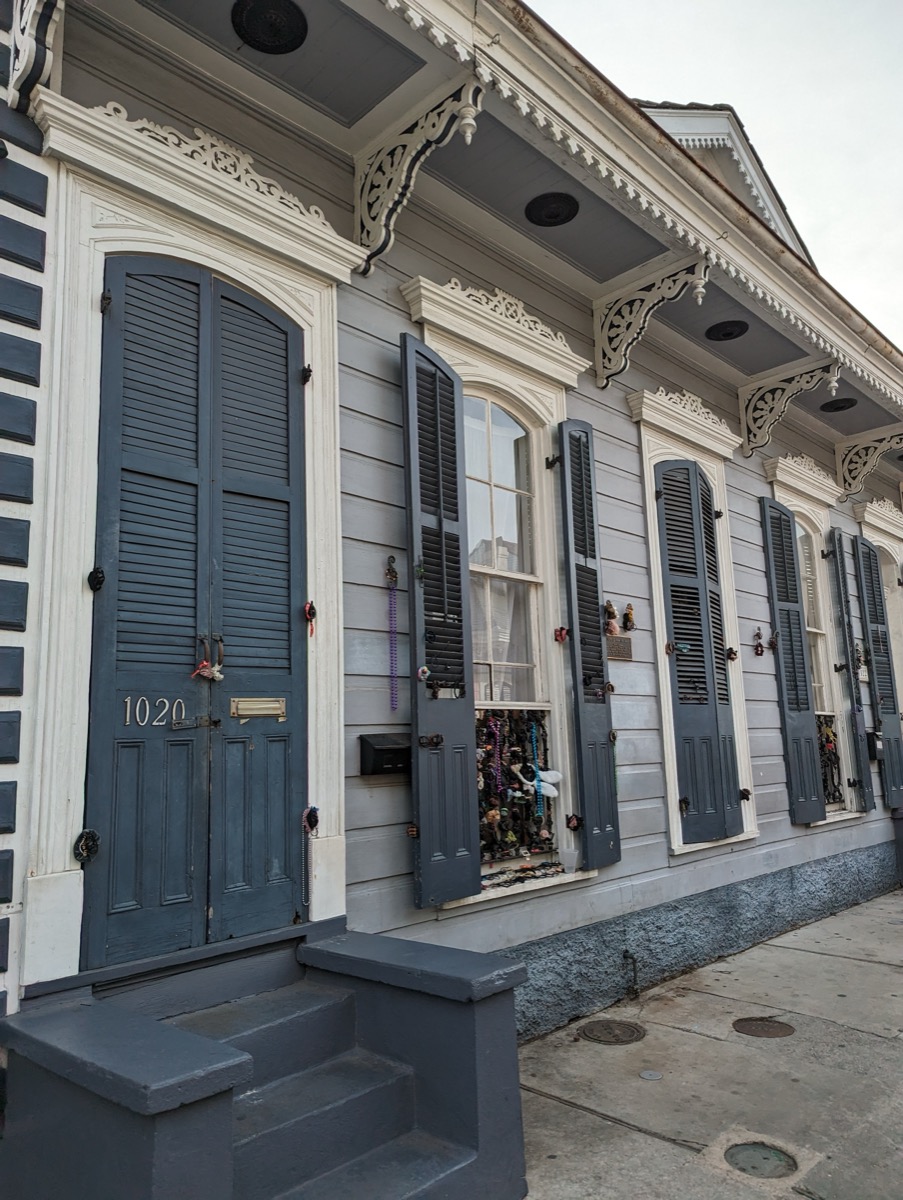
The house at 1020 St. Ann Street in New Orleans is where Marie Laveau actually lived and died, not the Bourbon Street shop that borrows her name. Guests have woken to chanting from the locked living room, and found a single feather on the floor.
The house at 1020 St. Ann Street in New Orleans is the one people get wrong. The shop on Bourbon Street with Marie Laveau's name over the door isn't where she lived. This is. A creole cottage in the French Quarter, blue shutters, the door numbered 1020, beads hung on the slats by visitors who still come to leave them.
A vacationing couple who rented the place woke one night to chanting and drumming. The husband traced it to the living room, where every window was locked and nothing was inside. In the morning they found a single pristine feather lying on the floor. Other guests report a shadow standing in a corner, glaring. A tap on the shoulder with no one behind them. On the sidewalk out front, passersby tell of a woman in a long white dress and a tignon, the turban headdress Laveau always wore.
She was real, and most of her life is on record. Born in 1801, a free woman of color and a Louisiana Creole, she worked as a hairdresser for wealthy families, an herbalist, a midwife, a devout Catholic, and a Voodoo priestess. Her grandmother bought this lot in 1798, and three generations of women lived here. People interviewed decades later for the Federal Writers' Project remembered her altars crowded with saints and effigies, and remembered her taking in orphans and sheltering Choctaw vendors. She held services here, at Congo Square, and out at Lake Pontchartrain. She died in this house in 1881, at 79, and was buried across the Quarter in the Glapion family crypt at St. Louis Cemetery No. 1.
The tomb drew its own ritual. Visitors marked three X's on the stone, turned around three times, knocked, and called out a wish. So many came, scrawling and offering, that the Archdiocese closed the cemetery to general tourists in 2015 after the marking and pink latex paint damaged her grave. The faithful had been wearing down her resting place. The house, all the while, kept giving people reasons to think she hadn't quite left it.
The original cottage was torn down in 1903, and a new house went up on the same foundation in the early twentieth century. That continuity is the whole of the haunting. Believers hold that the ground itself kept her.
Early on May 19, 2025, fire broke out in the kitchen. Crews had it out by 6:31 that morning. The rear half was gutted, the floors soot-black, the family photos melted. The house next door at 1022 was untouched. "Every voodoo tour in the Vieux Carre stops in front of the site," a guide who lives nearby said afterward. The site she meant was the place that burned.