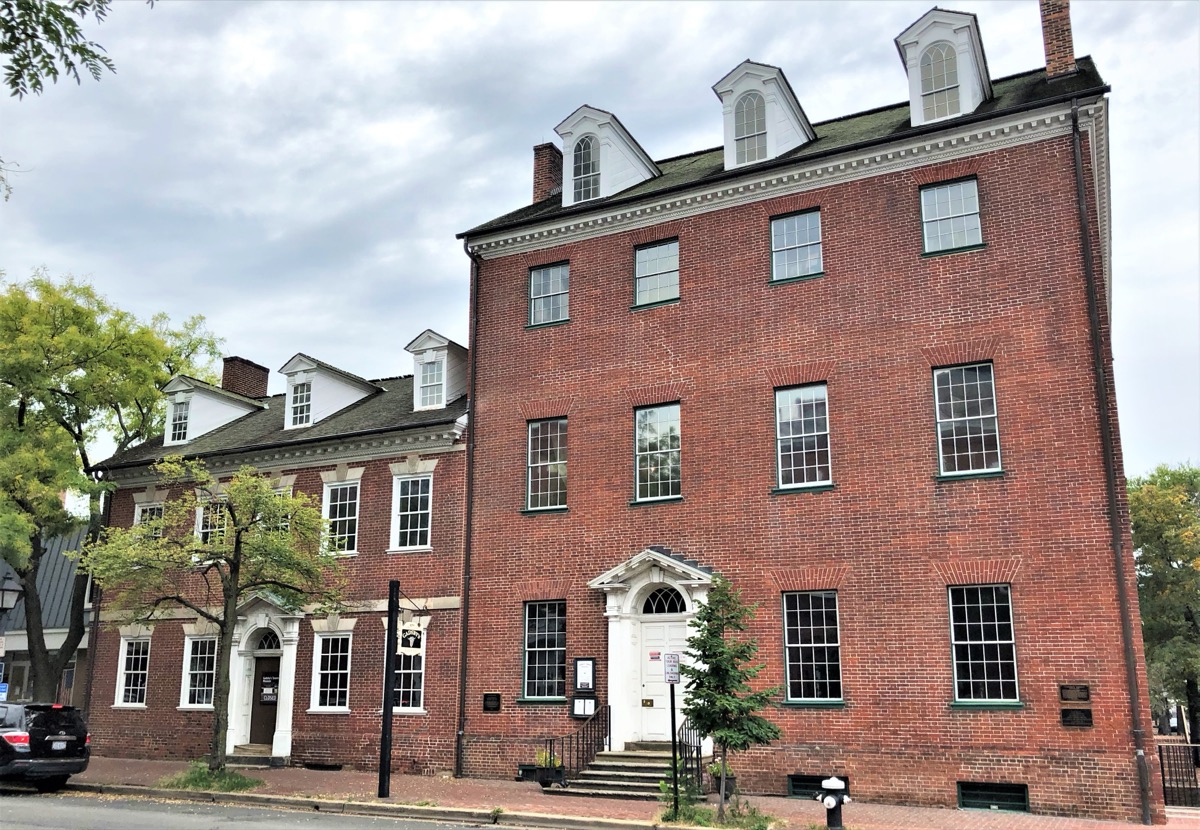
The Female Stranger died at Gadsby's Tavern in 1816. Nobody knows her name. People still see her in the window of Room 8.
Walk into St. Paul's Episcopal Cemetery in Alexandria and you'll find what might be the strangest gravestone in America. It reads, in part: "To the memory of a FEMALE STRANGER whose mortal sufferings terminated on the 14th day of October 1816. Aged 23 years and 8 months." No name. No hometown. No family. Just a date, an age, and a husband who paid the entire $1,500 bill at Gadsby's Tavern with a Bank of England note that turned out to be a forgery, then vanished.
Everyone comes to 134 North Royal Street to hear that ghost story.
She arrived in Alexandria in September 1816 from the West Indies. She was already sick when she got off the boat, and her husband took rooms at the City Tavern, the larger of the two buildings that make up the Gadsby's complex on the corner of Royal and Cameron. By October 14 she was dead. Dr. Samuel Richards treated her. The nurse who sat with her, Elizabeth Tretcher Steuart, later described her as "young, refined, and strikingly beautiful." Before she died, the husband swore the doctor and nurse to secrecy about who she was. They kept the promise. So did he. He prepared the body himself, sealed the coffin so no one could view her, attended the funeral, paid every cent owed, and then left town with the valet and the maid. The note he paid with was counterfeit. The grave was already in the ground.
The room she died in is known as Room 8. The museum identifies it that way and so do the ghost-story retellings, though the 1816 newspapers don't actually use a room number. Call it Room 8 anyway. The door says so now, and people keep saying they see her in it.
What gets reported most often is simple. A veiled woman in the second-story window, visible from Royal Street, gone when you look again. Cold spots in the East Bedchamber. Crying when no one's there. Museum Director Liz Williams has shared one witness account in particular: a man at a ballroom party followed a figure into the East Bedchamber. She vanished. He found a single lit candle in a room that had been empty and dark a minute before.
The Female Stranger is the headliner, but she isn't the only person who died here. On June 28, 1808, the celebrated English-American actress Anne Brunton Merry Wignell Warren died at Gadsby's at age 39, four days after delivering a stillborn son. She's buried at Christ Church in Alexandria, not at St. Paul's. The tavern was a real hotel in a real city, and real people died in its rooms.
It was also the social center of the early republic, which is the part that makes the ghost story land harder. George Washington attended Birthnight Balls in the ballroom in 1798 and 1799, the last two of his life. Thomas Jefferson hosted his inaugural banquet there in 1801. John Adams, James Madison, James Monroe, and the Marquis de Lafayette all came through; Lafayette stopped in during his grand 1824 tour. John Gadsby, the English tavernkeeper who gave the place its name, leased the City Tavern from owner John Wise in 1796 and ran both buildings until 1808, when he left for Baltimore.
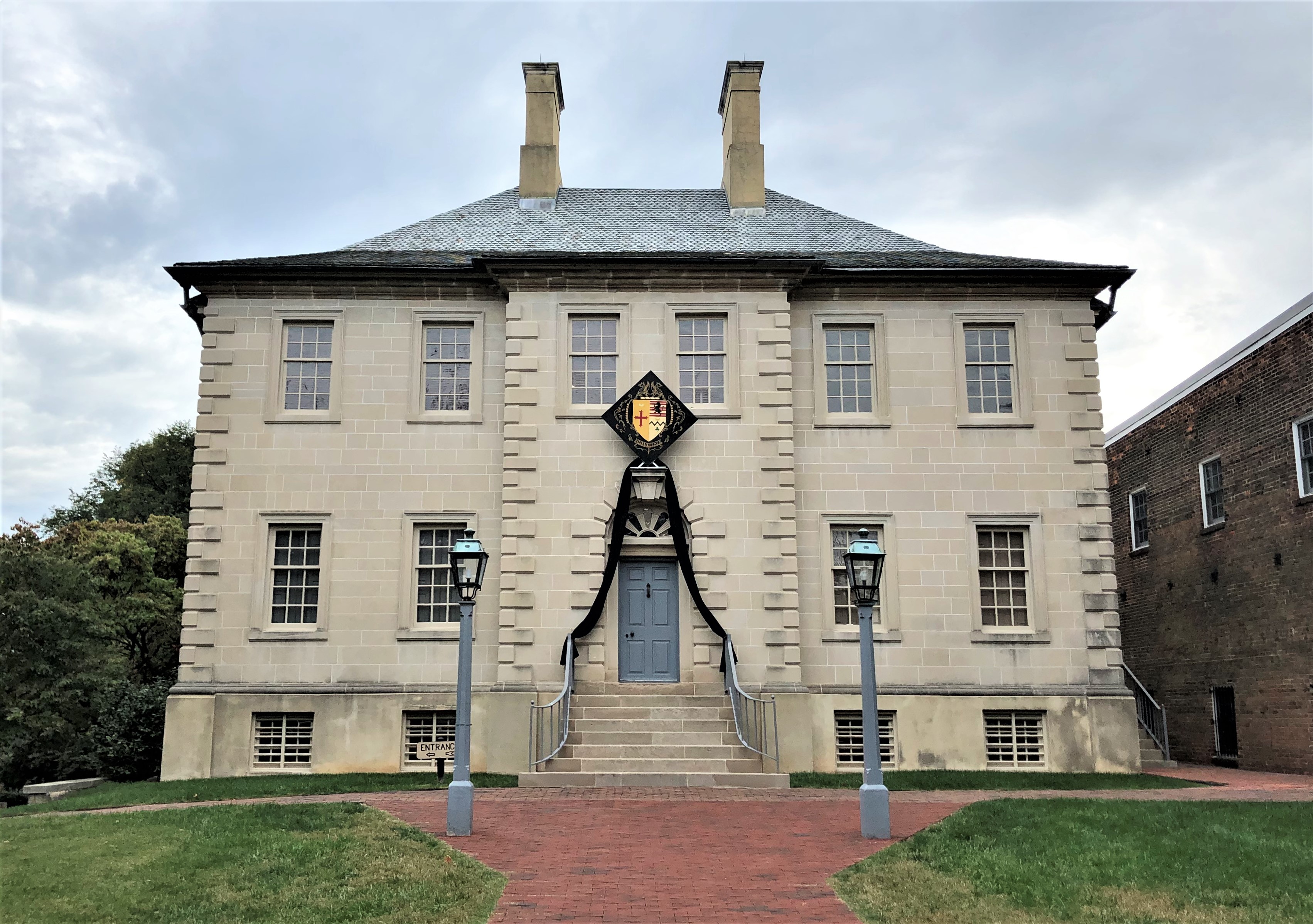
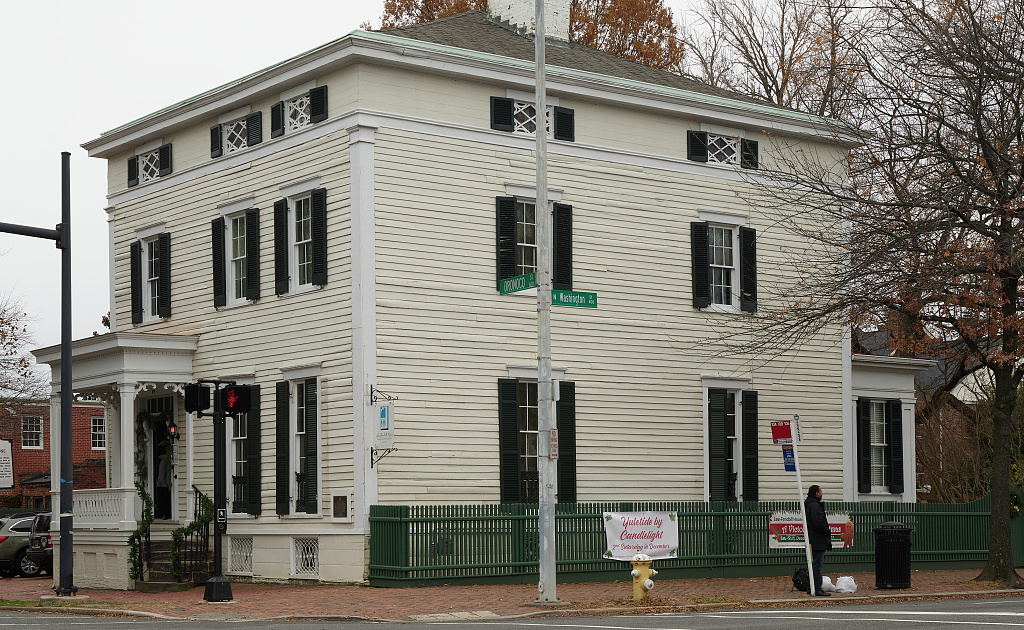
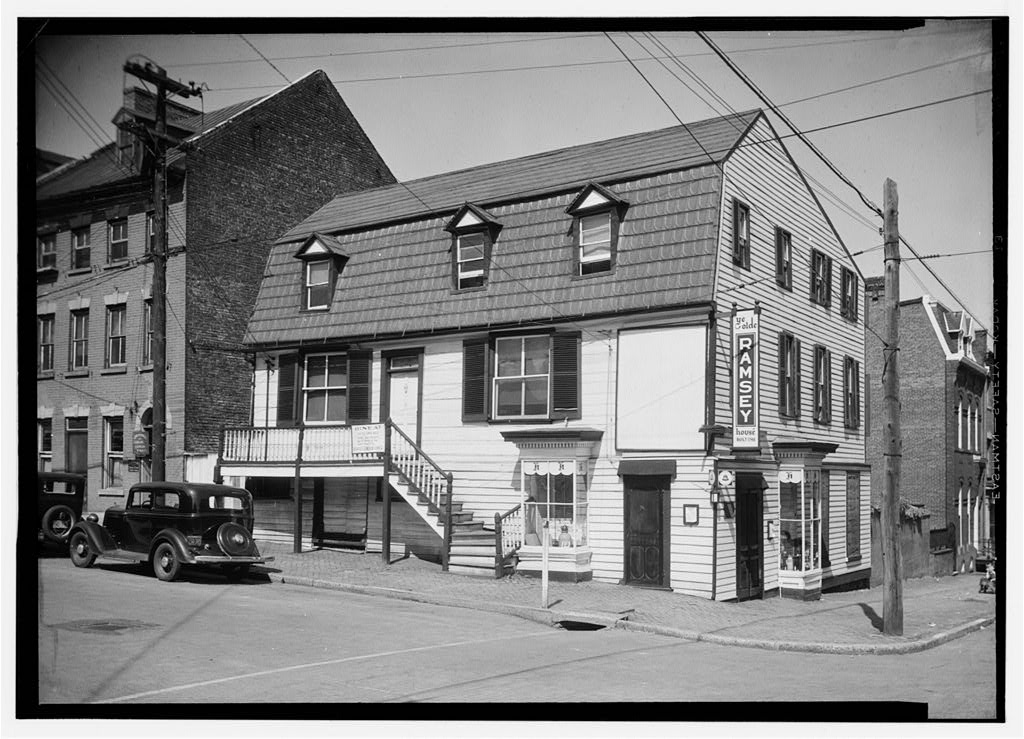
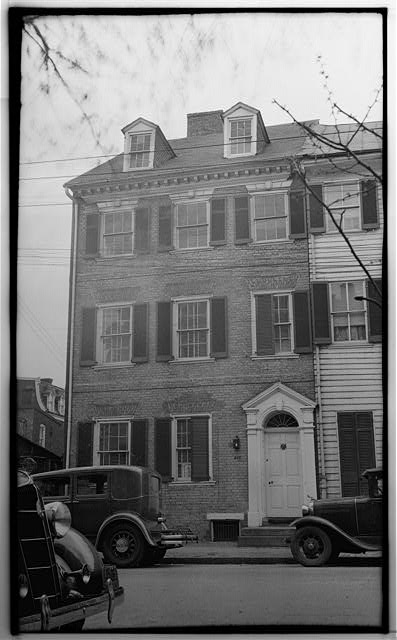
The older of the two buildings dates to about 1785, when Wise built a Georgian tavern on a plot he'd bought three years earlier. The larger Federal-style City Tavern and Hotel went up in 1792. Both are still standing on the corner where they started. The complex was named a National Historic Landmark on November 4, 1963, and added to the National Register on October 15, 1966.
Here's the strange epilogue. In 1917 the Metropolitan Museum of Art bought the entire ballroom. Not a piece of it. The whole thing. The musicians' gallery, the cornice, the doorframes, the mantelpieces. They acquired it on May 21 of that year, and on November 11, 1924, they unveiled it in the American Wing as the "Alexandria Ballroom." It's still there. If you stand in the reconstructed ballroom inside Gadsby's today, the woodwork around you is a careful reproduction. The room where Washington danced his last birthday ball lives in midtown Manhattan.
The original woodwork is in New York. The Female Stranger is still on Royal Street.
The City of Alexandria restored the complex in the 1970s and now runs Gadsby's Tavern Museum out of the buildings. A separate restaurant operates in the 1792 dining room. Every October, around the anniversary of her death, the museum hosts a "Death at the City Hotel" event. Port City Brewing puts out a black IPA called Long Black Veil in her honor. The story has become a small local industry, and the museum has leaned into it, which is the right call. The mystery doesn't shrink under attention; it only deepens.
People have tried for two centuries to figure out who she was. Theodosia Burr Alston, Aaron Burr's daughter, lost at sea in 1813? Probably not. The dates don't work. An illegitimate daughter of Alexander Hamilton from the Reynolds affair? A con artist's wife? One account claims the husband was later spotted by an Alexandria resident inside Sing Sing prison. Another says he died around the 1830s, when whoever had been paying for upkeep of the grave stopped paying. None of it sticks. The husband was good at what he did. Nobody has ever cracked it.
The monument was re-cut in November 1930 by the Society for the Preservation of Virginia Antiquities, so the stone you see now is fresh enough to read clearly. The full epitaph runs longer than the famous opening, and the last line is a reference to Acts 10:43. Worth reading on the grave itself if you're in Alexandria. Two lines down from "Female Stranger," the carving reads: "This stone is placed here by her disconsolate Husband in whose arms she sighed out her latest breath."