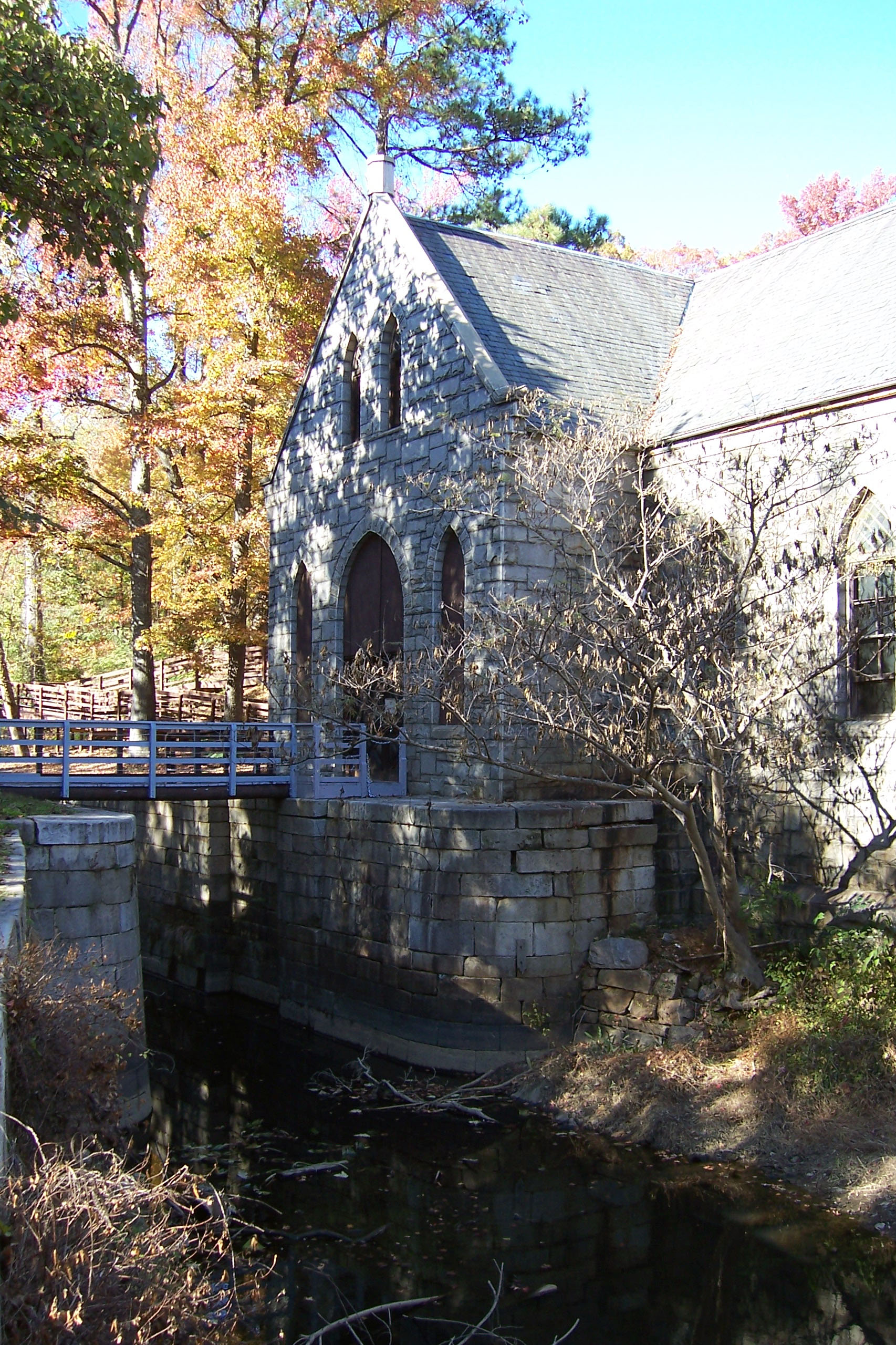
The Friends of Pump House say Byrd Park Pump House isn't haunted. A paranormal investigator with a Tesla-coil booth disagrees.
The people who spend the most time inside the Byrd Park Pump House say it isn't haunted. Their FAQ is blunt about it: "Is the building haunted? As best we can tell, no, and we spend a lot of time there! We are aware of stories floating around on the internet stating otherwise, but we have been unable to find any evidence of such in our research, and have never experienced it directly ourselves."
The Friends of Pump House, a nonprofit founded in 2017 by Joe Costello, wrote that. They run events inside the building. They oversee the restoration. They know the place better than anyone alive.
Robert Bess disagrees.
Bess holds a physics degree, founded the Foundation for Paranormal Research, appeared on Travel Channel's Ghost Adventures, and on March 8, 2010 wheeled a Plexiglas booth on wheels with a Tesla coil at its center into the Pump House. He called it the Parabot. A smoke machine pumped fog around it. Alarms sounded when the doors closed. He named the event "3 Mile Lock Experiment, Conquest," drew a crowd, and afterward claimed the activity inside was so intense it overloaded his equipment.
Ghost Theory covered the demonstration in real time and was less impressed: "His methods are questionable along with his character and the Parabot is a remote controlled platform of entertainment, designed to be more of a showpiece than a tool."
A Gothic Revival waterworks where the custodians say no and the showman says yes.
The Pump House itself is worth the visit even if you skip the ghost angle entirely. Col. Wilfred Emory Cutshaw designed it. Cutshaw was Richmond's city engineer from 1873 to 1907, a Confederate artillery officer who'd been shot in the knee at First Battle of Winchester in 1862 and lost a leg to amputation after Battle of Sailor's Creek. Robert E. Lee personally recommended him for the city engineer job. He came to the Pump House project missing a leg, with the architectural ambition of someone building a cathedral.
What he produced is granite, with a steeply pitched slate roof, projecting gables, Gothic arches, and lancet windows. Construction ran 1881 to 1883, and operations began May 4, 1883. The building pumped roughly 12 million gallons of water per day from the James River and Kanawha Canal up to the Byrd Park Reservoir. Boring half over.
The interesting half is what Cutshaw put on the second floor: an open-air ballroom. The pumps churned below; Richmonders danced above. Historic Richmond calls it one of the only buildings in the country designed and used as both a public utilities building and a social hall. Well-dressed guests would board a flat-bottomed canal boat at Seventh Street and ride the Kanawha Canal up to the Pump House for dances. Wikipedia says the boats were mule-drawn. Friends of Pump House just calls them flat-bottomed. Pick your level of romance.
The dance hall got enclosed in 1899, which left twenty-five years of operations during which the building was both pumping the city's water and hosting parties. The pumps quit August 31, 1924, replaced by a flat-roofed stucco electric-pump building next door. That newer building, the one nobody photographs, still supplies city water today.
The old iron pumps and metalworks were sold for scrap in the lead-up to World War II. (Some accounts say specifically to Japan in the 1930s. That specificity isn't well-corroborated, so file it under maybe.)
Richmond slated the Pump House for demolition in the 1950s. First Presbyterian Church bought it for $1 in 1956 to save it. The property later reverted to the city. It landed on the Virginia Landmarks Register September 11, 2002 and the National Register of Historic Places November 21, 2002, NRHP #02001366. Two senators, Mark Warner and Tim Kaine, secured $500,000 in federal funds in the December 2022 omnibus. Historic Richmond matched it. The Friends of Pump House completed a roughly $150,000 lower-floor window restoration, and the city is now lining up a $2.1 to $2.2 million slate-roof project. Current indoor capacity is 25 people. Hard hats are mandatory during events.
Now back to the ghosts, because the story is the story.
The named entities come almost entirely from Robert Bess's 2009-2010 publicity cycle and the lore sites that came after. The first is Daniel Tetweiler, said to have hanged himself inside the building. No newspaper archive, no city death record, no contemporaneous account confirms a Tetweiler suicide at the Pump House. The name appears in lore sites that cite each other. Treat it as legend, not history. The second is Elizabeth, described as a floating orb of light. The third is "Spectra," a woman in white. Bess told RVA Ghosts that twenty-three different spiritual groups travel within Spectra's aura. That claim lives or dies entirely on whether you find Bess credible.
His theory for why the building is active: the combination of running water, steel, slate roofing, and iron creates a conductor that acts as a portal. Convenient that the building also happens to be Gothic and photogenic, but the materials check out.
There's one more story worth flagging, with a hedge. RVA Ghosts tells of a volunteer who descended into the machine room because workers upstairs were hearing voices from below. The flashlight died on the way down. The voices stopped. The light came back on once he was back upstairs. No witness is named. No date is given. It appears on one site and the sites that repeat it. File it next to Tetweiler.
What's actually verifiable about the Pump House is more interesting than what isn't. A one-legged Confederate engineer built a Gothic cathedral to push water uphill and put a dance floor on top of it. Victorians rode canal boats to it in formal wear. The city tried to tear it down and a Presbyterian church bought it for a dollar to save it. Every October the Friends host "Poe at the Pump House," where Edgar Allan Poe impersonators read ghost stories inside the granite shell.
The custodians' position remains: "We have been unable to find any evidence of such in our research, and have never experienced it directly ourselves."