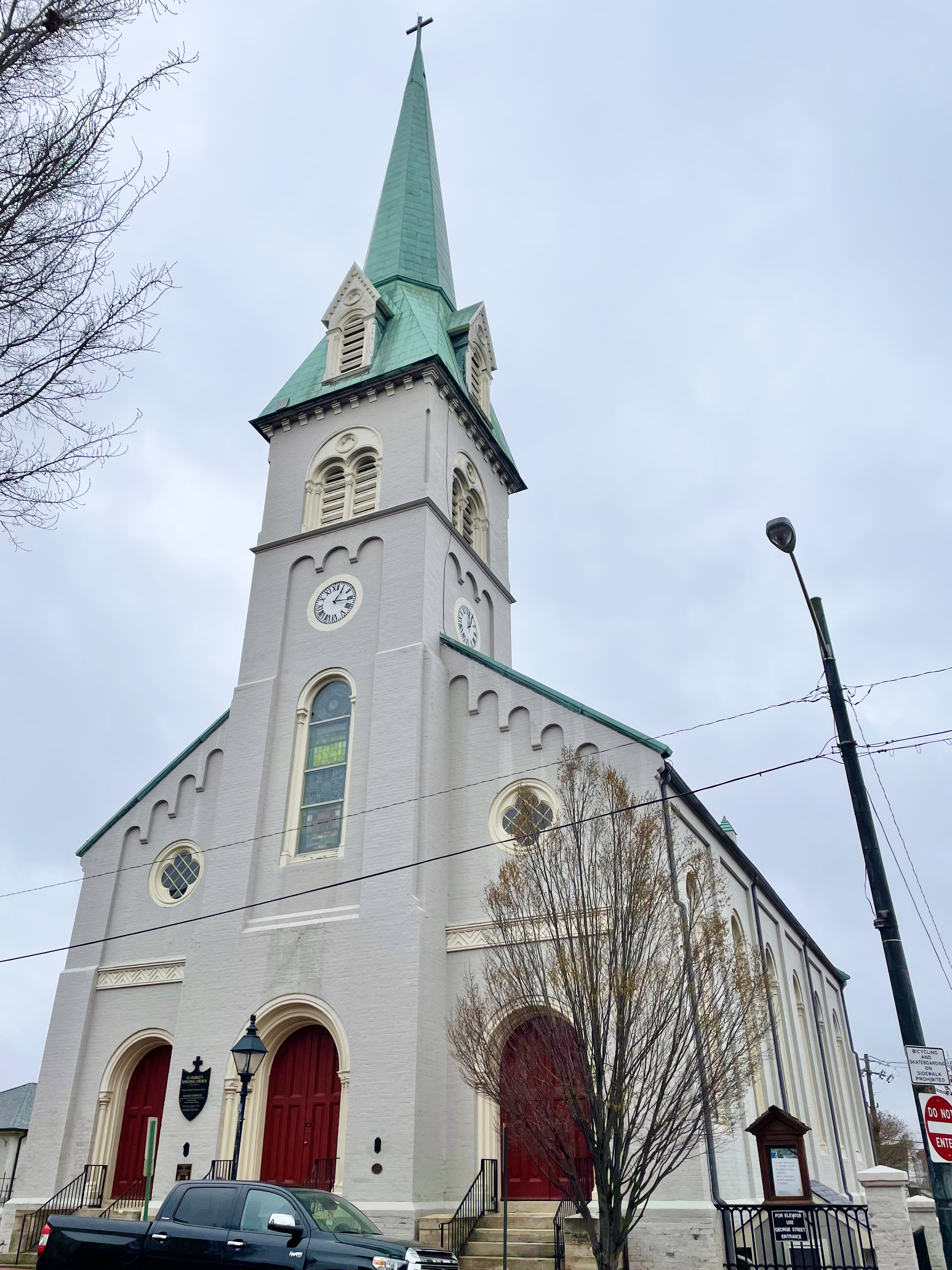
A veiled woman at the altar rail, footsteps in a locked sanctuary, and police K-9s that refuse the balcony door. St. George's, Fredericksburg.
In 1858, seventeen-year-old Ella McCarty climbed to the choir loft for practice and looked down into the empty vestibule. A veiled woman in white was kneeling at the altar rail. The woman rose, met Ella's eyes with what Ella later described as a "sad expression," and disappeared. Her companion Marshall Hall and the organist were elsewhere in the building. Ella was alone in the loft. L. B. Taylor, in *The Ghosts of Fredericksburg*, called the apparition the "Gentle Ghost," and the name has stuck because, unlike almost every other figure tied to this church, she has never seemed to want anything from the living.
St. George's has been at 905 Princess Anne Street, in one form or another, since 1720, when the Virginia House of Burgesses established the parish on November 18. The current sanctuary is the third on the lot. A wooden church from 1735 gave way to a brick one in 1815, and the 1815 building was replaced by what stands now: a Romanesque Revival church consecrated April 22, 1849, designed by Baltimore architect Robert Cary Long, Jr., and built for $19,000. It is, per the Virginia Department of Historic Resources, the only Romanesque church Long built in Virginia. The clock in the steeple has kept Fredericksburg's city time since 1851.
That clock almost didn't survive the Civil War.
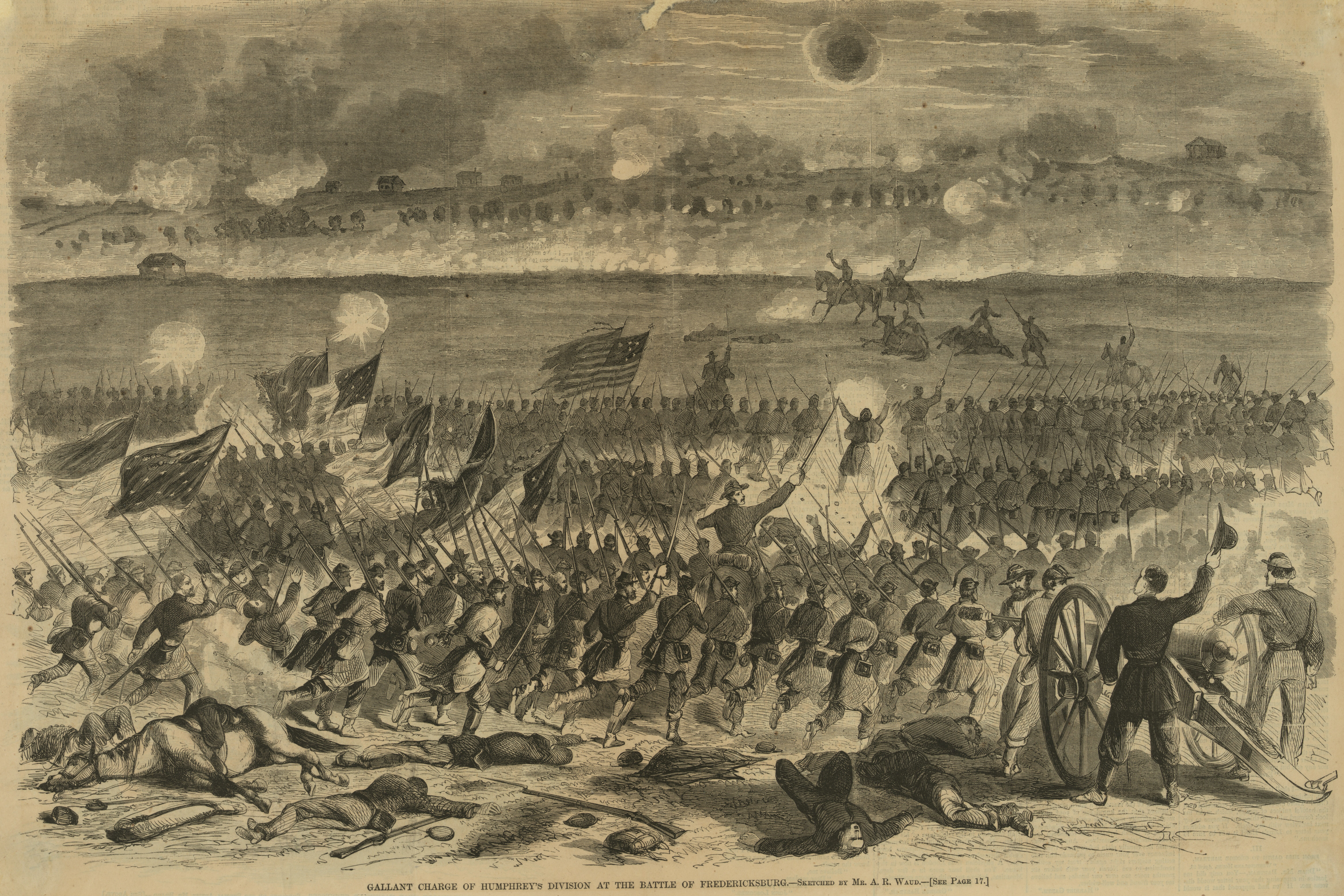
On December 11, 1862, Confederate sharpshooters from the 17th Mississippi and other units climbed into the steeple and fired down George Street at advancing Union troops. Federal artillery answered. The parish's own history says the church was hit by shellfire at least 25 times between December 11 and December 15. The London Times, in a January 23, 1863 dispatch, reported that on the day of the bombardment St. George's "escaped with one" round-shot hole while the nearby Baptist church was "rent by a dozen great holes." Both accounts can be true. The Times was reporting one day; the parish is counting the whole battle week. A Union artillery officer, by his own later admission, set out to destroy the clock and stopped. He said he "experienced such a change of feeling that nothing could have induced him to harm it." The clock is still running.
After the December 13 fighting, the church became the brigade hospital for the Irish Brigade. Major General St. Clair Augustin Mulholland of the Pennsylvania 116th Regiment wrote of the lecture room, today called Sydnor Hall: "eight operating tables were in full blast, the floor was densely packed with men whose limbs were crushed, fractured and torn." A soldier on the night of December 13 saw the dead "piled on either side as high as the top step of church." In May 1864, after the Battle of the Wilderness sent 10,000 to 15,000 wounded into Fredericksburg, St. George's took the overflow again. Federal troops also stole the church's sterling silver communion service that December. All four pieces were eventually recovered. The last one came home in 1931, sixty-nine years after it left.
So this is the building. A parish older than the country, a sanctuary that has been a sharpshooter nest and an amputation theater, a graveyard from 1728 holding Colonel John Dandridge (Martha Washington's father, grave #114) and William Paul (John Paul Jones's brother, buried in 1774, grave #14) and Confederate dead. It would be strange if nobody saw anything.
The witnesses who keep coming back are local cops. Mark Nesbitt's *Civil War Ghost Trails* (2012) reports that police K-9s "are especially nervous inside and outside of the church," and that the dogs react hardest at one specific spot: the door to the balcony. Not a generic "the church is scary." The balcony door. Officers also lock the sanctuary doors at night, return an hour later, and find them unlocked. They hear footsteps in the empty nave and pew benches creaking as if someone were settling in. One officer told Nesbitt: "There aren't too many police officers who haven't had an experience in St. George's."
The clergy don't argue. Rev. Charles Sydnor, who served as assistant rector from November 1, 1973, became rector in 1976, and retired May 1, 2003, kept his account dry. "I never had a run in with a ghost," he said, "but occasionally one of the pew doors would pop open with no one near." Elizabeth Roberson, who was secretary at St. George's for 37 years (1959 to 1996), had a sharper story. She was in the chancel before a funeral, alone with the casket, when she heard the deceased, a man whose voice she recognized in life, begin to speak to her. She ran to the rector's office. Rev. Faulkner's response, per her oral history: "I reckon I'd better go over there and see what else he wants to say." Roberson also blamed Hattie Tackett, a devoted member who died in 1933, for hymn-board numbers that kept falling off on their own.
Some accounts go further. Ghost-tour copy mentions pews turned over and a red room that appears and then isn't there, and there's a theory that the Lady in White is Betty Lewis, sister of George Washington, drawn back to her husband Colonel Fielding Lewis. None of that holds up against parish records. The graveyard's own historians say Fielding Lewis "likely rests in Clarke County," not under the steps at St. George's, and the Lady has no documented name. Taylor never tried to give her one. Better to let her keep the mystery than tape someone else's identity onto her.
Three Tiffany Studios windows went in between 1912 and 1917: *Road to Emmaus* in 1912, *Angel Standing in a Field of Lilies* in 1914, and *Angel of Victory / Guardian of Medical Science* in 1917. The church was added to the Virginia Landmarks Register on June 21, 2018 and the National Register of Historic Places on March 19, 2019. The graveyard, which holds the earliest documented burial from 1752, remains the oldest in Fredericksburg.
Go in the late afternoon if you can, when the Tiffany glass is throwing color across the nave and the steeple clock is ticking out the same minutes it has been ticking since 1851. Then look up at the choir loft, where Ella McCarty stood at seventeen, and down at the altar rail, where the veiled woman knelt. They are still where she left them.