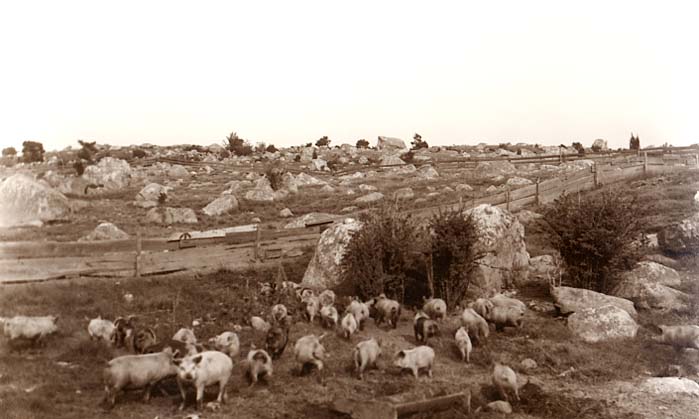
Dogtown Common

Dogtown Common

👻 other

Gloucester, Massachusetts · Est. 1693

About This Location

An abandoned colonial settlement in the woods of Cape Ann. The village was deserted by the early 19th century after many residents died or left. Only cellar holes and stone foundations remain, along with boulders carved with inspirational messages in the 1930s.

👻

The Ghost Story

Deep in the woods of Cape Ann, where massive glacial boulders rise like monuments to forgotten gods, lies the remains of a village that Massachusetts tried to forget. Dogtown Common was once home to 80 prosperous families. Today it is 3,600 acres of tangled forest, crumbling cellar holes, and something darker—a place so saturated with tragedy that author Elyssa East described it as having "an unusual vibe or aura... a haunted feeling."

The settlement began in 1693, when colonists fled five miles inland to escape pirates and hostile raids. They called it the Common Settlement, and for sixty years it thrived. By the 1750s, it housed 20% of Gloucester's population. Farmers raised cattle among the ancient boulders, built sturdy stone walls that still stand today, and carved out a life in soil too poor for crops.

Then the threats from the sea diminished. After the War of 1812, new coastal roads bypassed the inland village entirely. Families moved to the booming harbor. Their abandoned houses fell to squatters, vagabonds, and the desperately poor. War widows, their husbands lost at sea, kept packs of dogs for protection and company. When these last inhabitants died, their dogs went feral, howling through the moors at night. The village earned a new name: Dogtown.

But it was the women who gave Dogtown its darkest reputation.

Thomazine "Tammy" Younger was known as the "Queen of the Witches." From her house on Fox Hill near Alewife Brook, she entertained "buccaneers and lawless men," made rum and butter, held card games, and read fortunes. Locals claimed she could bewitch oxen—commanding them to halt on the bridge near her house until their owners paid her a toll in fish or corn. A 1921 New York Times article attributed "a large number of lost hikers in Dogtown to the alleged witches' evil power" and claimed "occasionally a distinct cackle can be heard coming from the woods."

Tammy's aunt, Luce George, allegedly cursed the wood on passing carts. Peg Wasson was accused of flying on a broomstick disguised as a black crow; legend holds that soldiers shot her with a silver button, and a matching button was later extracted from her injured leg. Molly Stevens, Judy Rhines, Molly Jacobs—all bore the witch's mark in the eyes of their neighbors.

Were they really witches? Scholar Elyssa East notes they were likely healers or social outcasts—"destitute" women "accused of licentiousness and of possessing unusual, if not supernatural, power." Roger Babson, the Gloucester millionaire who later preserved the site, saw them differently: "Tammy had great courage and apparently remarkable executive ability... Today these same people would be leaders in political gatherings, labor movements, and various reforms."

By 1828, the village was abandoned. The last resident was Cornelius "Black Neil" Finson, a freedman found in 1830 living in a cellar hole, his feet frozen, wrapped in rags and half dead. He was taken to the poorhouse and died shortly after. Hikers today report seeing his ragged apparition sitting by the trails, staring at passersby before vanishing if approached.

The last house was torn down in 1845, but Dogtown's horrors were not finished.

On June 25, 1984, Anne Natti, a 39-year-old teacher, set off on a shortcut through Dogtown to visit a friend in Rockport. She was an avid hiker who walked through rain or shine. That day, Peter Hodgkins Jr., a known sex offender, crushed her skull with a rock and dragged her body from the trail. Her husband Erik found her that evening, led to her resting place by their dog. Hodgkins was convicted of first-degree murder and sentenced to life without parole.

The murder reinforced what locals had always sensed: something malevolent lives in Dogtown. East, who spent years researching the area, frequently describes Hodgkins as "a disturbed, impressionable vehicle for Dogtown's malevolent spirit, which possessed him and made him do its bidding."

Strange sightings continue. On March 17, 1984—just months before the murder—a Boston resident reported a gigantic animal roaming the cliffs near Dogtown, possibly a mountain lion, though officials insist none live on Cape Ann. Four days later, a deer was found torn apart but not eaten, and that same night two people saw "a gray monstrous dog-like animal" running into the woods.

Today, visitors walk trails marked by cellar holes where the witches once lived and massive boulders carved with inspirational messages—"Courage," "Help Mother," "Never Try/Never Win"—commissioned by Roger Babson during the Great Depression. The terrain is treacherous; old foundations give way underfoot, and many report the area to be disorienting, as if the land itself wants them lost.

The cackle still echoes through the woods, they say. And Black Neil still sits by the trail, waiting.

Researched from 8 verified sources including historical records, local archives, and paranormal research organizations. Learn about our research process.

More Haunted Places in Gloucester

Hammond Castle

Hammond Castle

mansion

More Haunted Places in Massachusetts

🪦

Burial Hill

Plymouth

🪦

Spider Gates Cemetery

Leicester

🪦

Copp's Hill Burying Ground

Boston

🏚️

Lizzie Borden House

Fall River

🏚️

The Wayside

Concord

👻

Boston Common

Boston

View all haunted places in Massachusetts

More Haunted Others Across America

Point Sur Lighthouse

Big Sur, California

Ghost Tree (17-Mile Drive)

Pebble Beach, California

The Exorcist House

Bel-Nor, Missouri

Hales Bar Dam

Guild, Tennessee