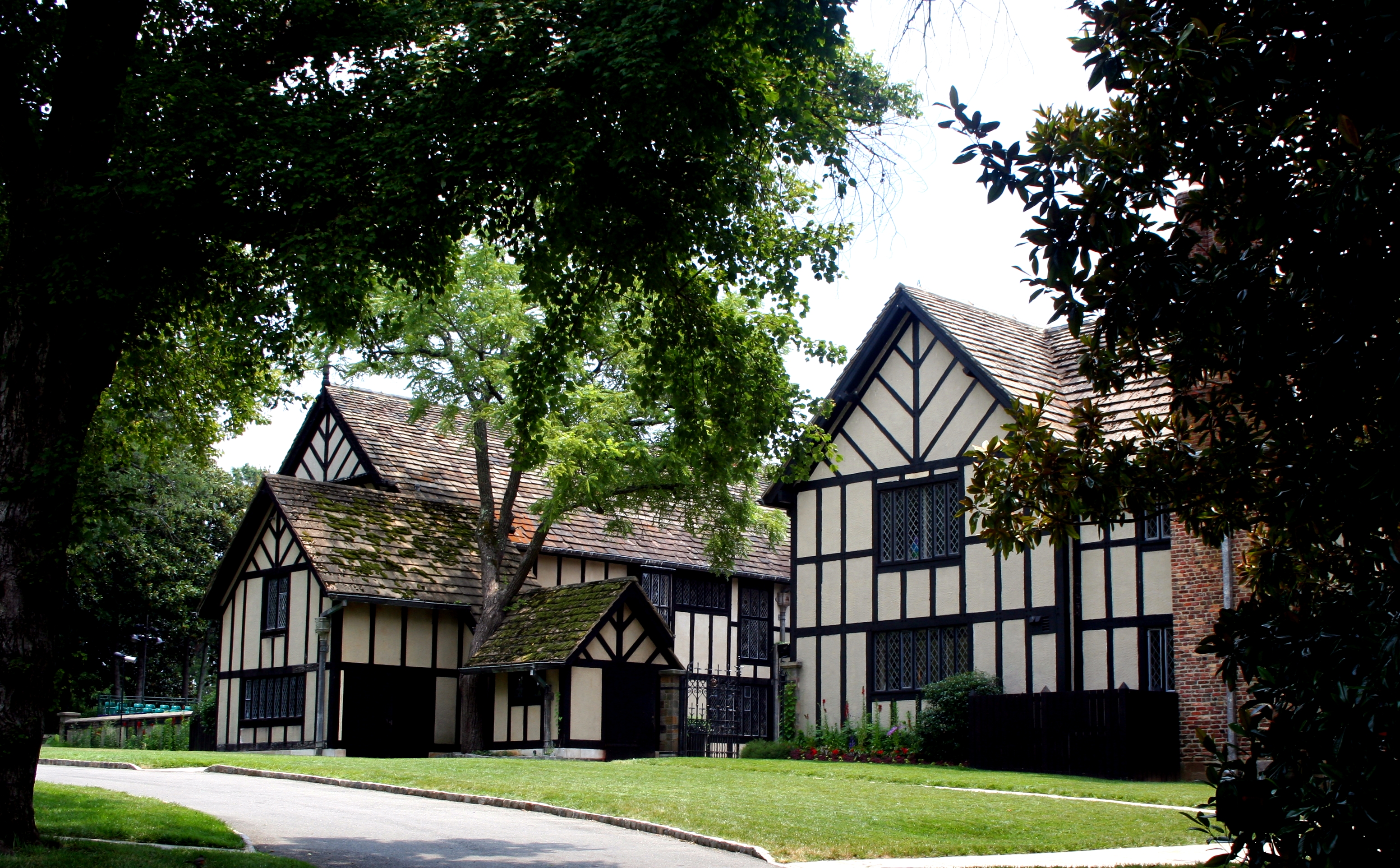
Agecroft Hall is a Tudor manor crated up in Lancashire in 1925 and rebuilt on the James River in Richmond. The legends came with the wood.
In 1925, a Tudor manor in the Irwell Valley was taken apart timber by timber, crated, loaded onto a ship, and sent across the Atlantic. Between 1926 and 1928, it was put back together on a bluff above the James River in Richmond. The same oak beams that had stood in Pendlebury, Lancashire since the late 15th century (beams that watched the English Civil War, the Catholic priest persecutions, four hundred years of Lancashire weather) are now in Virginia. The whole strange premise sits right there.
Most haunted-house pages start with the ghosts. This one can't. There are no documented hauntings at the Richmond site. None in the museum's own materials. None in the rosters of Richmond ghost tours (Haunts of Richmond, RVA Ghosts, US Ghost Adventures all skip it). The Richmonder's haunted-legends roundup doesn't list it. Style Weekly's 13 Most Haunted Places in Richmond doesn't either. So if you came here for cold spots and figures in Tudor clothing, the honest answer is that nobody credible has reported them.
What Agecroft has instead is older and weirder. It has the legends that came with the wood.
Start with the witch mark. In 2016, a dendrochronologist from England named Ian Tyers was at Agecroft inspecting wood panels when he noticed something on the Great Parlor fireplace. Five squares up from the floor, on the left-hand side of the mantle, lightly scratched into the Tudor oak, was a daisy wheel. A hexfoil. An apotropaic mark, the kind English homeowners carved near doors, windows, and fireplaces from roughly the mid-1500s to the mid-1700s to keep witches and evil spirits from getting in. Someone in Lancashire, hundreds of years ago, was scared enough of something to take a blade to the wood. That same wood is now in Richmond. The mark sits next to a 1593 panel portrait of George Poulet.
Now the Babes in the Wood. There's a 1595 English ballad about two children sent off to be murdered by a wicked uncle for their inheritance. Most scholars place it in Wayland Wood, Norfolk. But Lancashire historian Cyril Bracegirdle, in his 1973 book "Dark River: Irwell," tied it to a 1374 incident at Agecroft, young Roger Langley and his sister fleeing a man named Robert de Holland. Other researchers push back. Susan Bradbrooke argued the Prestwich manor involved was "probably not Agecroft Hall in Pendlebury, Salford, but somewhere else near Prestwich Village." Wikipedia notes both traditions. So the story may have happened on this land, or it may not have. The wood remembers either way, which is convenient, because the wood doesn't talk.
Then Cardinal Langley's curse. Thomas Langley was Bishop of Durham and Lord Chancellor of England. He was elected Cardinal and refused the appointment. Local Prestwich histories tell a story of Langley cursing the Dauntsey family for abandoning the old Catholic faith. The Prestwich.org.uk history pages carry it, Bracegirdle's book carries it, but it has no primary documentation, and more careful sources note that Cardinal Langley wasn't actually of the Agecroft branch of the Langleys. So the curse is a folkloric attachment. A pretty one, but an attachment.
The Tyldesley ghost is the closest thing to an actual haunting in the Agecroft story, and it isn't here. Sir Thomas Tyldesley, a Royalist commander, was killed at the Battle of Wigan Lane on August 25, 1651, the last armed action of the English Civil War. He's said to roam the Lancashire Agecroft. The trouble is, the Lancashire Agecroft doesn't exist anymore. Its timbers are here. And the source for the Tyldesley ghost is mainly Higgypop, a paranormal blog; the well-curated Paranormal Database has no Agecroft entry. So even the one named ghost is thin.
You may have read on the existing Agecroft page that visitors report sharp temperature drops, the feeling of being watched, figures in 16th-century clothing who vanish. No source confirms any of it. It looks invented. Same with the claim about King James I's witchcraft treatise sealed with Elizabeth I's own beeswax. Agecroft has Tudor and Stuart artifacts, but that specific item isn't confirmed anywhere I can find.
And the priest hole, the small concealed chamber where Catholic priests would hide from Crown searchers? The one at Agecroft in Richmond is a replica. The museum says so itself, in plain language: "By constructing a replica priest hole concealed in a wall of what was once a bathroom, Agecroft Hall strives to bring stories of 17th century England to life in 21st century Virginia." Whether the Lancashire original ever had one is unknown.
Here's where I land on Agecroft. The place doesn't need invented ghosts and shouldn't have them. What actually happened is more interesting. A grieving collector named T.C. Williams Jr. bought a 15th-century English manor at a 1925 auction, after the Lancashire coalfields swallowed the surrounding valley, and rebuilt it in Richmond for around $250,000 in 1920s dollars. He died on February 14, 1929, about a year after the hall was finished, the same calendar day, as it happens, as the 1376 deed that's often cited as the earliest mention of Agecroft in Lancashire. His will set up a trust for the upkeep. His widow Elizabeth lived in the house until 1967. It opened to the public on July 5, 1969.
The cheap version of Agecroft is the made-up cold-spot tour. The truer version is more haunting. Go look at the daisy wheel on the fifth square up from the floor on the left side of the Great Parlor fireplace. Someone carved it four hundred years ago in a country three thousand miles from here, because they were afraid of something specific in the night, and the wood they carved it into is the wood you're standing in front of.