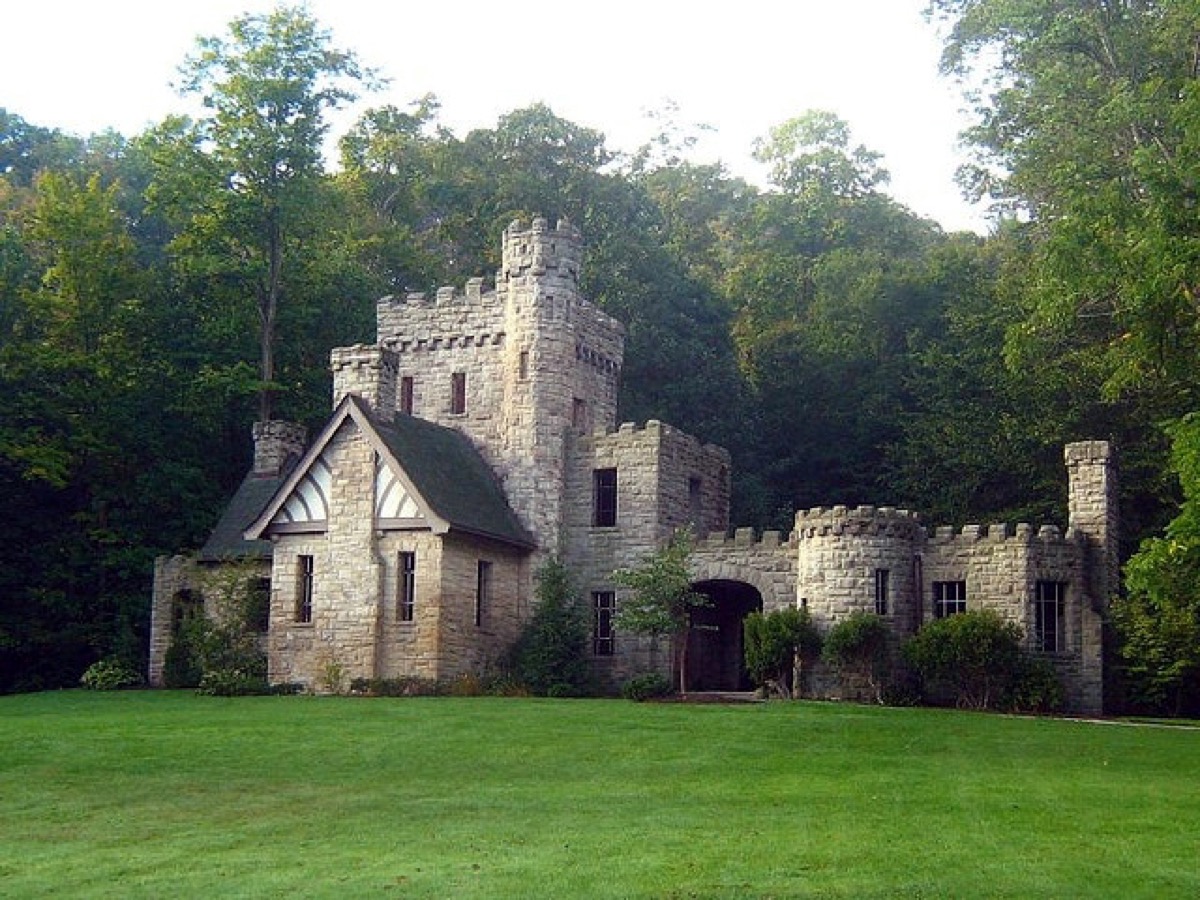
People keep seeing a woman with a red lantern in an upstairs window of Squire's Castle near Cleveland, Ohio. There is no upstairs — the place is a gutted stone shell. And the wife the ghost is built on died old, of pneumonia, miles away.
Squire's Castle stands in the woods of the North Chagrin Reservation, a Cleveland Metropark near Willoughby Hills, Ohio. The ghost people come for is a woman who passes the upstairs windows at night, a red lantern in her hand. What the visitors don't always notice is that the castle has no upstairs.
What stands in the woods is a hollow bluestone shell. Cleveland Metroparks stripped out the floors, the stairs, and every fixture decades ago. Walk inside today and you look straight up at the iron struts where the upper stories used to rest, past the empty sockets that once held leaded glass. The window the woman appears in opens onto nothing but sky.
The story says she belonged to the man who built the place. Feargus Squire, a Standard Oil executive, bought about 525 acres here around 1890 to raise a baronial country estate he called River Farm. This building was only the gatehouse; the manor meant to rise behind it never did. For a castle it had remarkably little: no electricity, no gas, no running water, no sewer, built on country land his wife had little wish to live on. As the legend goes, his wife liked to wander the gatehouse alone at night with a red lantern, and one night something startled her in the dark — his mounted hunting trophies, some tellings say — and she tripped and broke her neck on the stairs.
She didn't. Squire's wife was Louisa, and she outlived the castle by decades. The couple sold the estate in 1922 and settled at a house called Cobblestone Garth in Wickliffe, where Squire served a one-year term as mayor. Louisa died there in 1927, of pneumonia, an old woman miles from the gatehouse. No one broke her neck on a dark staircase.
Even her name comes through the legend wrong. The dead woman is usually called Rebecca. There was no Rebecca. The wife the story is built on was named Louisa, and she died of an ordinary illness somewhere else, long after anyone had lived in the gatehouse at all.
So the figure people report in the upstairs window is a wife who was never frightened, in a fall that never happened, under a name that wasn't hers, framed by a floor that isn't there. The park closes at dusk, and most who claim the red lantern see it from the trails and the parking lot after dark, a light moving through an empty stone husk that holds nothing capable of carrying one.