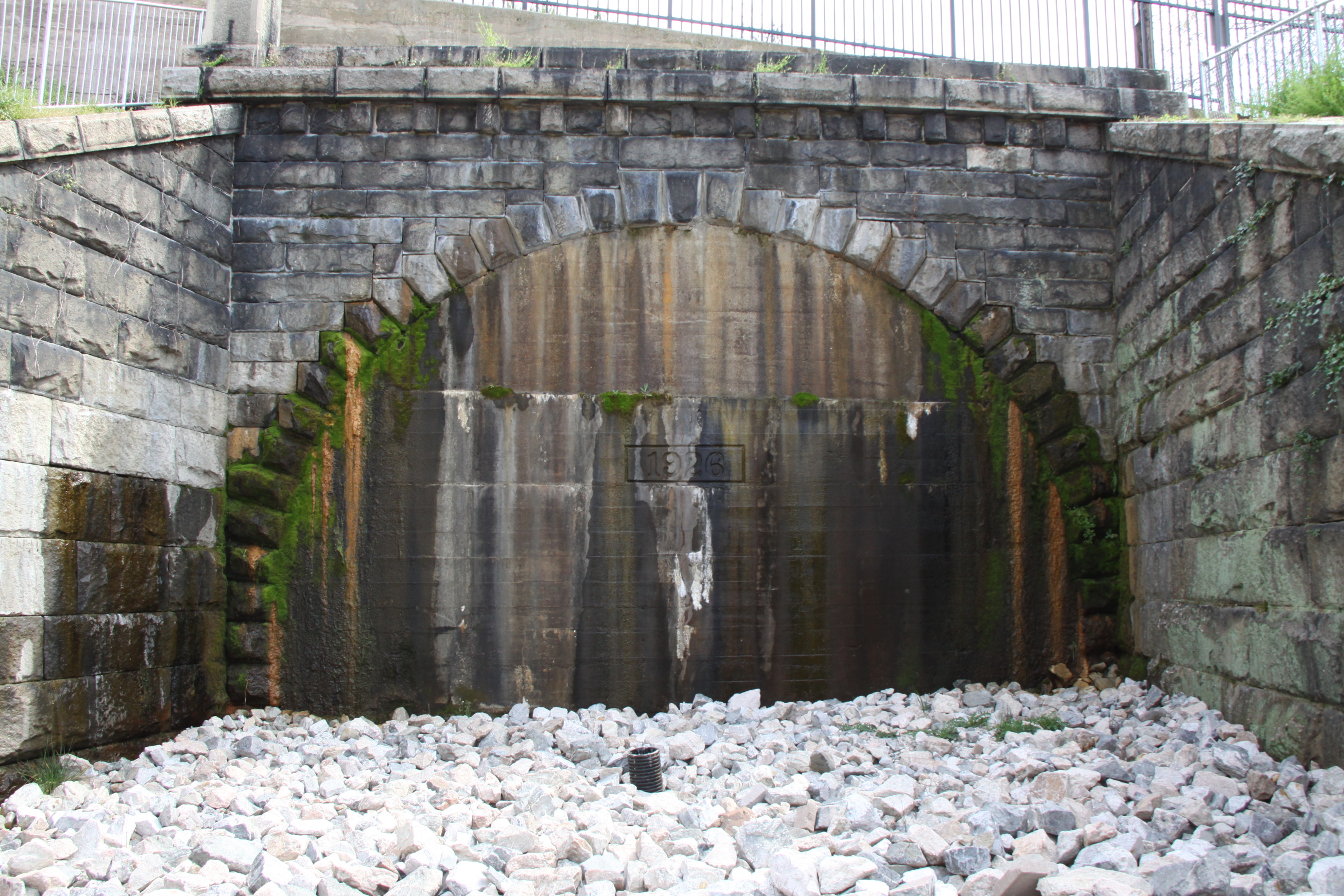
Church Hill Tunnel collapsed in 1925 with about 200 men inside. Locomotive 231 is still buried under Jefferson Park.
A 28-year-old fireman named Benjamin Franklin Mosby crawled out of the eastern portal of the Church Hill Tunnel on the afternoon of October 2, 1925, with skin hanging off his body and his teeth broken. He had been shoveling coal when the locomotive's boiler ruptured. He made it to Grace Hospital. He died there at 11:40 that night, about seven hours after he escaped.
His body, and the way witnesses saw him stagger into the daylight, is the actual seed of the Richmond Vampire legend. Not a coffin at Hollywood Cemetery. A scalded railroad worker who walked out of a cave-in.
The tunnel runs roughly 4,000 feet under Richmond's Church Hill neighborhood, from around 19th and East Marshall to 31st and East Grace. The Chesapeake and Ohio Railway finished it in 1873. At the time, it was one of the longest tunnels in the United States, which would have been impressive if it hadn't been bored through blue marl clay, a shrink-swell soil that expands and contracts with groundwater and absolutely should not have a 4,000-foot rail tunnel running through it. Geologists warned the C&O. The C&O built it anyway.
The trouble started immediately. On January 13, 1873, while crews were still finishing the tunnel, large cracks opened in the ground above. The next morning a chunk of Church Hill 120 feet long and 30 feet wide sank twenty feet straight down, taking several houses with it, including the study and kitchen of the rectory at St. John's Church, the same St. John's where Patrick Henry gave the "Liberty or Death" speech. The hill itself collapsed onto the Episcopal furniture.
At least nine workers died in cave-ins between construction and the 1925 disaster. The C&O eventually gave up on the tunnel around 1901, built a viaduct over the James River, and walked away. Then in 1925 they decided they needed the extra capacity back. So they sent a crew in to clean it out and reopen it.
About 200 men were working inside on October 2 when a section of roof near the western end gave way. The Richmond Times-Dispatch quoted witnesses who described the moments before: "A few bricks in the roof fell with a splash into the pools of water which spotted the earthen floor. The bulbs on the line of electric lights flashed twice." Then nearly 200 feet of ceiling came down on the work train.
The train was C&O switch engine number 231, a 4-4-0 steam locomotive, with ten flat cars behind it. The engineer was Thomas Joseph Mason. The reverse lever pinned him in the cab. He didn't get out. Mosby was the fireman beside him, and when the boiler split open it cooked him alive but didn't kill him fast enough to spare him the walk to the eastern portal.
Two African American day laborers, Richard Lewis and H. Smith, were trapped further back in the tunnel. Their bodies were never recovered. The historical record names four dead. Some sources allude to more. No primary record names additional victims, and the true count will probably never be known.
A Virginia State Corporation Commission investigator delivered an assessment within days. The collapse was caused by "a failure to use horizontal braces of walls that were known years ago to have been defective." A century of warnings, a century of cave-ins, and the C&O still didn't brace the walls.
Rescuers dug for over a week. Mason's body came out on October 10. The Commission then ordered the western end sealed for safety, and the C&O obliged in 1926 by filling the tunnel with sand and pouring concrete across both portals. Locomotive 231 is still down there. The ten flat cars are still down there. The bodies of Lewis and Smith are still down there.
In 2006 a railroad enthusiast named Pete Claussen partnered with the Virginia Historical Society to see if Engine 231 could be exhumed. They drilled boreholes through Jefferson Park, the public green space that sits directly on top of the tunnel. They dropped a camera through. What it found was silt and murky water, and a strong suggestion that any serious excavation would collapse the neighborhood above it. When the estimated cost reached $5 million, they stopped.
So the engine stays buried, the park stays green, and the western portal stays sealed behind a 1926 concrete plug visible from North 18th Street, right next to the Atrium Lofts at Cold Storage.
Now about the vampire. The W.W. Pool mausoleum at Hollywood Cemetery, the one Richmond ghost tours have been pointing to for years as the home of a flesh-eating creature, has nothing to do with this collapse. Oral legends about Pool being a vampire were already floating around Richmond in the 1960s, decades before anyone tied them to the tunnel. The first text fusing the two stories appeared online in 2001 and showed up in print in Beth Brown's 2007 book "Haunted Richmond: The Shadows of Shockoe." Folklorist Gregory Maitland later identified the so-called creature as exactly what it was: Mosby, shirtless and scalded, walking out of the eastern portal in front of a crowd that did not yet know what a boiler explosion looked like. Tourists kept vandalizing the Pool mausoleum looking for fangs. The remains were eventually removed.
Visitors and Church Hill residents say they hear a muffled locomotive whistle from the sealed western portal, particularly in early October. They report digging sounds. Knocking from inside the concrete. These aren't documented in newspaper archives, they're tour-stop and neighborhood reports, and Richmond ghost tours stop at the portal nightly. Take them for what they are.
What's not in question is the geology, the names, and the date. Blue marl clay. Mason and Mosby and Lewis and Smith. October 2, 1925, around 3 p.m. The tunnel is now owned by CSX Transportation, the C&O's corporate successor, and the concrete seal at the western portal still bears the date the railroad walked away: 1926.