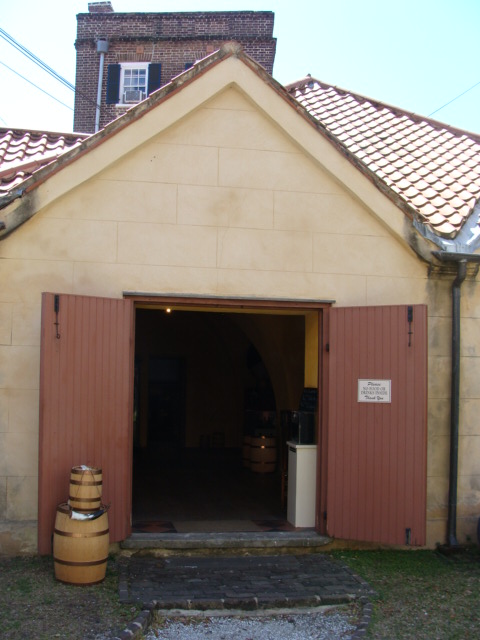
Tour guides at Charleston's Powder Magazine say the pirate Anne Bonny peers out from behind the museum displays inside the 1713 building. A ghost hunter who went looking for a tie between her and the place found no record of one at all.
The Powder Magazine in Charleston, South Carolina is the oldest public building still standing in the Carolinas, and the tour guides will tell you a pirate haunts it. They say Anne Bonny peers out from behind the museum displays and moves through the single small room, red-haired and watching the people who wander in.
Then a ghost hunter went looking for the tie between Bonny and the building, and came back with nothing. No record, no image, no personal account placing her here at all. "The whole Anne Bonny and Mary Read correlation with the Powder Magazine feels more like a tourist trap attraction to liven up such a historical building," he wrote, after the search came up empty. The most-told ghost in the place is the one the record can't put inside it.
The building never needed her. It was finished in 1713 to hold gunpowder, up to five tons of it, in a squat brick box roughly 27 feet square with no windows and walls close to a yard thick. The roof was engineered to fail upward: arched to vent a blast at the sky and packed with sand to smother the flames, so an explosion inside would spend itself over the city instead of blowing out into the streets. It was a room built to come apart safely.
The war put it to work. In 1780, with the British closing in during the Siege of Charleston, General William Moultrie had the powder hauled out and bricked up behind a wall inside the Old Exchange. The occupying army turned the Exchange into a prison and never found what was sealed in the same building. That same spring, a different Charleston magazine took a spark: roughly 4,000 pounds of powder, close to 200 people dead, at least six buildings gone. More died in that one blast than in the entire siege.
After the powder left for good, a merchant named Gabriel Manigault, one of the richest men in colonial Charleston, used the little room as a cellar for his madeira wine.
And it is Manigault, not the pirate, who has the ghost with something behind it. Visitors report a man in period clothes pacing the narrow interior, looking for something he can't seem to find. The story goes he is still after a lost bottle, moving through the dark of his old cellar the way he must have in life.
So the crowds come for the pirate no record can place here, and drift right past the man who actually used the room — the one who left something down here, and never stopped looking for it.