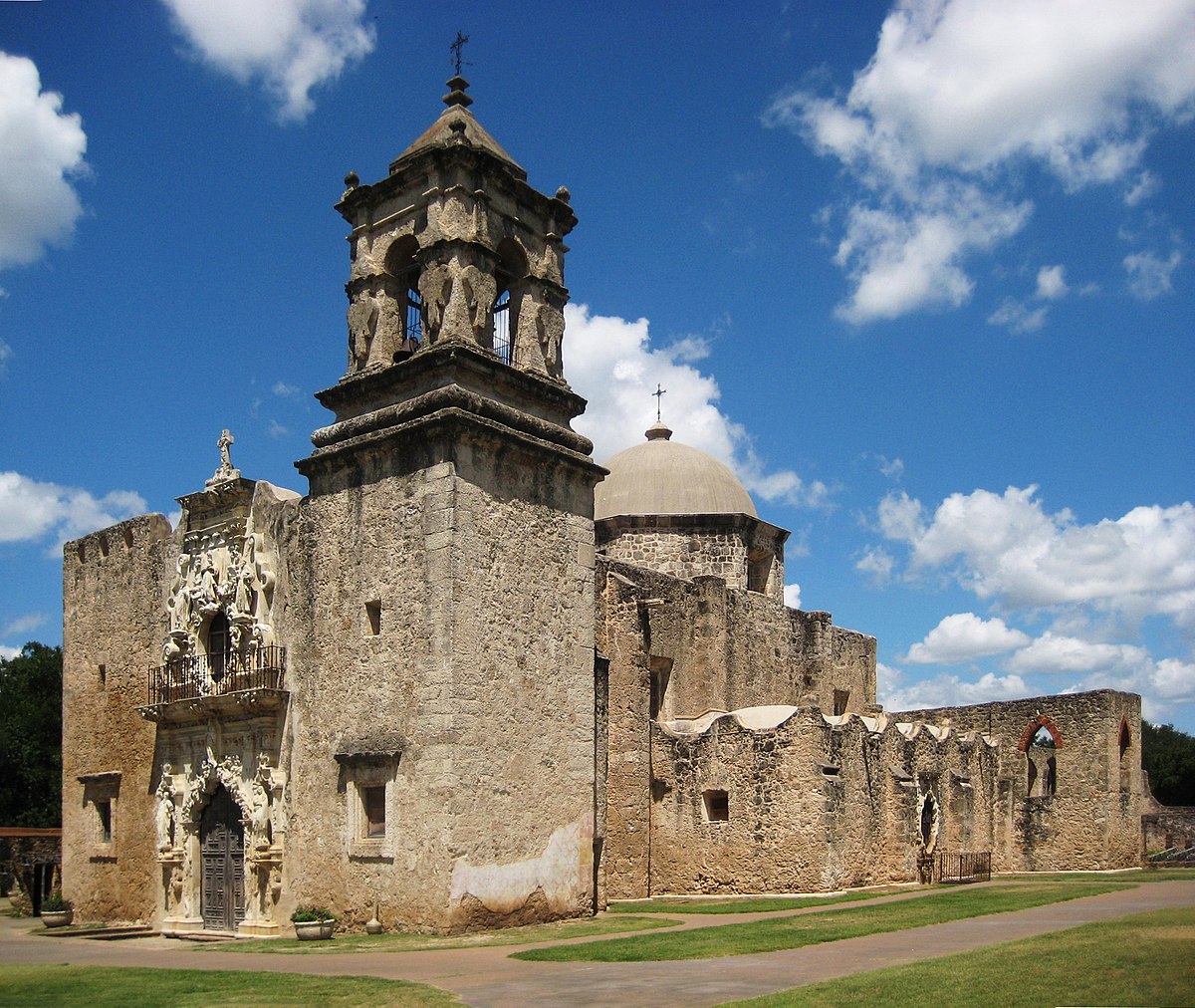
Mission San José in San Antonio keeps a headless monk in its courtyard, a huge black dog on the same grounds, and a woman who appears at the Rose Window, the sacristy carving a sculptor is said to have named for a sweetheart lost at sea.
Mission San José in San Antonio, Texas is the largest of the Spanish missions strung along the San Antonio River, and the story there is that a monk with no head crosses its courtyard after dark. A huge black dog is said to prowl the same grounds. One account holds that the dog is not a dog at all, but a Native spirit wearing an animal's shape.
Ghost City Tours collects the rest of it. Dark human-shaped figures with no features, standing motionless along the walls and near the old living quarters in the fading evening light, gone the moment anyone walks toward them. Robed figures pacing the church nave with their heads bowed. Footsteps on the stone corridors with nobody in them, whispered Spanish coming out of empty rooms, and the heavy church doors creaking open or slamming shut with no wind to account for it.
The oddest report belongs to a window. On the south wall of the sacristy is the Rose Window, a single carved opening the Park Service calls the premier example of Spanish Colonial ornamentation in the United States. A San Antonio community guide records a woman appearing near it, seen sometimes inside the mission and sometimes outside it.
There is already an answer for who she might be, and it is older than she is. The legend says the sculptor Pedro Huizar carved the window and named it for Rosa, his sweetheart, who sailed from Spain to marry him and was lost at sea before her ship reached Texas. In the fullest version he never took another woman, and spent the rest of his life in penance, carving the saints that stand above the church door.
A National Park Service study finished in 1981 went looking for Huizar in the records. He was real: born in Aguascalientes, a carpenter and surveyor who worked at San José. He also married twice, fathered at least three children, and did not reach the mission until the 1790s, some twenty years after the Rose Window was finished. The prevailing theory now is that the window is named for Saint Rose of Lima, the first saint of the New World. Texas Monthly notes that the plaque beside it still credits Huizar.
The mission's dead are less settled than the story told about them. A Park Service article on the mission's camposanto counts 352 entries in a burial book covering 1781 to 1824, most of them people put into the ground here. It puts the colonial cemetery at roughly 222 feet on a side, ringed with a rubble wall, between the soldiers' quarters and the church, and gone now. The same article counts two markers out front: one for Juan Huizar, who died in 1893, and one worn illegible. The burials were made on consecrated ground, it says, either in that vanished cemetery or inside the church, and does not say which.
Two stones, one of them unreadable, and a church floor that may be lying over everyone else.