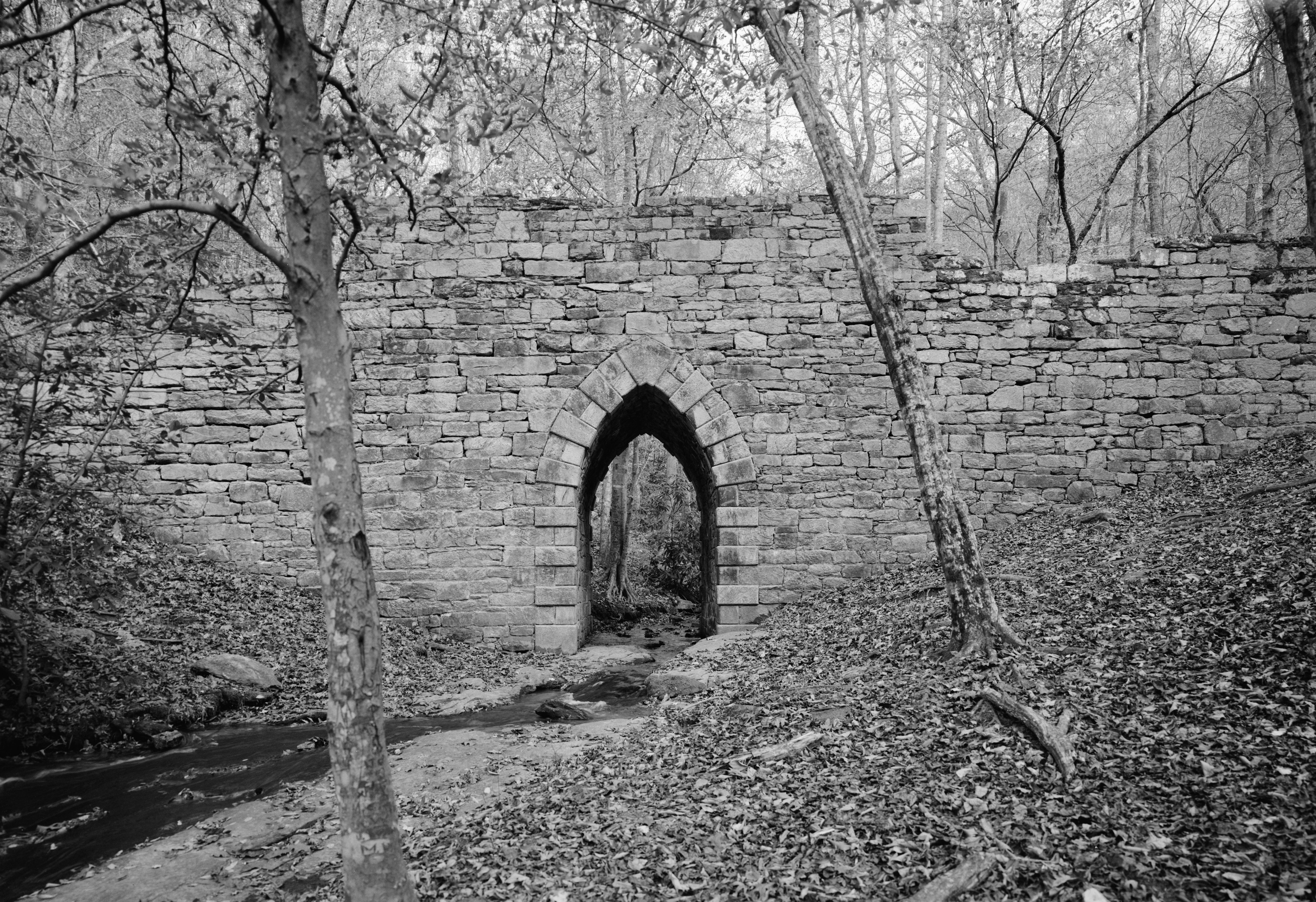
The Poinsett Bridge, an 1820 Gothic stone arch in the South Carolina mountains, has one signature haunting: visitors walk down to the creek and return to find their engines dead. The car starts again once it's towed off the site. The legends behind it were never written down.
The Poinsett Bridge sits off Highway 25 in the northern mountains near Landrum, South Carolina, and the thing people report there isn't a figure on the arch. It's their own car. Visitors park in the small lot, walk down to the creek to see the old stone span, and come back to find the engine dead. The story goes that it turns over fine again once the vehicle is pushed or towed a short way off the site. The same visitors report screams from the top of the arch and lights moving on the mountainside after dark.
The bridge is worth the walk on its own. Built in 1820, it's the oldest surviving bridge in South Carolina, and maybe in the whole Southeast. It carries no traffic now. Its pointed Gothic arch rises about 14 feet over Little Gap Creek, built of wedge-shaped stones fitted together dry, no mortar holding them, and the keystone is etched with a single date: 1820. It's named for Joel Roberts Poinsett, the diplomat the poinsettia is named for too. The pointed Gothic shape is credited to Robert Mills, who later designed the Washington Monument, though the original plans were lost and the attribution rests on a drawing he made the year after the bridge went up.
In 2019, Condé Nast Traveler put it on a list of the 30 most haunted places in America. The legends behind the car trouble don't agree with each other. One says a worker caught a fever during construction and was sealed into the stones themselves. Another has a man shot on the bridge in 1861 returning as a headless figure on rainy nights, "exactly at the stroke of midnight." Locals tell of a guardian over a burial ground, of Irish masons who come back to admire their work. What the tellings share is that none of them is written down anywhere. One account that collects the lore says plainly there are no records of any of it.
The strangest piece has a paper trail of a different kind. A paranormal team spent the night of December 13, 2008, under the arch. Their thermometers swung from below zero to 60 degrees while the air around them held near 37. Of roughly 400 photographs they took, about a quarter came back showing orbs, and they logged a mist they described as man-sized and red and white lights that flared for a second or two. The team wouldn't call the site haunted outright, writing only that it seemed "a place of highly elevated paranormal occurrences." Then a 95-minute recording session came back, they say, with two names: "Abraham" and "Willie." The commissioner who oversaw the bridge's 1820 construction was Abram Blanding. His eldest son was named William.