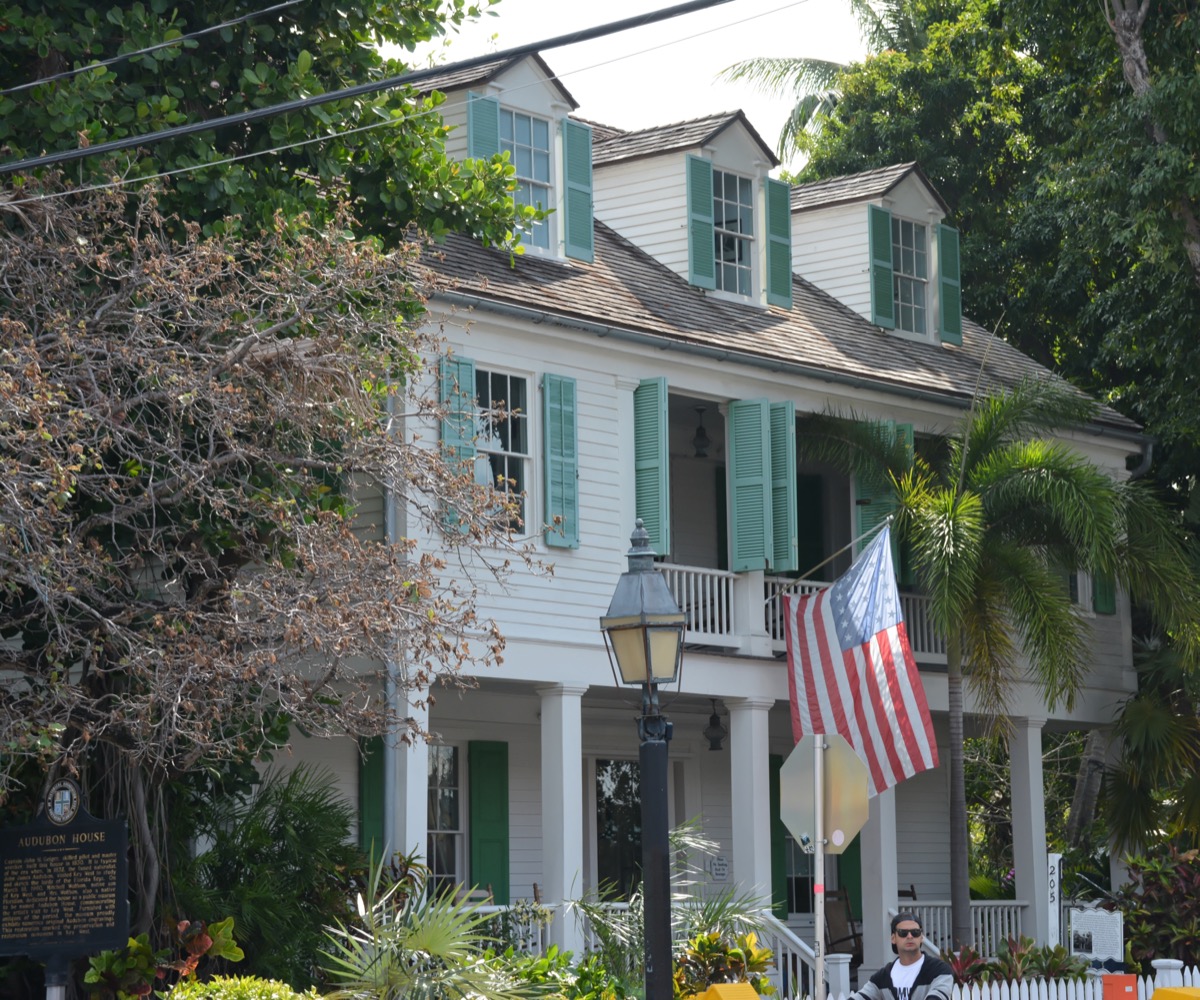
The Audubon House on Whitehead Street in Key West has a naturalist's name on the door who never slept a night there. The man staff keep seeing in the upstairs windows is Captain Geiger, who built it and watched four generations of his family live and die under its roof.
A distinguished man stands in the upstairs windows of the Audubon House on Whitehead Street in Key West, watching down, on floors that staff and guides swear are empty. They take him for Captain John Huling Geiger. The strange part is that the house is named for someone else entirely.
John James Audubon's name is on the door, but he never lived here, and he couldn't have. He came to Key West in 1832 to draw birds and left having sighted 18 new ones for his folio, including a white-crowned pigeon he painted in a Cordia tree still standing in the front yard. But he was so afraid of yellow fever that he vowed never to sleep on the island. He stayed offshore aboard a revenue cutter and only came ashore to work. The house wasn't even built until the late 1840s, more than a decade after he was gone.
The man who built it was Geiger, a harbor pilot and master wrecker who turns up in 57 wrecking court cases. He and his wife Lucretia had 12 children. Seven daughters and two sons reached adulthood, which means several did not. Four generations of his family lived in the house across roughly 108 years.
In the gardens, guides and visitors describe a presence among the plants, a tobacco scent where no one smokes, the feeling of being watched. Two paranormal groups have certified the house as haunted. The youngest Geiger child, the venue's own ghost page says, still gives the occasional tap or tug to people passing through.
The last of the family to live here was a great-grandson, William Bradford Smith, another harbor pilot. For more than 20 years he sealed himself inside as a recluse, with no electricity, no running water, no kitchen. Rather than step outside, he lowered baskets from the upper windows to collect his groceries.
He died in 1956. The famous name is the one carved into the door — but it was a Geiger who spent his last two decades watching the street go by from those upstairs windows, and never came down.