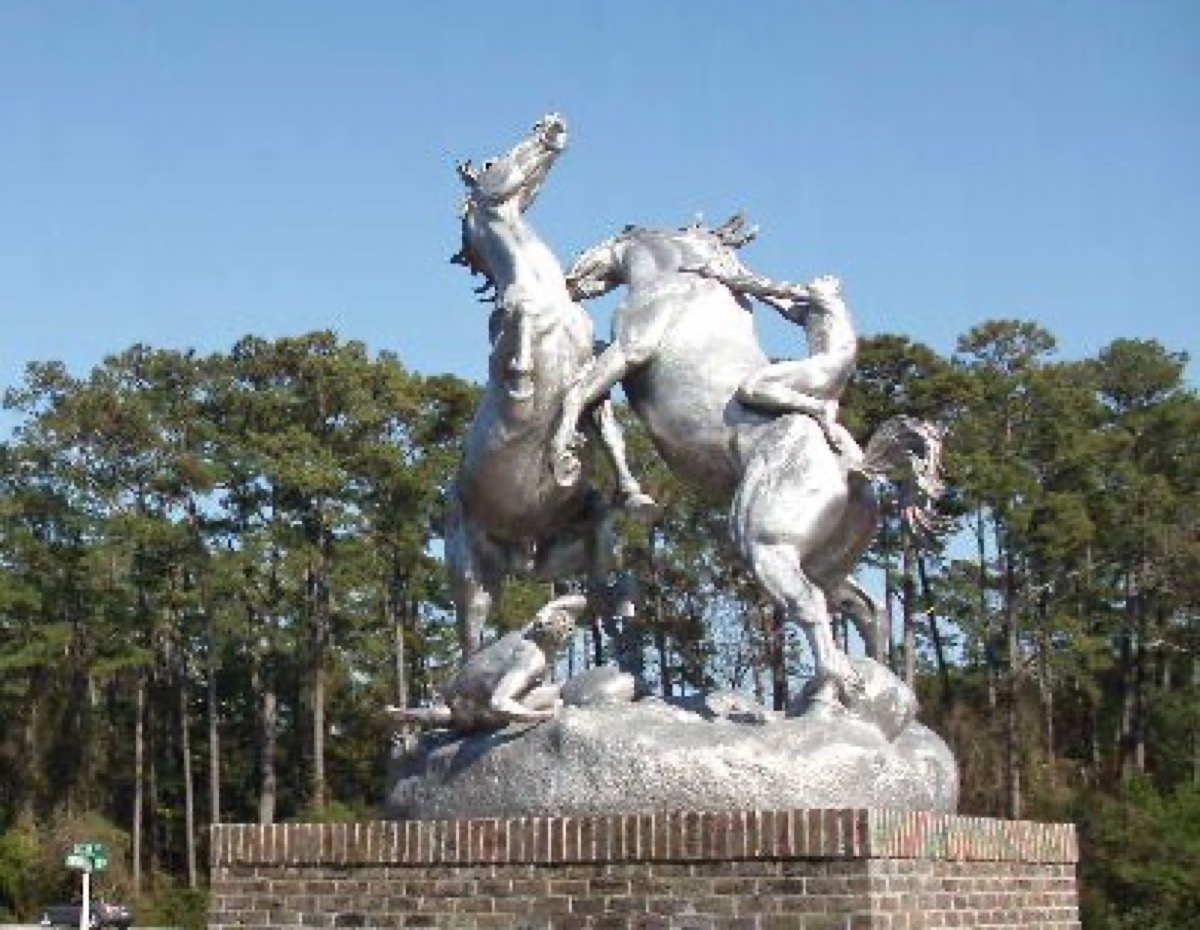
Brookgreen Gardens, a celebrated sculpture garden near Georgetown, South Carolina, was laid over four former rice plantations. On foggy nights, a governor's wife who vanished at sea in 1812 is said to walk its old rice fields, still searching for her father.
Brookgreen Gardens sits on the South Carolina coast near Georgetown, the country's first public sculpture garden, laid over four former rice plantations. On foggy nights, the story goes, a woman is seen out on the old rice fields, on the Georgetown docks, and floating above the waves at the beach across the highway. She is looking for her father.
They say she is Theodosia Burr Alston. She lived here, at a plantation called The Oaks, where the Alston family cemetery still stands, and the beach where she is seen was once called Theaville in her honor. Her father was Aaron Burr, the former vice president. Her husband, Joseph Alston, became governor of South Carolina, which made Theodosia the state's first lady.
In June 1812, her only son died of malaria. He was ten. Grieving, Theodosia boarded a schooner called the Patriot at Georgetown on the last day of the year, bound for New York to see her father. The ship and everyone aboard were never heard from again. One theory holds that it was wrecked and looted off Nags Head, North Carolina; a portrait of an unknown woman, said to have been pulled from a wreck and long rumored to show Theodosia, surfaced there decades later. What became of her, nobody ever learned. Wikipedia records the legend plainly: "Her ghost is said to haunt the Grand Strand, looking for her father."
Theodosia is the ghost with a name. The older darkness at Brookgreen has none. One of the four plantations belonged to Joshua John Ward, the king of the rice planters and the largest slaveholder in the United States when he died in 1853, with more than a thousand enslaved people working his fields. South Carolina folklore keeps a story from those years: an overseer named Fraser beat the enslaved so brutally that blood pooled on a barn floor and soaked into the wood. In the telling it is remembered as "a pool of mama's blood." Freed people washed and scrubbed at the boards after emancipation, and the stain kept coming back. "Tread them down; walk them out; cover them up. All in vain!"
When Archer Huntington bought the plantation in 1930, one of his first acts was to tear the barn down. The sculptures went up two years later. The barn is gone and the garden is beautiful, and the ground beneath it, as the old story has it, never did come clean.