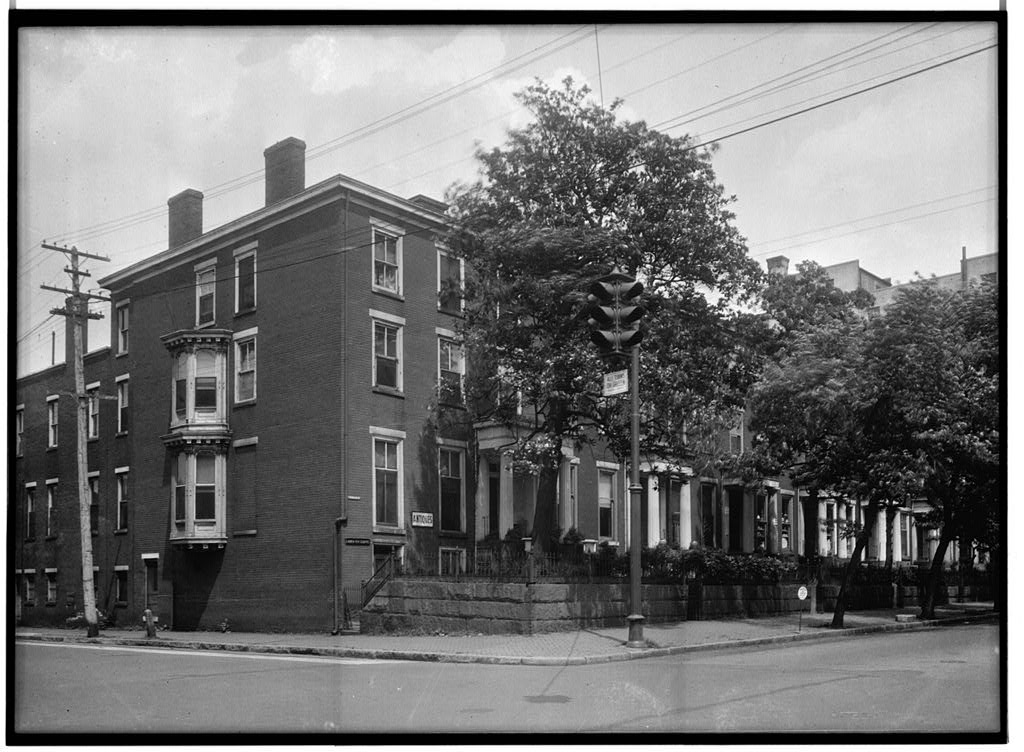
Linden Row Inn's famous Eliza Poe ghost story can't be true. The inn's director says so. Something is still here.
The Eliza Poe ghost at Linden Row Inn is the one that cannot possibly be there.
Travel listicles love repeating it: Edgar Allan Poe's mother, Eliza, wandering the hallways looking for the children she left orphaned when she died of consumption in Richmond in December 1811. It's a tidy story. It's also, by simple arithmetic, impossible. The first five townhouses of Linden Row, the eastern row, weren't built until 1847, thirty-six years after Eliza was in the ground. The western row went up in 1853. There were no buildings here for her to haunt.
Vishal Savani, the inn's director, says this on the record. "One of the ghost stories out there, that is false, is that his mother Eliza Poe's ghost roams the buildings," he told the Washington Post for a 2010 bed-check piece. "The story is her ghost is here because she stayed in one of the townhouses, but these buildings hadn't been built in Eliza Poe's lifetime. Edgar hadn't even played in the gardens that were here until after her death."
Which is the interesting part. The management gave up the easy ghost. They kept the place anyway, and the place kept its hauntings.
There is, for instance, a room. Staff won't say which one. A staff member told the Post, "There is one room that gives me an eerie feeling whenever I go in. Anyone who checks in there, they usually leave right quick." The Post sat on the room number. Nobody on record has filled it in since. You can stay at Linden Row tonight and not know if you're in it until you are.
The dining room is the other thing. It's not a dining room by birth. It's a converted stable behind the main row of townhouses, the building where the horses lived when guests in 1853 arrived by carriage. The inn brought in paranormal investigators some years before 2010. Per Savani, in the dining room they "did pick up something." No team is named. No date is published. No findings are quoted past those three words. You're left holding what the inn is willing to hand you, which isn't much, which is the point.
Guests fill in the rest. Alarm clocks going off in rooms where nobody set them. Odd noises down hallways that should be empty. On its own, you'd write any single report off as old plumbing or a tired traveler. The pattern stops being individual when enough strangers, in different rooms, in different years, keep saying the same things.
Now here's where the ground gets older than the buildings.
In 1816, a Richmond merchant named Charles Ellis bought the eastern end of this block and turned it into a formal garden. Roses, jasmine, honeysuckle, flowering myrtle, and linden trees, walled in brick. Chris Semtner, curator at the Edgar Allan Poe Museum, told the Post that "in Poe's time, the whole block was a big garden surrounded by a brick wall, and everybody in the neighborhood would hang out there. It was filled with linden trees and roses. They say you could smell the roses from a block away."
Across the street, on the south side of Franklin, stood the Allan house. Edgar Allan Poe lived there for a stretch with his foster family after returning from England. He played with the Ellis children in the garden. And as a teenager, in 1825 and 1826, he courted a girl named Sarah Elmira Royster among those rose bushes. They got secretly engaged before he left for the University of Virginia. The engagement fell apart. Sarah married someone else. Poe spent the rest of his life writing about her without ever quite using her name.
In 1848 he published a second poem called "To Helen," the one with the "enchanted garden." This garden. The one a Richmond merchant kept walled and perfumed for thirty years and that a teenage Poe walked through with a girl he'd never get over. Fleming James paved most of it under in 1847 to build a real-estate venture he called Linden Square, named for the trees. Otis Manson designed the houses. Greek Revival, brick veneer on high English basements, with one-bay entrance porches fronted by two fluted Doric columns each. They are pretty. They are also built on what was once the most famous garden in Richmond, and on what is now the only one of Poe's love stories that still has a physical address.
The inn doesn't try to sell you a romance. It tries to sell you a clean bed in a building that survived everything.
It barely survived everything. Two of the original ten houses came down in 1922 for the Medical Arts Building. The rest were headed the same way by midcentury until Mary Wingfield Scott, the preservationist who wrote *Houses of Old Richmond*, started buying the surviving houses one at a time between 1950 and 1957. She used her own money. She did some of the brickwork herself. She gave the whole thing to the Historic Richmond Foundation in 1980. It was restored and opened as the Linden Row Inn in 1988. National Register of Historic Places, listed November 23, 1971, reference 71001061.
Other things happened in these walls that the ghost tour doesn't usually mention. Mrs. Virginia Johnson Pegram ran a girls' school here after her husband died in an 1844 steamboat accident, raising five children on the tuition. Two of her sons died in Confederate gray within two months of each other in 1865. Miss Virginia Randolph Ellett ran another girls' school here from 1895 to 1906; her pupils included Irene Langhorne, who married Charles Dana Gibson and became the original Gibson Girl, and Irene's sister Nancy, who became Lady Nancy Astor, the first woman to take a seat in British Parliament. The novelist Mary Johnston lived here with her sisters until 1913. Behind the row, the former slave dwellings still stand.
That's a lot of life pressed into one block. It would be strange if nothing lingered.
Whatever does linger doesn't have a name. The easy name was the wrong one, and the management said so. What's left is a room nobody will identify, a converted stable that registered something for investigators nobody can name, and a courtyard with linden trees standing where a teenage Edgar Allan Poe once walked a girl named Elmira through the roses.
You can smell the linden in the courtyard in late spring. It's the only thing about the place that pre-dates the haunting.