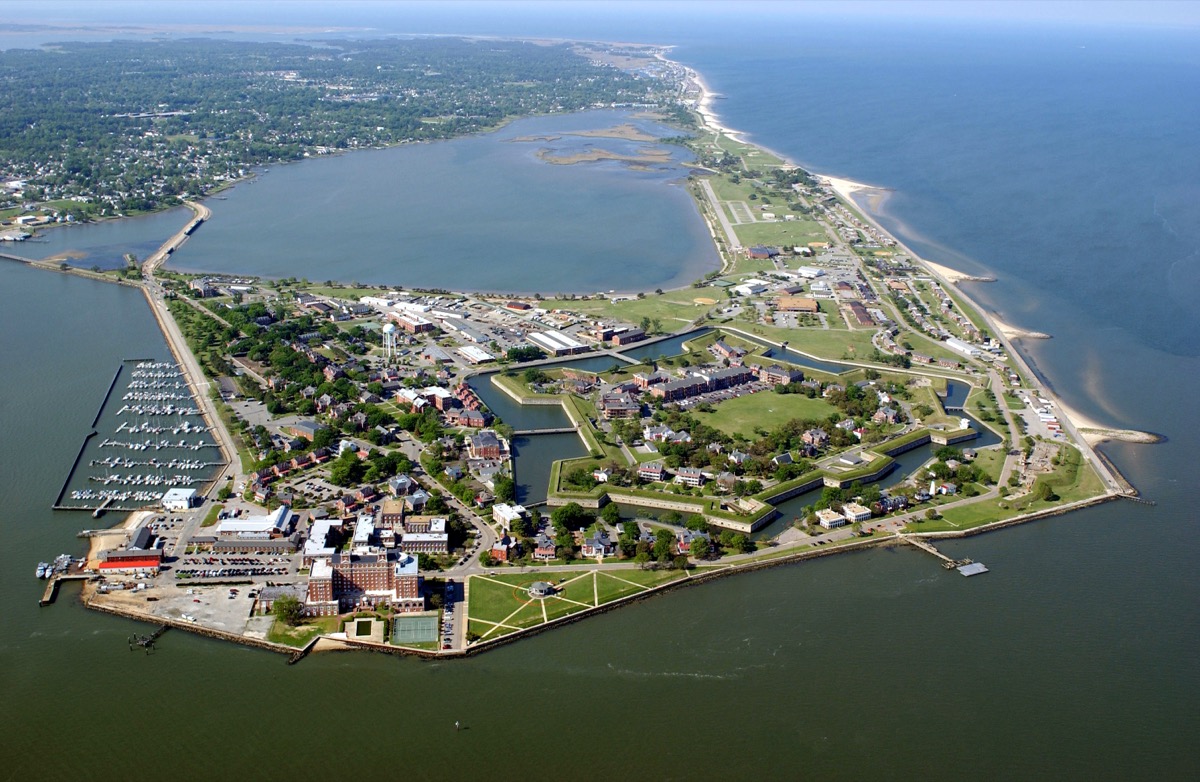
Fort Monroe is a moated stone fort in Hampton, VA where Jefferson Davis was jailed, Poe served as a sergeant, and three men rowed to freedom in 1861.
On the night of May 23, 1861, Frank Baker, Shepard Mallory, and James Townsend stole a small boat at Sewell's Point and rowed across Hampton Roads in the dark. They were enslaved men forced to build Confederate fortifications, and they had heard the U.S. Army still held the moated stone fort on the far shore. They reached Fort Monroe and asked for asylum.
Less than 24 hours earlier, Virginia had ratified its ordinance of secession.
The next day, May 24, a Confederate emissary named Major Cary came to the fort demanding the three men back under the Fugitive Slave Act. Major General Benjamin Butler refused. His reasoning was lawyerly and devastating: Virginia claimed it was no longer part of the United States, so the federal Fugitive Slave Act no longer protected its slaveholders. The three men were, in Butler's phrase, "contraband of war." Butler wrote out the full legal argument in a letter to Lt. Gen. Winfield Scott three days later, on May 27. By war's end, roughly half a million African Americans had reached Union lines seeking the same protection. Soldiers started calling the fort Freedom's Fortress, and the name stuck.
That story is the reason you want to come here. The ghosts are why you stay an extra night.
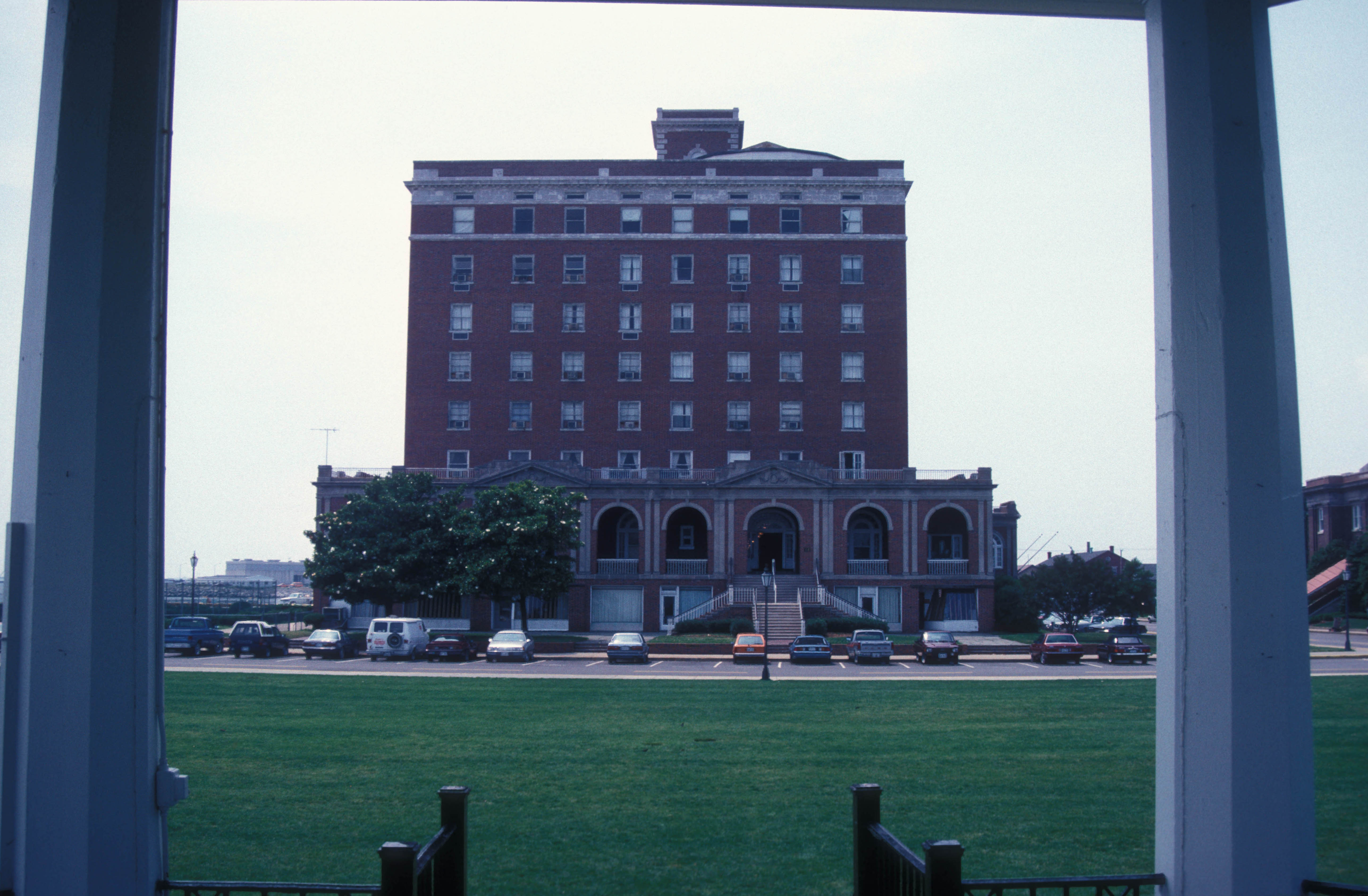
Fort Monroe sits at the tip of Old Point Comfort, where the Chesapeake Bay opens. Construction began in 1819 and continued through 1834. It covers 63 acres ringed by a moat, which makes it the largest stone fort ever built in the United States. The Army held the post for almost two centuries before deactivating it on September 15, 2011. President Obama signed Proclamation 8750 six weeks later, on November 1, designating Fort Monroe a National Monument. It was the first time he used the Antiquities Act.
The ramparts hold a strange roster of Americans. Edgar Allan Poe enlisted under the name "Edgar A. Perry" and served here in 1828 and 1829. He made Sergeant Major of Artillery on January 1, 1829, the highest non-commissioned rank, then was honorably discharged that April. A young Robert E. Lee arrived as assistant engineer in 1831, married Mary Anna Custis on June 30 of that year, and lived with her in Building #17, where their first son was born. The building is the park headquarters now. Lee stayed through 1834.
And then there's Jefferson Davis. On May 22, 1865, the Confederate president was confined inside the fort's stone walls in Casemate Cell No. 2. He spent his first months of postwar imprisonment in that cell before being moved to officers' quarters at Carroll Hall in October. He was released on May 13, 1867, on a $100,000 bond signed by Cornelius Vanderbilt, Horace Greeley, and the abolitionist Gerrit Smith. In June 1951, the Army opened a one-room museum around his old cell. That single room is now the Casemate Museum, which covers more than 400 years of fortification history at Old Point Comfort.
So: a fort whose stones held the man who tried to break the Union, built in part by the man who would lead its armies against him, manned briefly by America's most haunted poet, and remembered most for three men who rowed across a black bay one night and pried open the legal door to emancipation. You can see why the place has ghosts. The question is which ones to believe.
The U.S. Army itself published an article in October 2009 called "The haunting of Fort Monroe." When the Army puts ghosts on the record under a writer's byline, the folklore graduates. Tracci Dorgan's piece catalogues a tall shadowy figure on the ramparts that residents identify as Davis, Abraham Lincoln in Quarters Number 1, and a stretch of Matthews Lane behind the officers' quarters that everyone calls Ghost Alley. Investigators have photographed orbs at the Postern Gate and in the casemate embrasures. Audio recorders have caught what sounds like horse hooves moving along the alley with no horse in sight.
The most famous resident of Ghost Alley is the Lady in White. The story goes that a captain at the fort shot his wife after catching her with a young soldier, and she walks the boardwalk and the alley at night in a white nightdress, searching for the lover she lost. No historian has tied the story to a specific captain, year, or court-martial record. It's folklore. People still see her.
The most charming entry in the Army article belongs to Quarters Number 1, where Lincoln's ghost is said to walk. A paranormal recording at the building captured a child's voice calling for her cat, Greta. Visitors have reported a gray cat slipping around corners and vanishing. Whether you find that adorable or hair-raising depends on your tolerance for cat ghosts. Mine is high.
One resident of an early-1900s house on post, quoted anonymously in the Army article, described a camera that moved itself from storage to the bathroom sink, doors closing on their own, and an apparition of a woman in a maroon Victorian dress tending a crib. She didn't sound rattled. "It feels like this is a family dwelling and you very much feel at home here," she told Dorgan. Fort Monroe ghosts tend to be polite.
The first compiled account of the fort's ghost stories, Jane Keane Polonsky and Joan McFarland Drum's "The Ghosts of Fort Monroe," came out in 1972. Half a century later the stories keep circulating, the Army keeps publishing them, and the casemate cell that held Jefferson Davis remains open as the museum's anchor exhibit. The NPS page for the fort puts the place's importance plainly: Fort Monroe was "not only a stronghold for the Union but was also a destination of enslaved people seeking to liberate themselves." Read that line standing on the seawall looking out at the same water Baker, Mallory, and Townsend crossed in the dark.