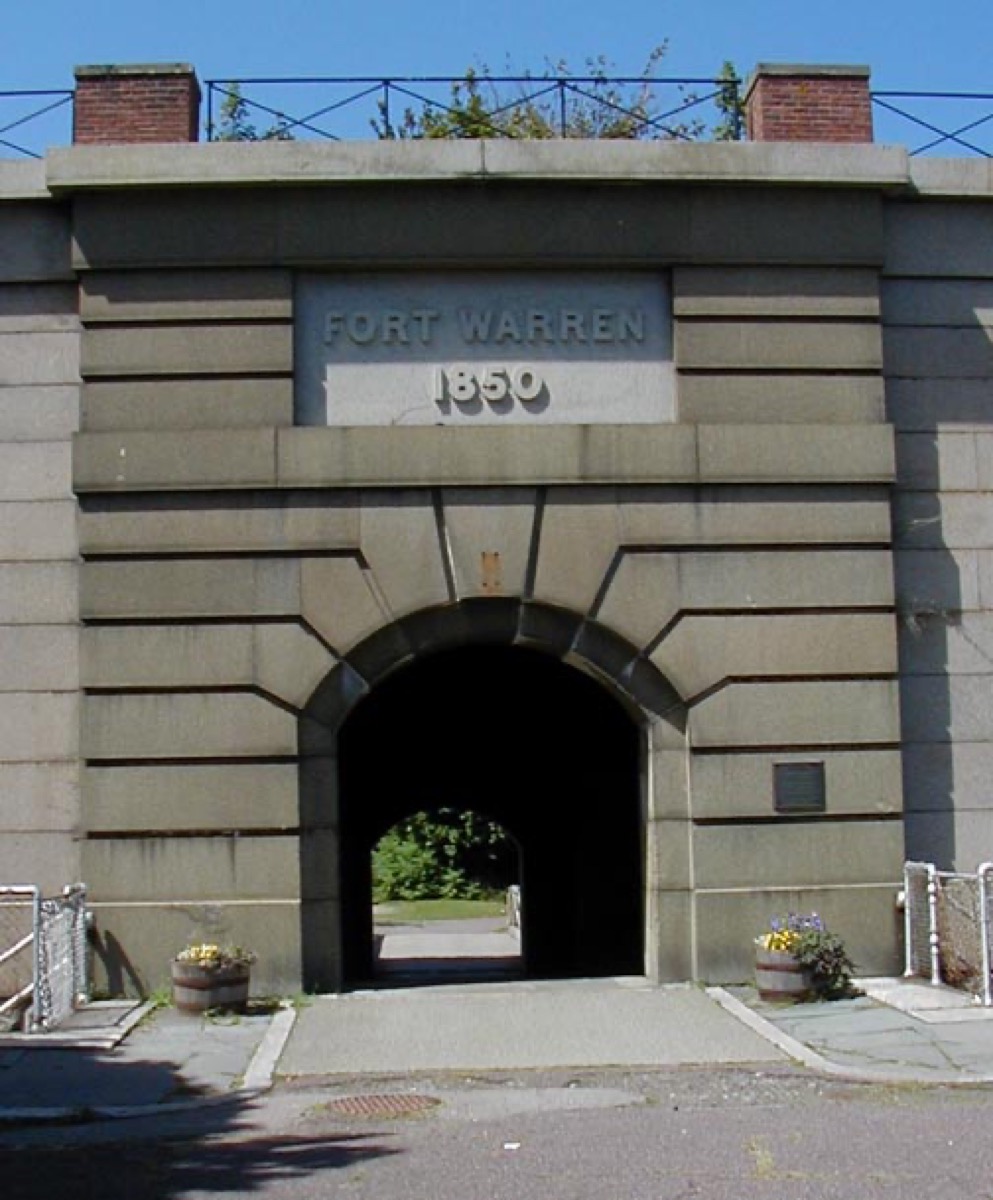
Fort Warren

Fort Warren

⛓️ prison

Boston, Massachusetts · Est. 1847

About This Location

A granite fort on Georges Island in Boston Harbor, built in the 1840s and used as a Confederate prison during the Civil War. The Vice President of the Confederacy, Alexander Stephens, was imprisoned here.

👻

The Ghost Story

Fort Warren rises from Georges Island in Boston Harbor, a massive pentagonal fortress of granite and stone constructed between 1833 and 1860 as part of America's coastal defense network. During the Civil War, under Colonel Justin Dimick, it became one of the most humane Confederate prison camps in the nation—housing over 2,300 prisoners with only 13 deaths, the lowest mortality rate of any Civil War prison. Among its captives were the Mayor of Baltimore, the Governor of Kentucky, Confederate Postmaster General John Reagan, and most notably Confederate Vice President Alexander H. Stephens, who arrived on May 24, 1865 and spent five months in solitary confinement before his release in October. Stephens kept a detailed diary of his imprisonment, later published as a valuable historical record.

The Lady in Black has become Boston's most enduring ghost legend, though its origins are more complex than most visitors realize. The story tells of Melanie Lanier, a young Southern bride who allegedly traveled from Georgia to Boston Harbor in early 1862 after learning her Confederate officer husband had been captured. According to the tale, she rowed to Georges Island under cover of darkness, dressed as a man with her hair cropped short, carrying an old pistol and a pick-axe. She signaled to her husband by whistling an obscure Southern tune, squeezed through his cell window, and helped Confederate prisoners attempt a tunnel escape. When discovered, a Union officer slapped the pistol from her hand—and the gun discharged, killing her husband. Charged with espionage, Melanie was sentenced to death by hanging. Her final request was to die in a woman's dress, but only black robes could be found, and she went to the gallows wearing them.

In truth, the legend is a literary creation. Historian and folklore writer Edward Rowe Snow first published the story in his 1944 book "The Romance of Boston Bay," clearly stating it was fiction. He pieced together various local legends to create a compelling narrative—and he had a noble purpose. During the 1960s, Fort Warren was being used as a landfill and facing destruction. Snow conducted dramatic tours complete with costumed actors in black who would jump out and frighten visitors, generating public interest that ultimately saved the historic fort. No period documentation exists of any woman being hanged as a spy at Fort Warren—an event that would have been national news in 1862. A Samuel Lanier was indeed a prisoner who died at the fort in January 1862, but of typhoid fever, and researchers have found no evidence that Melanie Lanier ever existed.

Yet the hauntings persist, and this is what makes Fort Warren's story remarkable. Despite the legend being thoroughly debunked, sightings continue to this day from credible witnesses. Soldiers stationed at the fort reported seeing a woman in black so frequently that some were court-martialed for shooting at the phantom, while others faced charges for fleeing their posts after being chased by the apparition. One soldier swore he tripped and broke his ankle while running from her. In more recent decades, police officers, MIT researchers, and army personnel have all reported encounters with something unexplained at the fort.

Visitors describe mysterious lights and sounds within the granite walls, footsteps echoing when no one is present, and the distinct smell of vintage perfume wafting through empty corridors. Shadowy figures in Civil War uniforms—both Union and Confederate—have been spotted moving through the trees on misty evenings, their voices carried on the harbor breeze. The Corridor of Dungeons, accessible through a tottering staircase and dusty wall opening, is said to be where the Lady in Black was buried—and where her presence is most often felt. She has been seen standing atop the entrance arches, staring down at those who enter, or wandering aimlessly through the fort as if eternally searching for someone lost.

Fort Warren was decommissioned in 1946 and designated a National Historic Site in 1958, opening to the public in 1961. Since 1996, Georges Island has been part of Boston Harbor Islands National Park. Whatever walks these halls—whether echoes of the thousand Confederate prisoners who suffered here, the Union soldiers who guarded them, or something created by generations of belief in Snow's fictional romance—Fort Warren remains one of New England's most actively haunted locations, where a woman who may never have existed continues to be seen by those who least expect her.

Researched from 8 verified sources including historical records, local archives, and paranormal research organizations. Learn about our research process.

More Haunted Places in Boston

Omni Parker House Hotel

Omni Parker House Hotel

hotel

Granary Burying Ground

Granary Burying Ground

cemetery

Boston Common

Boston Common

other

Central Burying Ground

Central Burying Ground

cemetery

King's Chapel Burying Ground

King's Chapel Burying Ground

cemetery

Copp's Hill Burying Ground

Copp's Hill Burying Ground

cemetery

More Haunted Places in Massachusetts

🪦

Spider Gates Cemetery

Leicester

🪦

Burial Hill

Plymouth

🏚️

Captain Thompson Phillips House

Plymouth

🏛️

Pilgrim Hall Museum

Plymouth

🪦

Cole's Hill

Plymouth

🏚️

The House of Seven Gables

Salem

View all haunted places in Massachusetts

More Haunted Prisons Across America

1859 Jail and Marshal's Home

Independence, Missouri

Andersonville Prison

Andersonville, Georgia

Burlington County Prison Museum

Mount Holly, New Jersey

Sandusky County Historic Jail

Fremont, Ohio