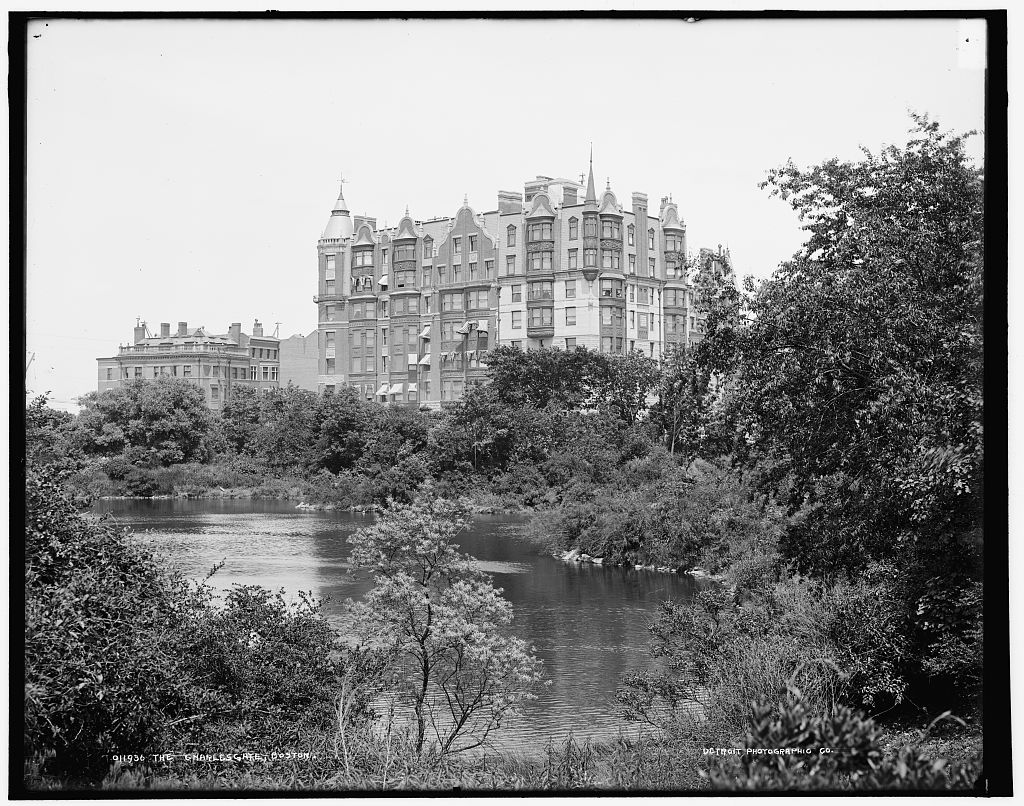
Charlesgate Hotel

Charlesgate Hotel

🏨 hotel

Boston, Massachusetts · Est. 1891

About This Location

A Romanesque Revival building originally constructed as luxury apartments in 1891, later becoming a hotel, then college dorms, and now condominiums. The building's turbulent history includes deaths, crimes, and decades of neglect.

👻

The Ghost Story

The Charlesgate Hotel stands as one of Boston's most notoriously haunted buildings, a Romanesque Revival masterpiece that has accumulated over a century of dark legends, unexplained phenomena, and architectural mysteries. Designed by architect J. Pickering Putnam and completed in 1891, this imposing structure near Kenmore Square has served as a luxury hotel, college dormitory, and now condominiums—each era adding new layers to its supernatural reputation.

The most enduring ghost story involves a young girl named Elsa, said to be the daughter of architect Putnam himself. According to legend, Putnam placed a decorative tile bearing Elsa's likeness near the elevator during the building's construction. Tragically, seven-year-old Elsa allegedly fell to her death down the elevator shaft while chasing her ball across the hallway—the very shaft beneath her memorial tile, which reportedly cracked at the moment of her death. Since that fateful day, Elsa has been spotted wandering the halls, eternally searching for her lost ball. Though historical research later revealed that the real Elsa Putnam lived until 1979, the legend persists, and students have reported encounters with a child-like presence for decades.

When Boston University operated the building as a female dormitory from 1947 to 1973, and later when Emerson College used it from 1981 to 1995, residents reported a staggering array of paranormal activity. Doors would slam shut after sudden bursts of cold air swept through rooms. Alarms that had never been set would sound simultaneously throughout the building. Strange, outdated music played from machines that were unplugged or not in use. In the bathrooms, toilets flushed on their own and seats clattered down in unoccupied stalls.

Students reported seeing dark figures in their rooms at night and witnessed mysterious fogs drifting through the hallways. One student awoke to find a thick, black fog hovering directly above him. As he regained his ability to move, he watched in horror as it crossed the room and disappeared through the wall. His subsequent investigation revealed a secret room hidden behind his wall—one of many concealed chambers throughout the building.

The "Man in Black" became another frequently reported apparition, often seen near the elevators. Darker legends claim the mafia purchased the building in the early 1900s and used it for executions, with three individuals allegedly shot in the elevator and their bodies disposed of down the shaft. While researchers have found no evidence of mafia ownership or murders, one documented death adds an element of historical truth: Westwood T. Windram, a Charlesgate resident suffering from insomnia, shot himself with a revolver in March 1908 while his wife was in the adjacent room.

Ouija board sessions among Emerson students in the 1990s produced chilling interactions. One group reported contact with a spirit claiming to be Elsa, who spelled out "ha ha ha" repeatedly. When one student was nearly electrocuted by a faulty shower lightbulb—standing in a puddle of water while trying to tighten the bulb—his friends in the next room watched their ouija board spell out "ha-ha-ha-ha-ha," and when asked why, it replied "ac-dc-ac-dc-ac-dc." Another entity calling itself "Zena" claimed to be a protective spell cast by the building's original builders.

The architecture itself fuels paranormal theories. Comparing the original blueprints on file at the Boston Public Library to the current structure reveals numerous inconsistencies—rooms that should exist but don't, spaces that appear on no plans. The top floor cannot be seen from the outside, and boarded-up areas conceal hidden chambers. One such room on the sixth floor was reportedly the site of a suicide, and residents have discovered these secret spaces only by following slight cracks in the walls. Recent photographic analysis has revealed faces in the metalwork and scratches forming phrases like "No Exit," "Hell," and "Gone."

Additional legends speak of horses that perished in the basement during a flood, along with the young men who tried to save them—their spirits allegedly still lingering below. Gurneys have been reported rolling past rooms on their own, and an alarm clock on one floor activated at exactly 6:11 a.m. daily despite being unplugged.

The Charlesgate remains one of the most haunted buildings ever owned by either university, and alumni who lived there still share stories of the inexplicable events they witnessed within its walls.

Researched from 8 verified sources including historical records, local archives, and paranormal research organizations. Learn about our research process.

More Haunted Places in Boston

Omni Parker House Hotel

Omni Parker House Hotel

hotel

Granary Burying Ground

Granary Burying Ground

cemetery

Boston Common

Boston Common

other

Central Burying Ground

Central Burying Ground

cemetery

King's Chapel Burying Ground

King's Chapel Burying Ground

cemetery

Copp's Hill Burying Ground

Copp's Hill Burying Ground

cemetery

More Haunted Places in Massachusetts

🏚️

The House of Seven Gables

Salem

👻

Gallows Hill Park

Salem

👻

Derby Wharf

Salem

🪦

Sleepy Hollow Cemetery

Concord

🏚️

The Witch House

Salem

🏨

Daniels House

Salem

View all haunted places in Massachusetts

More Haunted Hotels Across America

Marrero's Guest Mansion

Key West, Florida

Hollywood Roosevelt Hotel

Los Angeles, California

Hotel Gibbs

San Antonio, Texas

Louisville Bourbon Inn

Louisville, Kentucky