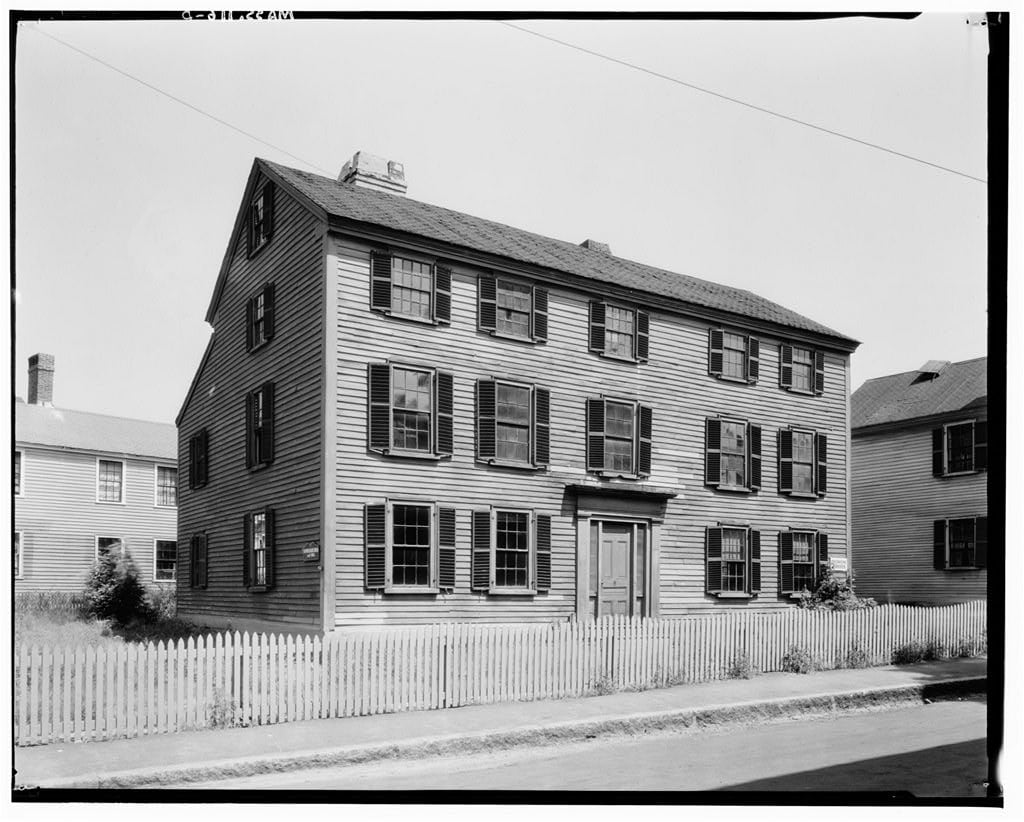
At the Daniels House in Salem, Massachusetts, guests describe a gray tabby cat that disappears when you reach for it. The 1667 house is older than the witch trials, and its first builders cut a charm against evil into the wood.
At the Daniels House in Salem, Massachusetts, guests keep describing a gray tabby cat. They see it cross a room, reach down for it, and find nothing there. It's one of three spirits people report in the house, and the only one no one can even guess a name for. No record explains the cat — no date, no death, no story of an animal that lived and died here. It simply shows up in the accounts, gray and quiet, and then it doesn't.
The other two have at least a little story. Accounts describe a man in Puritan dress who turns up in the Great Room on the second floor, believed to be Stephen Daniels, the shipwright who built the place around 1667 — though nothing ties him to the name beyond that belief. There's an unnamed woman as well. Lights flicker, and belongings go missing and turn up out of place. No investigation has ever pinned any of it down; the lore rests on the accounts people pass along and one guest review, not on dated sightings or recordings. As one ghost-history writer put it, asking who these spirits are: "It's all up for debate."
What isn't up for debate is the age of the house. It went up around 1667 — a quarter century before the 1692 witch trials — which makes it among the oldest structures still standing in Salem. For its first 150 years, shipbuilders and carpenters lived in it, and you can read their trade in the fine paneling and the nine-foot fireplace.
Here's the part that lingers. Cut into the c. 1667 chimney lintel is a Marian mark — a doubled "V" carved to invoke the Virgin Mary and turn evil away. Early New Englanders cut these into chimneys and doorways, the vulnerable openings, to keep demons out. A scholarly survey of colonial ritual-protection marks documents this one specifically. Whoever raised this house wanted the threshold guarded.
The house has been many things since: apartments, a day nursery, a boarding house, a guest house, an inn run by Kay Gill for 55 years until she died in 2018. New owners restored it in 2019, and it takes guests again across seven rooms.
So the protection mark is still there, cut by hands that expected something to come for them. And by the accounts people keep telling, three somethings settled in anyway — including a cat that lets you see it right up until you reach.