The moss-eaten ruin at the bottom of Portland, Oregon's Balch Creek Canyon isn't a castle, and there was never a witch. It's a 1930s public toilet, and the ghost everyone reports belongs to a hanging that happened a mile uphill, decades before the walls went up.
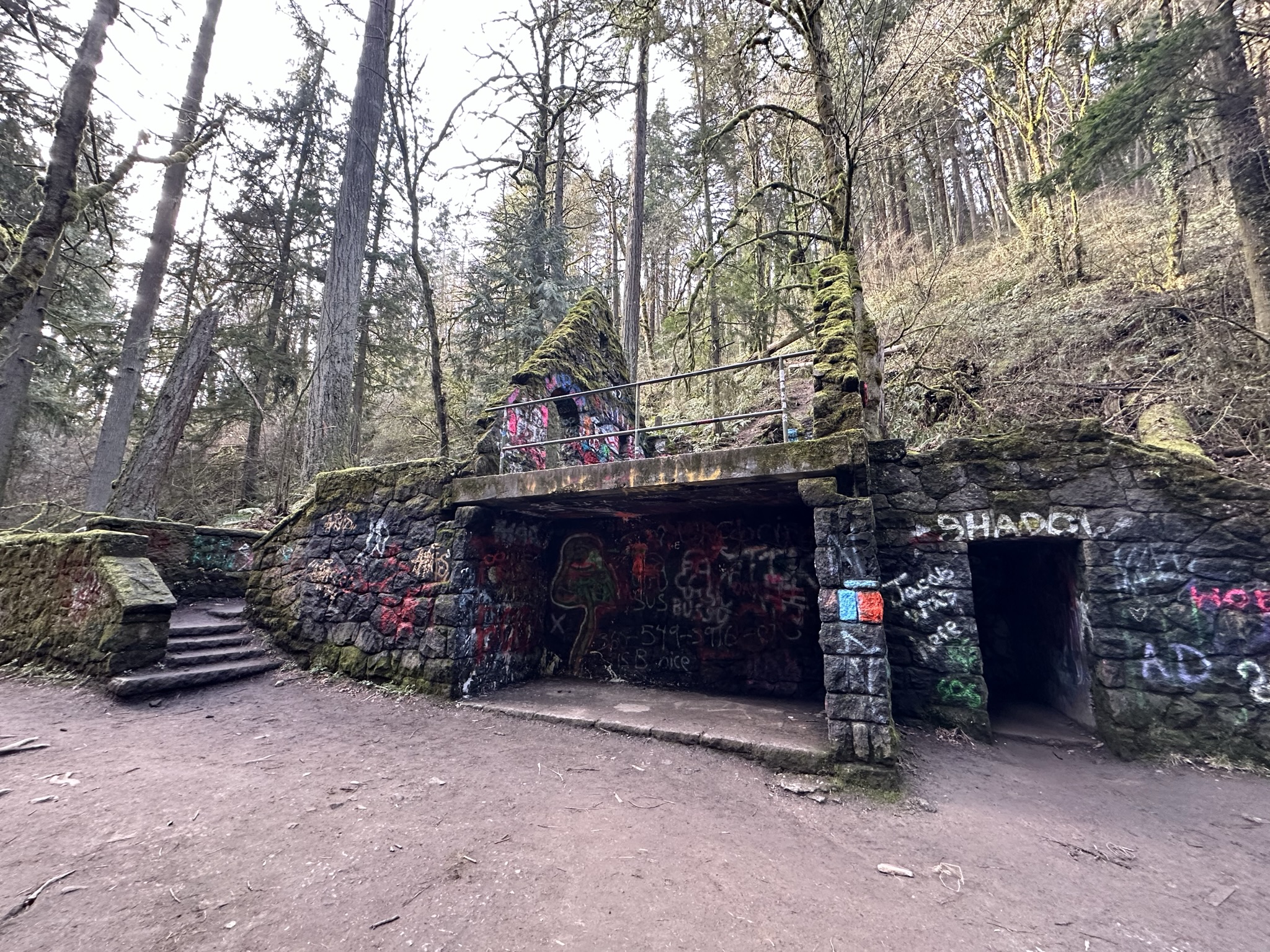
The Witch's Castle sits at the bottom of a canyon in Portland, Oregon's Forest Park, a moss-eaten stone shell where the Lower Macleay Trail bottoms out. Hikers who reach it report women and children standing in the doorways, floating lights, and shadowy shapes. Some say the ghosts of two feuding families fight it out among the stones around midnight.
There is no witch in the Witch's Castle, and there is not really a castle either. The two-story ruin is a Depression-era public toilet, designed in 1929 by Portland architect Ernest F. Tucker and built by the WPA, with men's and women's restrooms, a picnic shelter, and a tool room. A Portland Mercury writer once described the graffiti-covered shell as "Tolkien-esque ruins, if Middle-earth had taggers." The gothic name came later: local high schoolers found the abandoned building in the 1980s and started gathering there on Friday nights.
The genuinely dark story belongs about a mile uphill. Danford Balch claimed this land in 1850, arriving with his wife and nine children. Years later his 15-year-old daughter Anna ran off with a hired hand named Mortimer Stump. "The night I came home and found the girl gone," Balch said, "it struck a pain to my heart, like a knife cutting me." When the couple boarded the Stark Street Ferry to cross the Willamette, Balch was waiting with a shotgun, and he killed Mortimer where he stood.
He was convicted, and in 1859 he was hanged before a crowd of several hundred, the first man legally executed in Portland. Anna stood in that crowd, beside the family of the husband her father had shot. A reporter for the Oregonian called it "a disgrace to the intelligence of the age." As for the witch: at his trial, Balch claimed his wife had bewitched him into the killing, and the legend's witch grew out of that defense.
Here is the catch. The creek and the canyon carry Balch's name, but nothing in the record ties his tragedy to this building. The stone shell went up more than 70 years after he was hanged, on land his family had lost decades before. Real history, pinned to the wrong walls.
The ruin lost its plumbing in 1962, when a storm took out the water line and the city stripped the building down to bare stone rather than repair it. Nothing has worked inside it for more than 60 years. And still, the hikers who come down the trail say they hear the toilets flush.