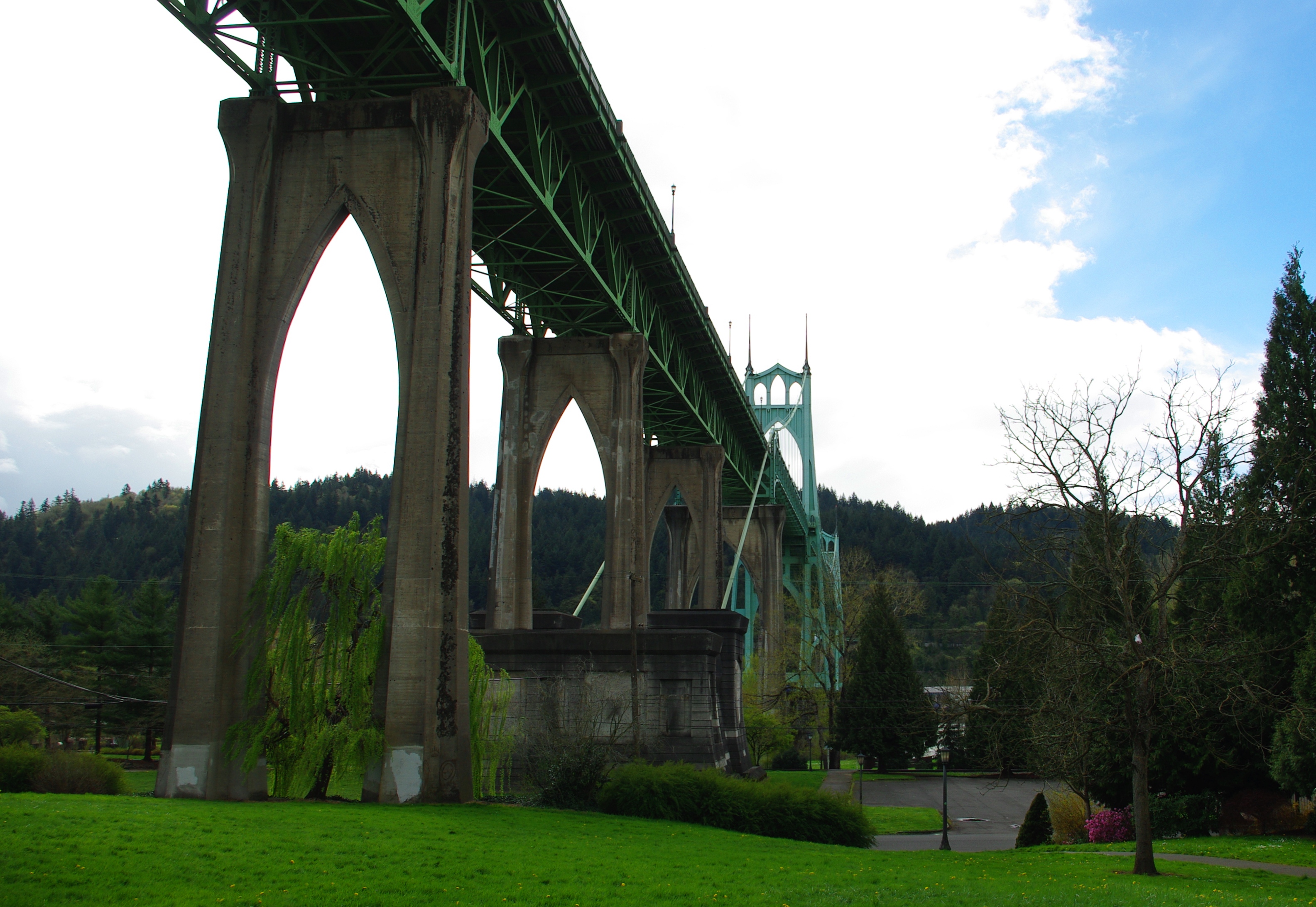
The legend at Portland's Cathedral Park has a girl screaming for help under the St. Johns Bridge on summer nights. She was real: Thelma Taylor, a 15-year-old murdered in 1949. Almost every detail the ghost story tells about her is wrong.
Cathedral Park, in Portland, takes its name from the Gothic arches of the St. Johns Bridge that vaults overhead. The story locals tell is that those same arches catch a sound on warm summer nights — a girl, somewhere beneath the span, screaming for someone to come and help her. "Oh yeah," a diner owner near the park once told a TV crew, "I've been down there at night and heard her scream, 'Help me, help me—somebody help me!'"
The girl was real. Her name was Thelma Anne Taylor, a 15-year-old sophomore at Roosevelt High School, and on August 5, 1949, she was waiting for a bus on North Fessenden Street, headed to a summer job picking beans in Hillsboro. A 22-year-old ex-convict named Morris Leland accosted her there and lured her to a secluded spot near the Willamette River, where he killed her with a steel rebar and a knife. Her body wasn't found for days; he had covered it in driftwood and wiped his prints from her lunch pail. He confessed unprompted after police pulled him over for car theft, and died in the gas chamber at Salem in 1953.
For decades the land under the bridge wasn't a park at all, just a dump of abandoned cars and tangled blackberry brambles that people were told to stay away from. The city didn't open Cathedral Park until 1980. A North Portland historian who attended Roosevelt in the 1960s remembered the place only as "a ghost that haunted the bowels of the St. Johns Bridge."
And almost everything the ghost story tells about Thelma is wrong. She wasn't killed in the park; it happened about eight blocks north of the bridge. She wasn't held captive for days. She died the morning after she was taken, even though it took a week to find the man who did it. Every team that has gone looking, one in 2007 and another on the anniversary in 2020, came back with the same answer: traffic, wind, and the bridge itself.
In 2012, a researcher named Erik Meharry built a Facebook page about Thelma, partly to keep her name alive and partly to separate the truth from the lore. Eight months later, a message arrived: "Thelma Taylor is my sister—who are you?" It came from Paulette Jarrett, Thelma's younger sister, who was three years old when it happened. She still remembers Thelma sharing chewing gum with her.
The legend made her a ghost who screams under a bridge. Her sister remembers a girl who shared her gum.