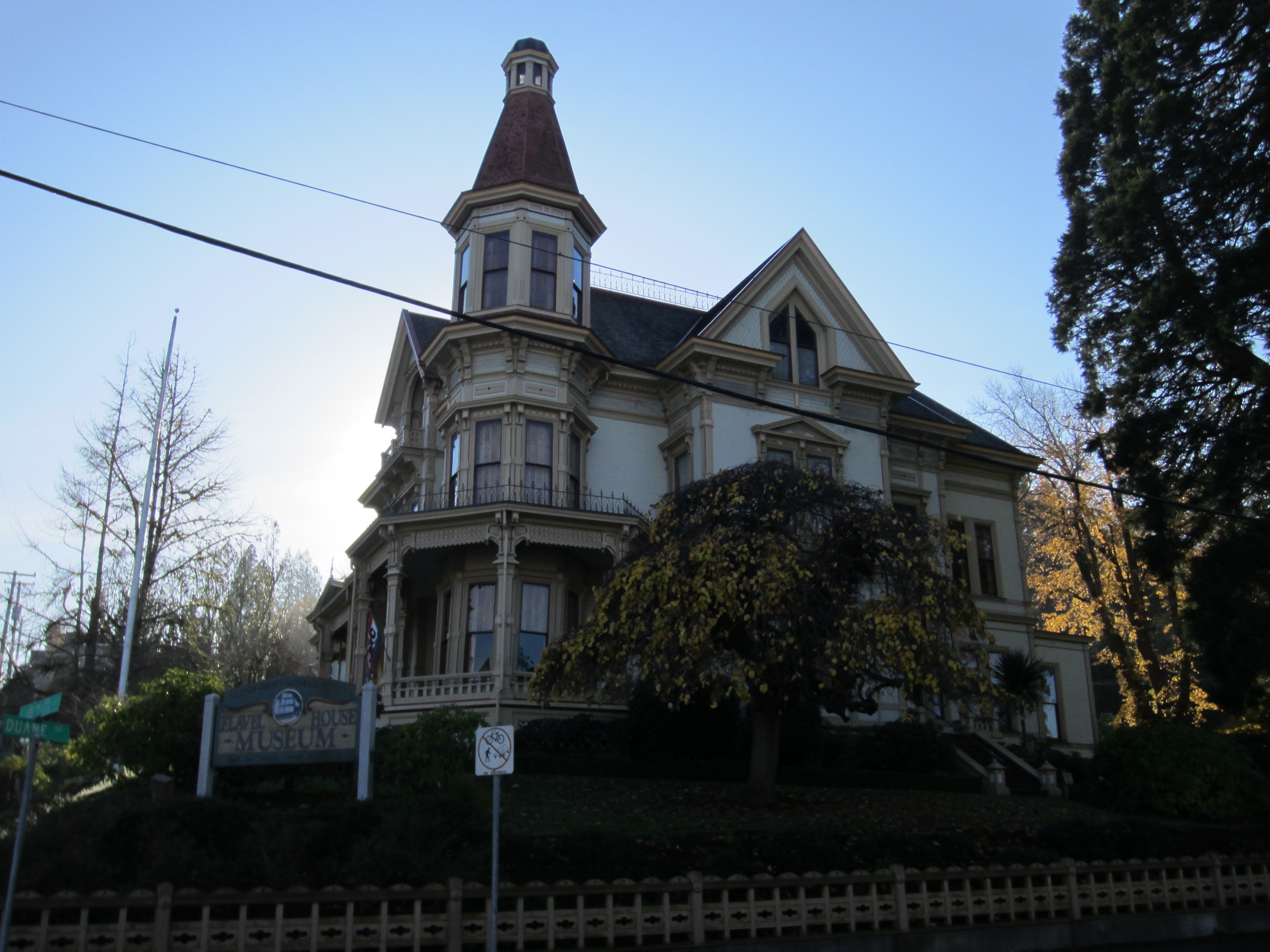
At the Flavel House in Astoria, Oregon, the long-dead Captain turns up at his old tower window, then sinks into the floor when noticed. His musician daughters leave phantom recitals in the empty music room, and a floral perfume surfaces in Katie's bedroom.
In the second-floor bedroom of the Flavel House in Astoria, Oregon, people keep seeing the Captain. He stands at the tower window, solid as anyone, and the story goes that the instant he's noticed he sinks into the floor and is gone.
The window matters. George Conrad Flavel was a Columbia River bar pilot, one of the men who guided ships across the deadly sandbar at the river's mouth, and the work made him one of Oregon's first millionaires. He built this Queen Anne mansion in the mid-1880s as a retirement house, a four-story tower rising over a full city block, and from that bedroom window he could watch the ship traffic on the river he had spent his life crossing. He lived here about seven years before he died in 1893. The figure people describe stands exactly where he used to stand.
He isn't the only one. On the first floor, in the music room, staff and visitors report hearing music when the house is empty, a few notes, voices, a recital with no players. Flavel's daughters, Nellie and Katie, were trained musicians who performed for Astoria society, and the phantom playing that drifts up after closing is laid at their feet.
Katie's bedroom holds the gentlest of it. A floral perfume surfaces there with no one in the room and no source anyone can find. And the curtains, drawn shut at the end of the day, are found open again the next morning, the lore says, because Katie liked the natural light. She died in 1910.
None of this is in the official record, and the absence is the strange part. The Flavel House is one of the best-documented homes in Oregon, nearly 11,600 square feet and listed on the National Register. You can read who designed it (a German architect named Carl Leick), down to its six tiled fireplaces and the indoor plumbing it had when that was a rarity, and the year it played a museum in The Goonies, 1985. It was nearly torn down for a courthouse parking lot before the county historical society saved it in 1951. The society runs tours through every room, and the tours are about the architecture. They don't mention the Captain at his window, or the music, or the perfume in Katie's room.
Everything about the house is written down. The only thing that isn't is the family that won't leave it.