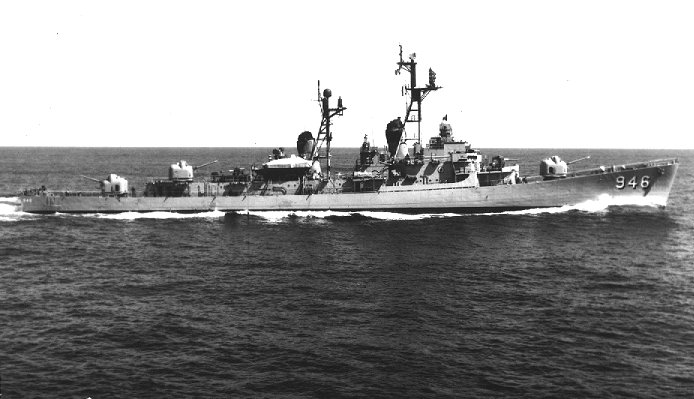
The USS Edson, a Cold War destroyer docked in Bay City, Michigan, has a ghost the volunteers all know by name. Paul Spampanato lived aboard her, said he wanted to die on her, and did — on Thanksgiving Day 1999. They say he never left.
The USS Edson is a Navy destroyer docked in Bay City, Michigan, and the ghost the volunteers there talk about isn't a sailor lost at sea. It's the man who loved the ship so much he moved in.
Two office workers saw him first. Before opening one morning, they watched a figure in khaki walking the port-side main deck. When they checked the security footage, he was on it for a moment, then gone — no record of how he'd come aboard, no record of where he went.
They think he's Paul Spampanato. Back when the Edson was a museum ship at the Intrepid in New York, Paul was her caretaker and tour guide, and he didn't just work aboard her. He lived aboard her, in one of the staterooms, and the story goes he said that if he ever died, he wanted to die on the ship. On Thanksgiving Day 1999, a heart attack took him in exactly that place. He got his wish.
During a paranormal investigation, someone asked the figure his name through a spirit box. The answer came back: "Paul." Asked what year he died, the box returned a single digit. "9."
The ship is worth keeping watch over. Commissioned in 1958, the Edson was the last all-gun destroyer in the U.S. Navy, and off Vietnam the enemy believed she'd been sunk and then watched her return to duty, so they took to calling her the Grey Ghost of the Vietnamese Coast. There's a stranger chapter, too. After the towers fell on September 11, when communication across New York City cut out, crews climbed the Edson's mast and used it as a radio tower. World Trade Center dust settled on her decks and stayed there.
She was towed roughly 2,000 miles from Philadelphia to Bay City in 2012, and the small things kept happening at her new mooring. Museum president Mike Kegley says tools he leaves organized turn up minutes later, all askew, in the few minutes it takes him to walk away and come back. Bill Randall, a Navy veteran who actually served aboard the Edson and volunteers there now, has worked alone and found doors closing and sealing themselves behind him, and wondered if it was Paul. In 2016 the cable show Ghost Asylum brought a team aboard to try to free whatever was trapped on the ship.
The museum runs overnight stays in the original berths and a paranormal program now, and most years it turns the destroyer into a Halloween walk-through. Through all of it, Paul, by every account, made the trip from New York with her. He's still on the deck before opening, walking the port side of the ship he wouldn't leave.