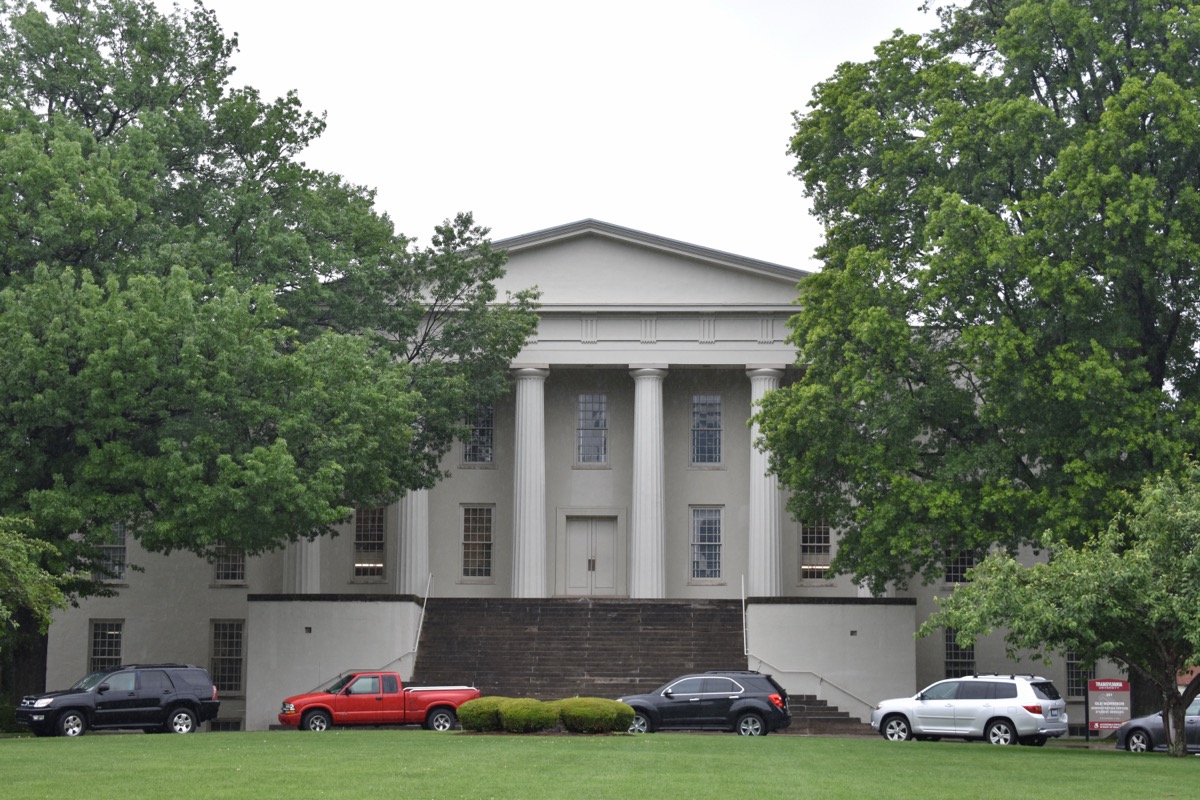
Old Morrison, the 1834 landmark at Transylvania University in Lexington, Kentucky, burned to its walls one night in 1969. The crypt beneath the steps came through untouched, and firefighters say a man stood in its doorway as the flames raged around him.
On the night of January 27, 1969, Old Morrison — the Greek Revival landmark at Transylvania University in Lexington, Kentucky — burned to its exterior walls. One thing came through untouched: the crypt beneath the front steps. As the fire raged around it, firefighters reported seeing the figure of a man standing in the crypt doorway.
The man they think they saw had been cursing this campus for a century and a half.
His name was Constantine Rafinesque, a Constantinople-born naturalist who taught botany at Transylvania through the 1820s and named thousands of new species. In the spring of 1826 he was fired — campus gossip blamed an affair with the wife of the university president, Horace Holley. In his own memoir, Rafinesque wrote that he left "with curses on it and Holley." The story hardened over the years into a rule: disaster strikes Transylvania every seven years.
The proof piled up. Within a year Holley resigned and died of yellow fever. The campus burned. Cholera came, then influenza. And in 1969, Old Morrison itself went up — every part of it but the crypt where the naturalist's remains were supposed to lie. The building took the worst of the curse twice: an earlier administration hall on the site had burned in 1829, and Henry Clay oversaw the construction of its 1834 Greek Revival replacement, the one that burned again in 1969.
The building has its own real dead, too. Early one morning in October 1961, a 19-year-old student named Betty Gail Brown was found strangled in her parked car directly in front of Old Morrison. A drifter later confessed, but the case ended without a conviction and was never solved. Some accounts say a woman is heard crying near the building at night.
That crypt is the strange heart of the place. In 1924 the dean traveled to Philadelphia to retrieve Rafinesque's body from a cemetery being demolished and reinter it here, beneath the steps, under an inscription that reads "Honor to Whom Honor is Overdue."
The campus has made peace with the lore. Every fall it holds Raf Week instead of homecoming, part of it meant to appease the curse, and a handful of students win a raffle to spend Halloween night inside the tomb.
But here is the turn. Testing decades later found the remains in that crypt are a woman's. They belong to a Mary Passamore — graves in crowded Philadelphia had been stacked, and the dean brought home the wrong body. Rafinesque is still in Philadelphia. The man the firefighters watched in the doorway, guarding his own grave from the flames, was never buried there at all.