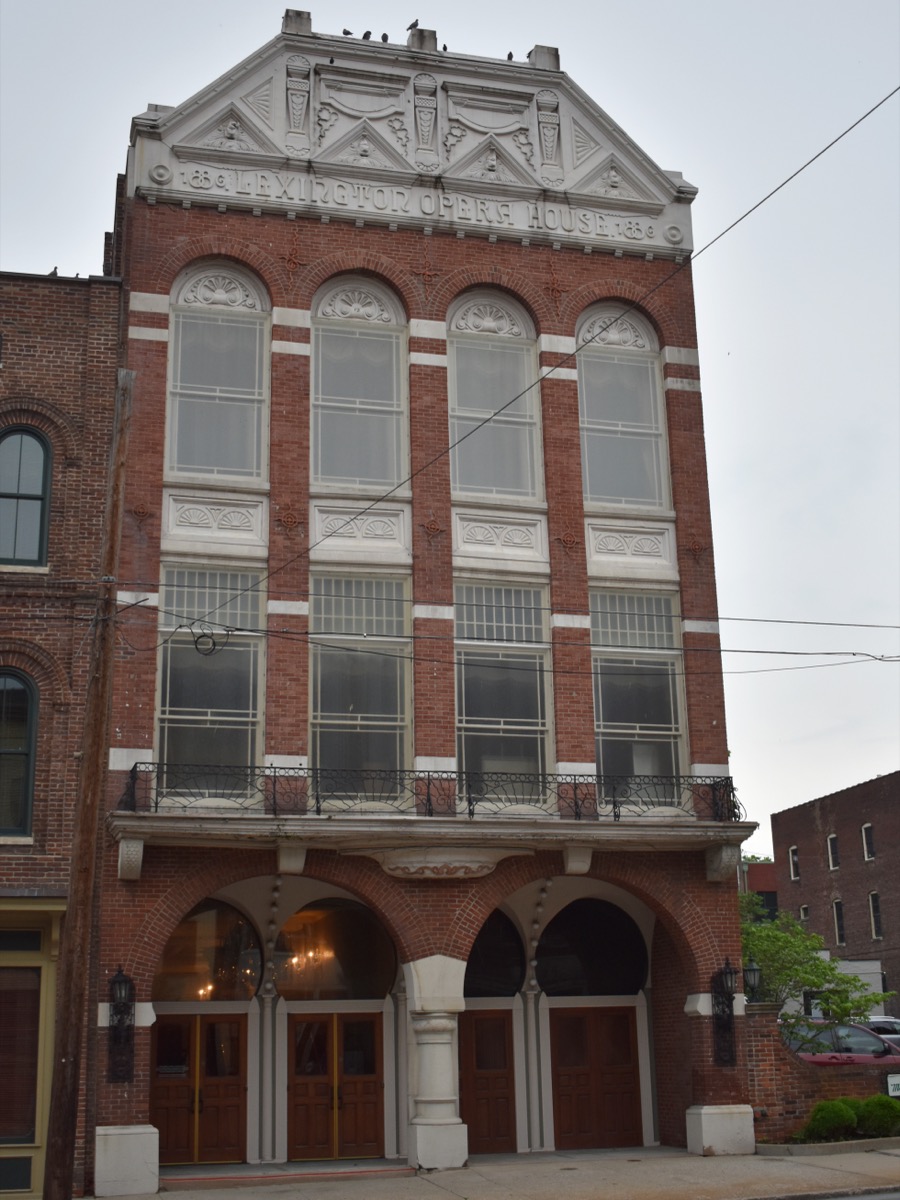
At the Lexington Opera House in Lexington, Kentucky, the crew keep seeing a man in a gray suit watching from the balcony during rehearsals. He belongs to an older century, and he's gone the moment anyone looks straight at him.
At the Lexington Opera House in Lexington, Kentucky, the crew keep seeing a man in the balcony. He wears a gray suit cut for a much older century, and during rehearsals he stands up there watching the stage. The accounts run the same way every time. Someone catches him out of the corner of an eye, turns to look, and finds the seat empty. They call him the Man in Gray, and he's the one ghost the house can't shake. He doesn't appear at intermission or in front of a packed audience. He comes during rehearsals, when the seats are dark and the work is happening on the stage below. Locals will tell you the place has more than enough ghosts even without the famous Phantom it never had.
The theater that holds him went up fast. In January 1886, fire took the previous opera house at Main and Broadway, and within that same year a new one rose on West Short Street. A Chicago theatrical architect named Oscar Cobb designed it, three stories, room for 1,250 people. It opened on July 19, 1887, with a concert by the Cincinnati Symphony, and the date is still carved into the pediment over the door: 1886, the year the old house burned.
For four decades it was where the big names came through. Harry Houdini played here. So did Sarah Bernhardt, Al Jolson, W.C. Fields, Will Rogers, Lillian Russell, and John Philip Sousa's band. The last live show before the place went dark and became a movie house was a production called "The Arabian," in 1926.
It nearly didn't survive the century. The balconies were sealed off behind a false ceiling for years, until a 1975 restoration tore the ceiling out, reopened the balconies, and rebuilt the stage. The house came back with fewer than 1,000 seats, which makes it one of only 14 American theaters built before 1900 still running at that size.
It's an active Broadway and variety stage today, and a stop on Lexington's ghost tours, where guides walk visitors through the rooms and talk up the phantom applause and a building full of held-over history. The hard claims thin out past the Man in Gray, though. No names, no dated sightings, no recordings. Just the same figure described the same way, account after account, for longer than anyone working there can account for.
The balconies he watches from were boarded up for decades before that restoration reopened them. He came back with them.