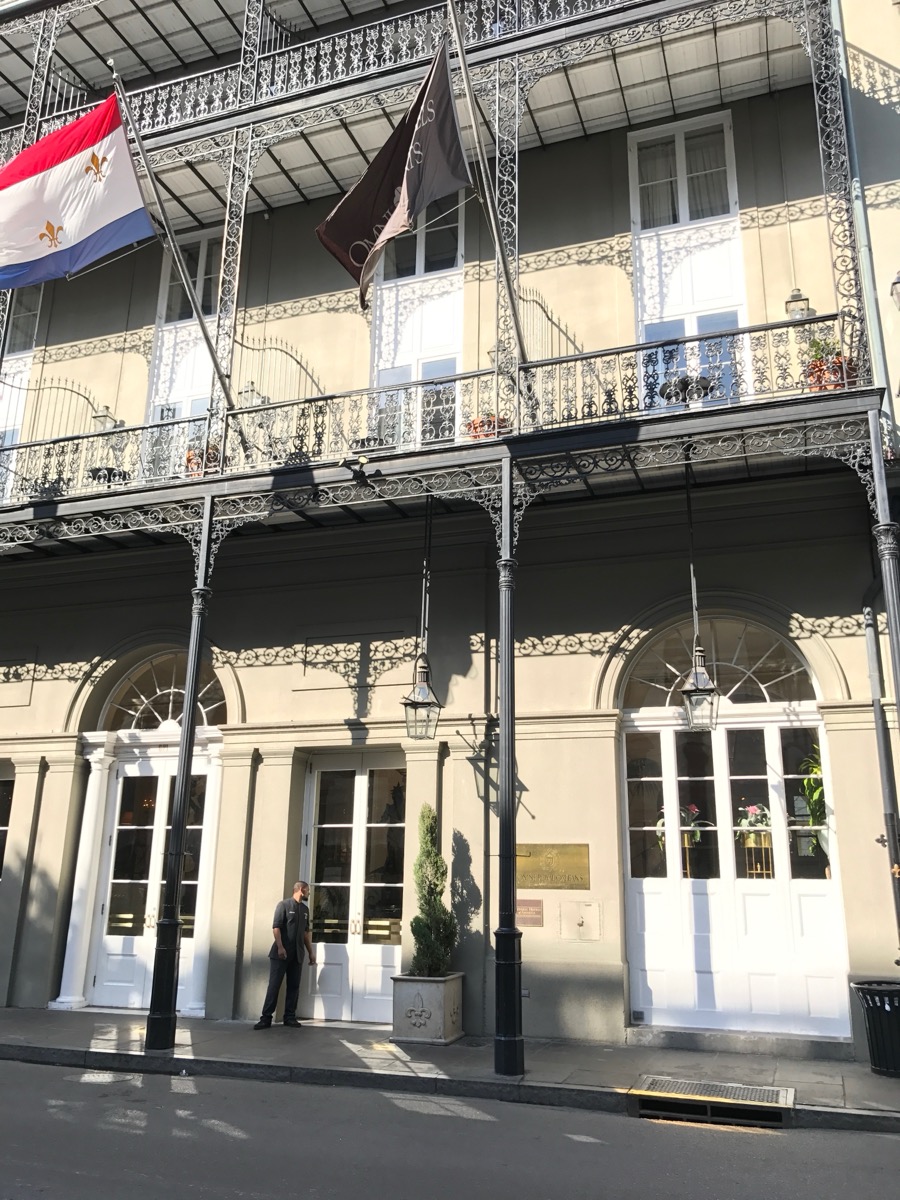
At the Omni Royal Orleans in New Orleans, guests on the second floor report a 19th-century maid who tucks them in and runs the faucets at night. She's the gentle one. The luxury hotel stands on a footprint that held a slave-auction block, a war hospital, and worse.
At the Omni Royal Orleans in New Orleans, the ghost guests describe most often is a kind one. On the second floor, the story goes, a maid from the 19th century moves through the rooms at night. She rearranges the toiletries laid out on the counter. She runs the faucets and flushes the toilets, and the water turns itself on in the small hours with no one near the tap. Some guests say they woke to find her trying to change the linens while they were still lying in the bed, and that she tucks the sleeping ones in before she goes.
She's the gentlest thing on the property. The rest of it is the problem.
The luxury hotel opened in 1960 at 621 St. Louis Street, designed by Samuel Wilson Jr., who worked salvaged pieces of the building it replaced into the new one. On the Chartres Street side, the word CHANGE still sits above the columns, lifted from the sign of the old St. Louis Hotel. That hotel went up in 1838, and under its grand rotunda, a dome of roughly 100 tons, an auction block ran on an almost daily basis for over twenty years. They sold goods there. They sold enslaved people there, by the day, in a room people now walk past on their way to the lobby.
When the Union took New Orleans in 1862, the building became a hospital for its soldiers. During Reconstruction it served as the de facto Louisiana state capitol. A hurricane gutted it in 1915, and it was torn down by 1916. The current hotel rose on the same footprint forty-some years later, which is to say the maid keeps house over every life that ground has had.
The other ghosts are darker than the maid. On the sixth and seventh floors, a Confederate soldier is said to pace as if he's still on guard duty, sometimes arriving ahead of the smell of tobacco. Children have been reported tugging at guests' sleeves in the middle of the night.
And one death here is fully on the record. In October 2006, a bartender named Zack Bowen leapt from the seventh floor. He'd killed his girlfriend Addie Hall twelve days earlier, then dismembered her body. The note he left read in part:
"This is not accidental. I had to take my own life to pay for the one I took."
The maid keeps tidying the second floor. Six floors up is where the worst of it actually happened.